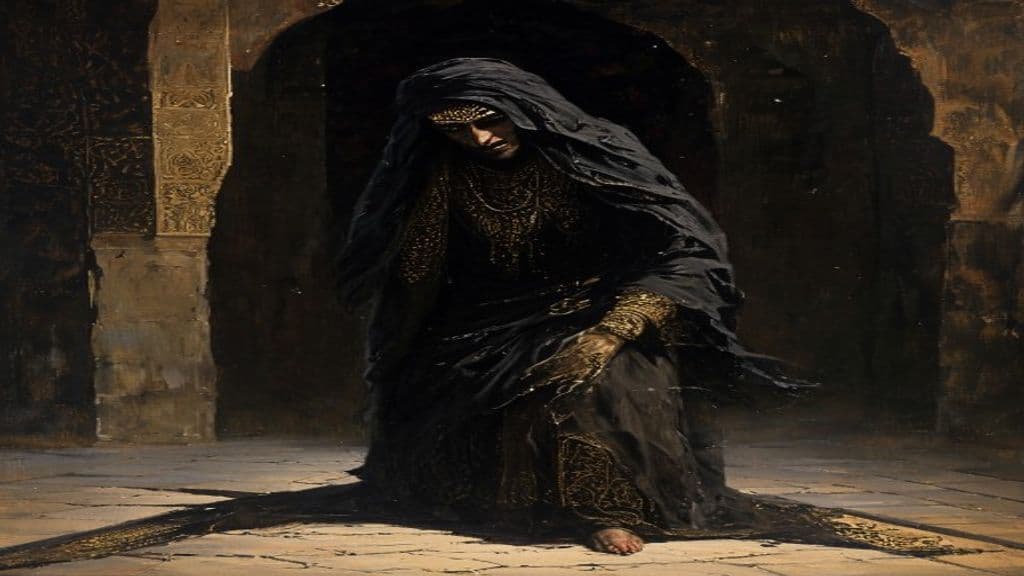
Mahd al-Aadiyya is a character mentioned in the context of the prophecy of Hud and the destruction of the ʿĀd nation by Allah's wrath. Her role is to convey divine warning through her muzdawaj form poetry.
There is no description of Mahd al-Aadiyya's physical appearance in the source material, suggesting that her character may be more focused on her poetic and prophetic role rather than any visual attributes.
As a vessel for conveying divine warning, Mahd al-Aadiyya has a connection to the divine. She is able to convey messages through her poetry, although it is unclear whether this ability is due to her own powers or because she serves as a vessel for the divine.
Darda'il
In the cited Islamic tradition, Darda'il (Arabic: دردائيل, glossed 'Journeyers of God') are angels who travel the earth searching out assemblies where people remember God's name. The name is also attested as that of an angel invoked in exorcism; the figure appears in modern cultural references alongside other named angels.
Jinn
A class of supernatural beings from pre-Islamic Arabian religion later integrated into Islamic theology; jinn are created, morally accountable entities distinct from humans and angels, often unseen but capable of taking visible forms and interacting with people in varied ways.
Rakhsh (Persian Tradition)
A mythological stallion and companion to the legendary hero Rostam in the Persian national epic Shahnameh. (Note: 1. Power tier: Based on Rakhsh's association with a legendary hero, it seems more likely to be Greater (deity-level) rather than Lesser. 2. Abilities: While we can infer that Rakhsh has strength and s)
Shaddād
A legendary king in Arabian folklore, described as tyrannical. (Note: 1. The power tier should be Greater (deity-level abilities are implied by association with a lost city and connection to Qur'anic lore). 2. Add appearance description from source material, mentioning )
Tahmina
In Persian epic tradition, Tahmina is a human character in the Shahnameh, a 10th-century epic poem. She is Rostam's wife and Samanganshah's daughter, appearing in the story 'Rostam and Sohrab'. Tahmina serves as a figure illustrating themes relevant to 10th-century Persian society. (Note: 1. Power tier should be "Lesser" since Tahmina is a human character with no supernatural powers. 2. Origin story section is missing. 3. Appearance section needs to state that there is no physical desc)
Mahangaatuamatua
A sacred canoe in Māori tradition, associated with spiritual significance and ceremonial importance. (Note: * Power tier: Not specified as Greater; instead, it's implied to be Primordial due to its association with creation/mythological events (first canoe to land in New Zealand). * Appearance: Remove state)
Mahapreta
The 'great ghost' — in Bihar and UP folk classification, a Mahapreta is a preta of exceptional power, born from a death involving multiple injustices simultaneously: wrongful killing, incomplete rites, and unresolved family debt combined. It commands lesser spirits and can cause harm across an entire lineage.
Mahasona
Mahasona (also Maha Sohona, Mahā Sōnā) is a major cemetery-associated spirit in Sinhalese/Sri Lankan folklore described in sources as "the greatest demon" or "god or demon of the cemetery." He is feared as an agent of sudden death and disease and figures prominently in Sinhalese exorcism ceremonies and in ritual mask traditions.
Mahavidya (the Ten Great Wisdoms)
The Mahavidya (Sanskrit: Mahāvidyā, "Great Wisdoms") are a canonical group of ten distinct goddesses or facets of the Divine Mother in post‑Puranic Shakta/Tantric traditions. They function as salvific, often paradoxical modes of Adi Parashakti (variously Mahākālī or Tripura Sundarī) and are central to Tantric sādhanā, yogini worship, and cross‑currents with Shaiva, Vaiṣṇava and Vajrayāna Buddhist practices.
Maheshvara
Maheshvara is a Sanskrit-derived divine name meaning "Great Lord" used in Hindu/Shaiva theology as an epithet of Shiva and, in certain Buddhist commentarial texts, as the name of a powerful deva who presides over the Maheshvara Heaven (the "Great Heaven of Ease"). The figure's theological status differs by tradition: in Shaivism Maheshvara functions as a principal divine identity of Shiva, while in Buddhist cosmologies he is represented as a great sovereign deity within a multi-tiered pantheon.
Maheśvara (Sabbalokādhipatī Devā)
Buddhist deva and teacher of spiritual knowledge, associated with the god Shiva in Hinduism. (Note: 1. Power tier should be Primordial, not Ancient (Maheśvara's association with Shiva and his role as a deva suggest a higher level of power). 2. No information about origin story, appearance, sensory c)
Mahishasura
Mahishasura (Sanskrit: महिषासुर, IAST: Mahiṣāsura) is a bovine asura in Hindu tradition, commonly described as a shape‑shifting buffalo‑demon who wages war against the devas and is ultimately slain by a manifested goddess (Durga/Mahishasuramardini). The episode is narrated in the Devi Mahatmya (part of the Markandeya Purana) and is commemorated in festival cycles such as Navaratri and Durga Puja.
Community Record
- [1]