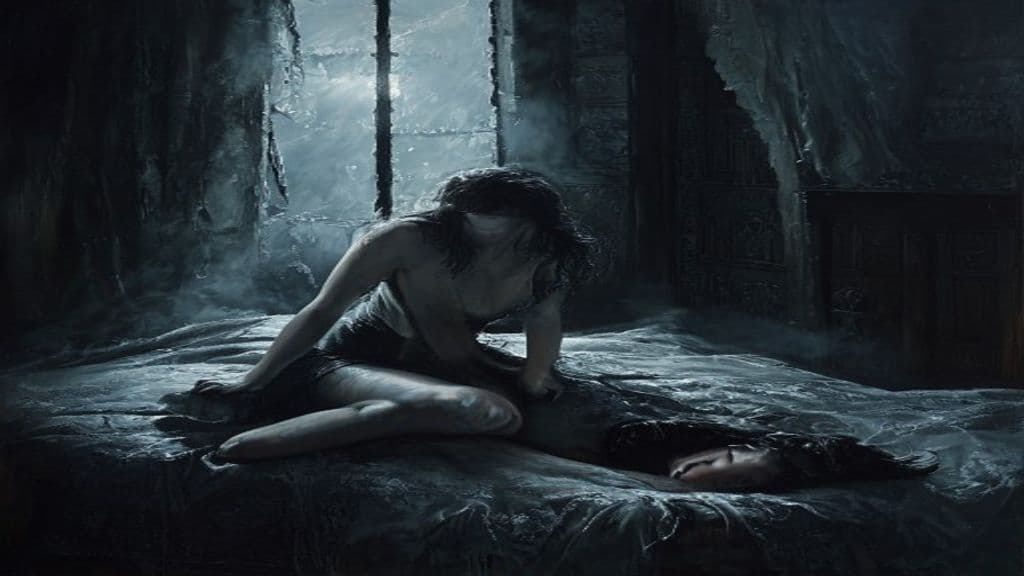
The mara (Old Norse, from which 'nightmare' derives) is a spirit — often the projected soul of a living person — that rides sleepers at night. In Scandinavian, Germanic, and Slavic traditions she is a woman who transforms after dark and travels to press down on the chests of those she desires or hates. She could ride horses until they were exhausted, braid their manes into tangles ('mara-plaits'), and even afflict cattle.
Often perceived only as a crushing weight on the chest — invisible. When visible, she appears as a pale woman, sometimes with wild hair, crouching on the sleeper's chest. She enters through keyholes and cracks under doors.
Caused sleep paralysis, terrifying dreams, and suffocation. Could ride a person for multiple nights, causing wasting illness. Could affect horses and cattle. In some traditions she was a living woman whose spirit left its body — if her name was kept in your hand as she entered, she would be trapped.
Weaknesses
- substanceSteel placed under pillow
- ritualSleeping with shoes pointed toward the door
Wards
- symbolBroom placed across the bedroom threshold
- substanceSalt sprinkled across windowsills

Phurba (Tibetan: phurba; Sanskrit: kīla / kila) — Phurpa
A Vajrayāna (and Bön) ritual practice centered on the phurba (kīla), a three-sided ritual peg/dagger. Employed within Indo‑Tibetan tantric contexts—especially Vajrakīlaya practice—to subdue, banish, or transform hostile spirits, obstacles, and karmic/aggressive forces through consecration, invocation, mantra/sadhana and ritual gestures using the implement.
Indo‑Tibetan Vajrayāna Buddhism and Bön · Tibet / Himalayan Indo‑Tibetan cultural area

Ta'awwudh (التعوذ — A'ūdhu billāhi min ash-shaitāni r-rajīm)
An Islamic verbal supplication recited to seek refuge in Allah from Shaitan (the devil) before reciting the Qur'an, beginning certain tasks, and as part of the opening sequence of formal prayer (salah). It addresses Satanic influence and is used to protect the forthcoming speech or action from satanic interruption.
Islamic · Global (Muslim communities; taught in curricula for new Muslims)
Community Record
- [1]Deutsche Mythologie. Grimm, Jacob. 1835. Deutsche Mythologie. Frankfurt.folk
- [2]Terror That Comes in the Night. Hufford, David J. 1982. The Terror That Comes in the Night. University of Pennsylvania Press.academic