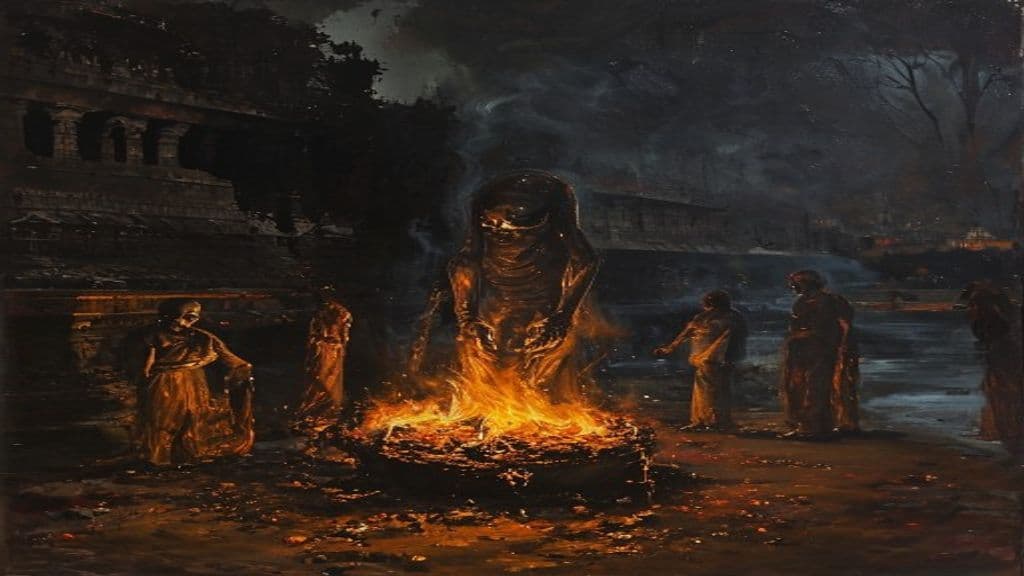
The Masaan is among the most ancient spirit-entities of the Hindu tradition, documented in Ayurvedic texts — particularly the Charaka Samhita and Sushruta Samhita — as a category of graha (possessing spirit) associated with cremation grounds.
It arises from a death that was not properly handled: the body left on the pyre without someone to tend the fire, the rites performed incorrectly, or the soul of a person who died violently or in extreme unresolved grief. The cremation ground — the mahashamshan — is its permanent residence and territory.
Varanasi, the city of pyres, has an entire cosmology built around the Masaan. The burning ghats are simultaneously the most sacred and the most haunted sites in North India.
The Masaan appears in multiple forms. In its most common manifestation it is a gaunt, ash-smeared figure seen at the edges of burning ghats after midnight. In possession, it expresses itself through the body of the afflicted person, who takes on the characteristics of the dead: speaking in altered voices, refusing to eat, smelling of ash and burning.
In classical texts it is sometimes depicted as riding on a corpse — a visual shared with the Vetala — and carrying a skull.
The Masaan's primary mode of harm is possession through the medium of ash. Someone who steps on cremation ash unknowingly, or who breathes the smoke of a pyre where rites were incomplete, becomes vulnerable.
The possession manifests as a wasting illness: progressive weakness, disorientation, loss of appetite, and the patient sometimes speaking words from the life of the dead person whose rites were incomplete.
Tantric practitioners who work with cremation ground energy — the Aghori sect most prominently — consider the Masaan a source of immense power that can be negotiated with rather than merely exorcised.
Weaknesses
- ritualCompletion of the incomplete last rites for the spirit's original death
- mantraMaha Mrityunjaya Mantra recited 108 times at the pyre site
Wards
- substanceSesame seeds (til) — offered to spirits of the dead
- substanceWashing feet thoroughly after visiting a cremation ground
- ritualPind daan (rice ball offerings) for unresolved ancestral spirits
Pishach is a wide class of malevolent flesh-eating demons found across South Asia. Masaan is specifically bound to cremation grounds and the spirits of children who died young — its powers are more localised and its rituals distinct.
Community Record
- [1]Graha and Spirit Possession in Classical Ayurveda. Weiss, M.G. (1977). Caraka Samhita on the doctrine of karma. In C. Leslie (Ed.), Asian Medical Systems. University of California Press.academic
- [2]Masaan (2015 film) — folkloric background. Wikipedia contributors. Masaan. Wikipedia, 2024.wiki
- [3]Shamshan Bhuta traditions in Varanasi. Parry, J. (1994). Death in Banaras. Cambridge University Press.academic