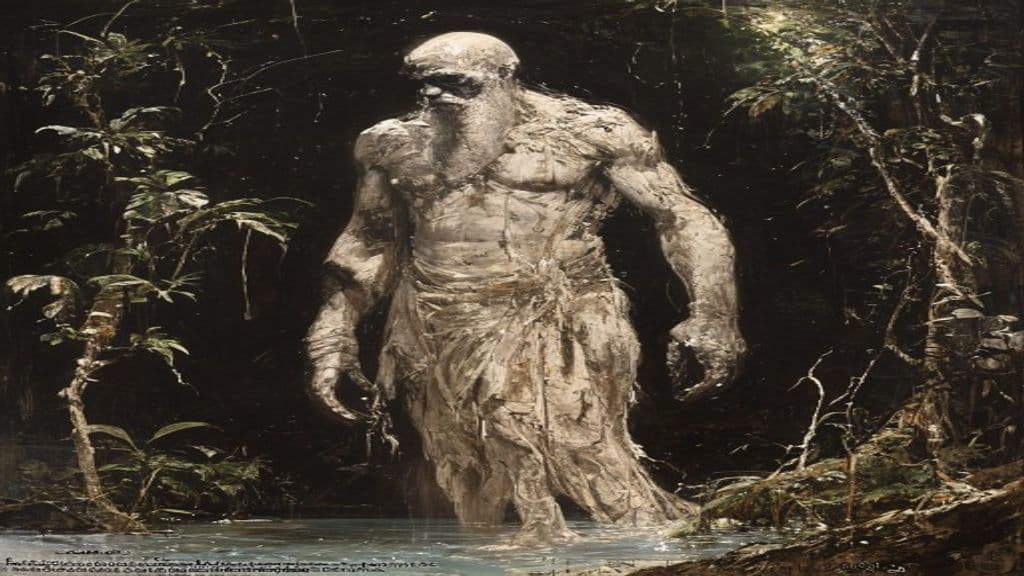
In the beginning Mbombo was alone and darkness and primordial water covered the earth. Mbombo, a solitary pre‑cosmic giant, suffered an intense pain in his stomach and vomited the sun, the moon, and the stars; later he vomited animals and many men. Nine animals and several human figures emerged and became progenitors of living kinds; Mbombo's sons completed aspects of creation (one son vomited white ants and died, another created the first plant, another created the kite). After the created world was established and delivered to humankind, Mbombo retreated into the heavens and placed a man called Yima (Loko Yima) to serve as 'god upon the earth.'
Mbombo is described in the sources as a giant in form and white in color. Sources provide no consistent additional details about clothing, facial features, or other bodily attributes.
Mbombo's primary power is creative production by bodily expulsion: he vomits the sun, moon, stars, animals, and many men. The first animals he produced act as progenitors that in turn produce whole classes of creatures (for example, the heron produced most flying birds, the crocodile produced snakes and iguanas, the goat produced horned animals, the scarab produced insects, and Yo Bumba produced fish). Mbombo's offspring and sons finish creation (one son produced white ants and died; Chonganda created the first plant; Chedi Bumba created the kite). Mbombo also provided cultural instruction—after Tsetse Bumba became the thunderbolt and left people without fire, Mbombo taught humans how to make fire from trees. After completing creation he withdrew to the heavens and ceased direct earthly rule.
Weaknesses
- othernone recorded in sources
Wards
- othernone recorded in sources
Maymun
Maymun (Maymun Abanuch / Maymun al‑Shahabi / Abu Nuh) is presented in Islamic folkloric and occult sources as the last of the seven kings of the jinn, a powerful wind‑jinn king associated in those traditions with Saturday, the planet Saturn, the color black, and gold. He appears both as a fearsome, martial, abducing jinn in manuscript imaginaire and as a venerated saintly figure in North African local cults (Sidi Mimun / Lalla Mimuna).
Mayūrabhaṭṭa
Mayūrabhaṭṭa (Sanskrit: मयूरभट्ट) is a 7th‑century Sanskrit poet and Hindu scholar traditionally credited with composing the Sūryaśataka, a one‑hundred‑verse hymn to the Sun (Sūrya). In the narrative preserved in later tradition he performed a vowlike penance at the Sūrya temple in Deo, tied one hundred threads to a peepal tree and composed one verse per day; according to the account, this devotional composition is said to have cured his leprosy and liberated a Brahmarākṣasa that haunted the tree.
Mazu
Mazu (媽祖) is a deified female protector of seafarers originating in Fujianese popular religion as the historical/legendary Lin Moniang. Venerated across Chinese folk religion, Taoist and Buddhist registers, and in coastal and diasporic Chinese communities (notably Taiwan), she functions as a tutelary sea goddess whose cult includes temples, imperial honorific titles, and large popular pilgrimages.
Mazzikin
In Jewish mythology, mazzikin are described as invisible demons that can cause harm or danger to individuals. (Note: - Power tier: change to Lesser (mazzikin cause "minor annoyances") - Weaknesses & Wards: list should be more specific, e.g., "Incantation bowls made by Aramaic-speaking inhabitants of Mesopotamia and )
Mañjuśrī
Mañjuśrī is a central Mahāyāna bodhisattva who personifies transcendent wisdom (prajñā). He appears as an authoritative figure in sutras, in esoteric mantra/dharani collections, and widely in Buddhist art and temple ritual contexts across South, Central and East Asia.
Mbielu-mbielu-mbielu
A mysterious animal reportedly seen in the Likouala River, Central African Republic/Democratic Republic of the Congo border. (Note: * Power tier: Not specified; needs to be determined based on available information. * Origin story: Omitted entirely; needs to be included if known. * Abilities: No information provided; needs to be e)
Mbwiri
Central African demon believed to possess people, causing neurological disorders. (Note: * Power tier: Given that the primary behavior of Mbwiri is possession, which seems more in line with a lesser or local spirit, it's unlikely to be classified as Greater. * Origin story: No information)
Me (Mesopotamian Tradition)
A Mesopotamian ritual or practice that embodies the divine, representing a sacred and transcendent aspect of the deity itself. (Note: - Power tier: Primordial is plausible given the described abilities (incarnation of deity). - Appearance: needs to be filled in with source material. - Origin story: needs to be filled in with source )
Meander
A meander is a geomorphological feature: a series of regular sinuous curves in the channel of a stream or river. The term derives from the river name Maiandros (Greek Μαίανδρος) and in classical usage came to denote anything winding or convoluted.
Mechho Bhoot
The fish-eating ghost of Bengal — the spirit of a fisherman or a person obsessively fond of fish in life, condemned to haunt river banks and fishing boats, stealing the catch and causing boats to capsize. Distinctly Bengali: a ghost shaped by the culture of a river civilization.
Mecho Bhoot
No verifiable information about an entity called "Mecho Bhoot" is present in the single provided source. The supplied source (a Wikipedia entry for the animated series Bantul The Great) does not define, describe, or mention Mecho Bhoot; therefore the nature, attributes, and cultural context of Mecho Bhoot are unknown based on the available material.
Mecisteus
Mecisteus is a mortal heroic figure from ancient Greek tradition attested in genealogical lists and epic-cycle episodes. He appears in connections with the Theban cycle (Seven Against Thebes), Trojan War narratives, and Argive genealogies, primarily as a warrior and ancestor rather than a developed individual character.
Community Record
- [1]Mbombo. Wikipedia, article 'Mbombo'.wiki
- [2]Mbombo (Wikidata entry). Wikidata entry Q2553587, 'Mbombo'.wiki
- [3]VOA Africa broadcast listing (mentions Mbombo in archive materials). Archive.org, VOA Africa: August 09, 2017 listing (per supplied materials; mentions Mbombo peripherally).other
- [4]Episode listing archive (mentions Mbombo peripherally). Archive.org episode listing (supplied materials; not primary ethnographic source).other
- [5]Academic paper archive (unrelated content; included among supplied materials). Archive.org academic paper (included in supplied materials; does not contribute primary mythic details).other