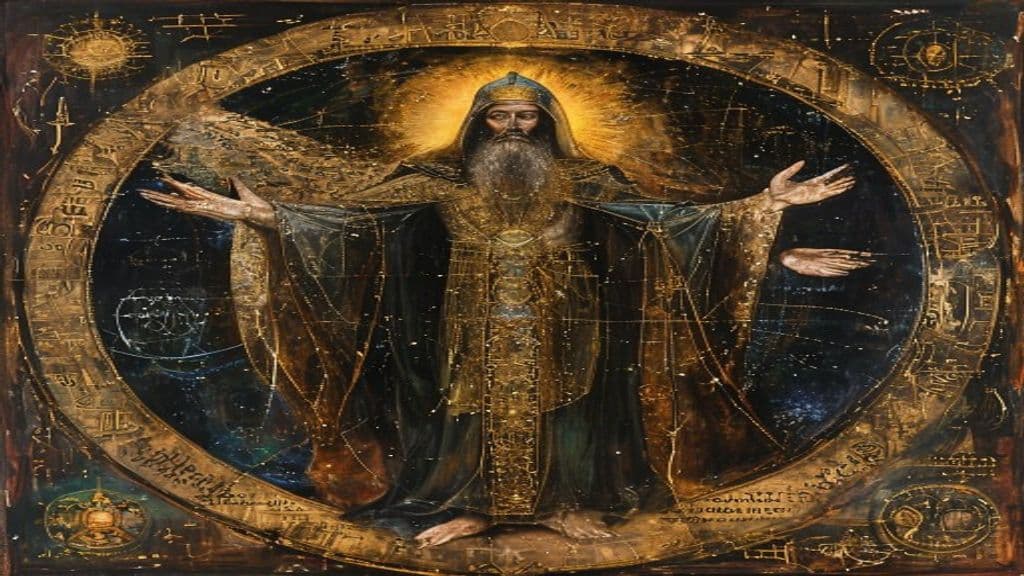
In the rabbinic and mystical corpus Metatron appears across multiple strata of postbiblical Jewish literature. The name and figure appear most fully formed in 3 Enoch, where the being is explicitly identified as the name received by the antediluvian patriarch Enoch after his transformation into a heavenly being. Earlier rabbinic texts and targumic fragments refer to an exalted heavenly function or 'prince' figure without uniformly making the Enoch–Metatron identification; later kabbalists often assumed the connection. Scholarly summaries note that Metatron occupies a contested conceptual position in late antique and medieval Jewish texts, involved in debates over a perceived 'second power in heaven.'
Sources provide limited sustained physical description. Some traditions associated with Enoch/Metatron (as cited in aggadic material) depict Enoch as 'clothed in light'; Hekhalot, Merkabah, and 3 Enoch literature portray a transformed, exalted celestial figure, but the supplied sources do not furnish a detailed, consistent physical portrait.
Across rabbinic and mystical texts Metatron is portrayed in multiple, sometimes overlapping roles: as a celestial scribe or record-keeper (rabbinic tradition), as an elevated court official or 'prince' within the heavenly palace (merkabah/Hekhalot material), and—explicitly in 3 Enoch and later Kabbalah—as the angelic identity assumed by Enoch after his transformation. Some sources (e.g., aggadic motifs cited in secondary summaries) associate the figure with guardianship of souls ascending to heaven. Metatron's exalted status generated theological discussion about the presence of a second high heavenly figure in Jewish thought.
Ahijah the Shilonite
Ahijah the Shilonite is a Levite prophet attested in the Hebrew Bible (1 Kings) who foretold Jeroboam's rise and is credited in Chronicles with a now‑lost work. Rabbinic literature expands him into a legendary long‑lived transmitter of sacred lore while also debating his moral fallibility in the Jeroboam episode.
Androgynos (Judaism)
In rabbinic Jewish literature, the androgynos (Hebrew: אַנְדְּרוֹגִינוֹס, ʾandərôg̲înôs) is a human juridical category for a person who possesses both male and female sexual characteristics. It is treated as a special halakhic classification that raises questions about which gendered legal obligations, prohibitions, and ritual statuses apply.
Azazel
In earliest biblical usage Azazel is a ritual locus or destination in the Yom Kippur scapegoat rite to which communal sins are sent; in later Second Temple and subsequent Christian and Islamic receptions Azazel becomes personified as a fallen angel associated with rebellion and the transmission of forbidden knowledge to humans.
Binah (בינה)
Binah (Hebrew: בִּינָה Bīnā, "understanding") is the third sephirah on the Kabbalistic Tree of Life, a non-personal divine attribute that receives, contains and structures the undifferentiated creative impulse (Chokmah). It functions as an intellectual/metaphysical principle in Kabbalistic cosmology and psychology rather than as an independent, anthropomorphic spirit.
Chochmah
Chochmah (Heb. חָכְמָה; also Chokmah/Chokhmah) is a metaphysical principle in Jewish Kabbalistic thought: the second of the ten sefirot, described as the primordial point of divine wisdom — the first flash of conscious intellect that issues from Keter and becomes intelligible through Binah.
Chokmah
Chokmah (חָכְמָה, 'wisdom') is the second sefirah on the Kabbalistic Tree of Life, described in classical kabbalistic texts as the primordial point of divine wisdom that emerges from Keter and precedes differentiation by Binah. It functions as an abstract metaphysical principle and cognitive archetype rather than a personified spirit in the provided sources.
Daʻat
Daʻat (Hebrew: דַּעַת, "knowledge") is a Kabbalistic locus or mystical state on the Tree of Life in which the sefirot are united; it functions as a mediating point between the transcendent Keter and the manifest sefirotic structure and as a correlate of certain human cognitive-emotional capacities.
Destroying angel
A divinely commissioned heavenly agent in the Hebrew Bible and later Jewish traditions sent by God to execute judgment, death, or punishment. The figure functions as an instrument of divine justice (mal'āḵīm / memitim / mashḥit) and appears in narrative episodes of plague, wartime slaughter, and in rabbinic and Enochic writings connected to postmortem or eschatological punishment.
Dumah
Dumah (Heb. דּוּמָה, dūmā, 'silence') is an angelic figure in Jewish rabbinic and mystical literature and later Islamic reports, associated with the silence of death and with authority over the wicked dead and the punitive agents of the netherworld. In Zoharic material Dumah is depicted as a chief or prince over attendants who punish souls, and in a hadith compilation reported by Al‑Suyuti Dumah receives the souls of deceased unbelievers from Azrael.
Ein Sof
Ein Sof (אֵין סוֹף, ʾēn sōf) is the Kabbalistic designation for the pre‑manifest, nameless divine principle—literally “no end” or “infinite”—from which the Ohr Ein Sof (Infinite Light) and the ten sefirot are said to emanate. It is described apophatically: beyond names, attributes, form, space and time.
Ein Sof Aur
A Kabbalistic metaphysical formulation linking Ein Sof (the Infinite) with ʾOr (divine 'light'), used to discuss divine emanation and the manifestation of revealed divine names (e.g., YHWH Elohim) rather than a personified folkloric being.
Eliezer
Eliezer (Hebrew: אֱלִיעֶזֶר, ʾĔliʿezer) is a Hebrew personal name borne by multiple human figures in the Hebrew Bible and later Jewish tradition — most prominently a steward associated with Abraham, a son of Moses, and a prophet who rebuked King Jehoshaphat. The name means roughly "Help of my God" and functions as a theological personal name and as a marker within rabbinic interpretive traditions.
Community Record
- [1]Metatron (Wikipedia). Wikipedia contributors, 'Metatron,' Wikipedia, The Free Encyclopedia, https://en.wikipedia.org/wiki/Metatron (accessed in supplied research notes).wiki
- [2]Wikidata: MetaTron (unrelated media entry noted in research notes). Wikidata entry Q124067950 (noted in research notes as unrelated modern media).other
- [3]Archive.org items referencing 'Metatron' (not textual sources on the tradition). Archive.org item 'enoch_metatron' (noted in research notes as not providing primary textual material on the traditional figure).other