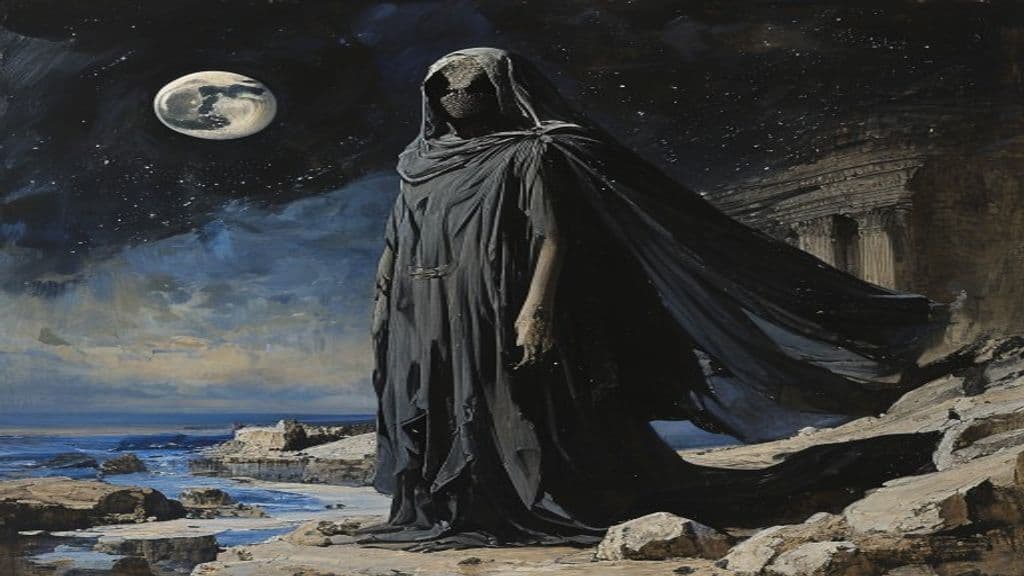
The sources treat Methone primarily as a name rather than a single mythic origin story. Wikipedia lists Methone (Μεθώνη) as applied to several ancient towns and to several figures in Greek mythology, indicating the name's roots in Greek onomastic practice. No provided source supplies a unified mythological origin or narrative in which Methone acts as an autonomous supernatural actor.
No source in the provided materials describes a consistent physical appearance for Methone as a personified or anthropomorphic supernatural being. The term instead refers variously to geographic locations, mythological personal names, an astronomical moon, a butterfly genus, and modern media titles.
The provided sources do not ascribe abilities, behaviors, or interactions with humans to Methone as a supernatural being. References are documentary (place‑names, taxonomic and astronomical designations, media titles) rather than descriptions of powers or deeds.
Messapus
Messapus is a literary figure in Virgil's Aeneid: an Etrurian king and captain, described as a son of Neptune and a famed tamer of horses who fights for Turnus against Aeneas. In the epic he is notable for martial prowess, cavalry command, a gleaming helmet that affects plot events, and a poetic attribute that 'no one can fell [him] by fire or steel.'
Mestor
Mestor (Ancient Greek: Μήστωρ, 'adviser, counsellor') is primarily an Ancient Greek personal name borne by several mortal figures in mythic genealogies (sons of Perseus, Pterelaus, Priam, Ajax and one of Poseidon's ten Atlantean princes in Plato). In modern popular culture the name was reused for a human antagonist in the Doctor Who serial 'The Twin Dilemma'.
Mestra
Mestra (Μήστρα) is a mortal woman in ancient Greek myth who, according to surviving sources, was granted the ability to change her shape by the god Poseidon. Her metamorphic gift is used to escape slavery and to provide for her father Erysichthon; in other traditions Poseidon carries her to Cos where she bears a son, Eurypylus.
Metanira
Metanira is the mortal queen of Eleusis in Greek myth, wife of King Celeus, who figures in the episode where Demeter, disguised as a nurse, attempts a secret rite to make a royal child immortal. Metanira’s discovery and frightened cry interrupt the goddess’s ritual and thereby alter the outcome, after which Demeter gives the household the gift of agricultural knowledge instead.
Metatron
An exalted heavenly figure in postbiblical Jewish literature, often identified with the transformed patriarch Enoch in later mystical texts and portrayed as a celestial scribe and high court official in merkabah and Kabbalistic writings.
Metheringham Lass
A place‑bound apparition reported at RAF Metheringham in Lincolnshire, presented in local wartime and post‑war lore as a young woman who approaches passing motorists asking for help for an injured boyfriend and then vanishes. The story is linked to the airfield's WWII history and persists in regional storytelling and contemporary paranormal media.
Metis (name / label; disambiguation of uses)
The string 'Metis' (variants Métis, Metiş) appears across many domains — as an Indigenous ethnonym (Métis), place names (Metis Shoal, Metiş village, Metis Island), astronomical and biological names (9 Metis asteroid, Metis moon, genus names), a brief Wikipedia mention of a mythological Metis (Oceanid and wife of Zeus), and multiple modern institutional and cultural uses. The supplied sources do not document a single, coherent supernatural entity named 'Metis' with folkloric appearance, powers, or rituals.
Metope
Metope (Μετώπη) is attested in Greek myth as a local Naiad — a freshwater nymph tied to the spring and stream called Metope near the town of Stymphalos in Arcadia. The lexical form 'metope' also denotes an architectural element in the Doric frieze, but this entry treats the mythological personage; the architectural sense is non-supernatural and separate.
Metsänhaltija (Metsänväki)
A metsänhaltija is a place‑bound haltija of the Finnish tradition — an invisible, solitary guardian spirit of a specific forest locality (the collective term metsänväki refers to the forest's inhabitants or powers). Metsänhaltijat protect their home, care for species associated with that place, and may reveal themselves to humans.
Metsänpeitto
A lesser spirit in Finnish folklore that conceals people and animals within the forest, making them invisible to those searching for them. (Note: - Change Power tier: Minor Spirit -> Lesser (According to the provided power tier classification, Lesser corresponds with a local spirit, which seems more fitting given Metsänpeitto's role in conceali)
Metsänväki
A Finnish term attested in fragmentary sources referring either to the animate power of the forest or to forest-dwelling spirits/creatures; sources supplied are brief and inconsistent about whether it denotes an impersonal force or a class of beings.
Mettekoe
Mettekoe is a contemporary processional giant created in Petit-Enghien, Belgium in 2022 that functions as a civic mascot for a charitable association concerned with orangutan conservation and as a participant in gatherings of giants and contemporary art events.
Community Record
- [1]Methone — Wikipedia. Wikipedia, 'Methone' (disambiguation page).wiki
- [2]Methone — Wikidata. Wikidata entry Q1764425 for Methone.other
- [3]Nicholas of Methone Contra Latinos (Archive item). Archive.org item referencing Nicholas of Methone (ecclesiastical toponymic usage).other
- [4]SUBWISE Podcast 013 — tracklist (Archive). Archive.org podcast tracklist listing 'Bad Gibbonz - Methone'.other
- [5]My doll became alive! (Archive item). Archive.org item including the phrase 'Methone's latest Kigurumi video' (contemporary media use).other