
Within the haltija concept, a metsänhaltija is understood as the original supernatural inhabitant and guardian of a forest place. The tradition holds that haltijat are connected to particular places or species — a haltija may be regarded as the original mother of an animal species or the rightful guardian of a locality. In some accounts a person who died and was buried at their home could themselves become a haltija, linking ancestral presence, burial place, and the continued guardianship of that site.
Accounts emphasize that haltijat inhabit an invisible environment parallel to the human world but are able to show themselves to humans; thus metsänhaltijat are normally unseen. The source does not record a consistent anthropomorphic or detailed visual form — instead, the hallmark is their place‑bound invisibility with occasional manifestations to people rather than a single fixed appearance.
Metsänhaltijat function as solitary protectors of their home, defending the nature and peace of their locality. They are described as custodians of living beings tied to that place; for example, a haltija of an animal species is said to protect that species' continued existence and is credited in the tradition with returning dead animals back to earth. They may reveal themselves to humans, and human burial at home is reported as one possible origin for new haltijat.
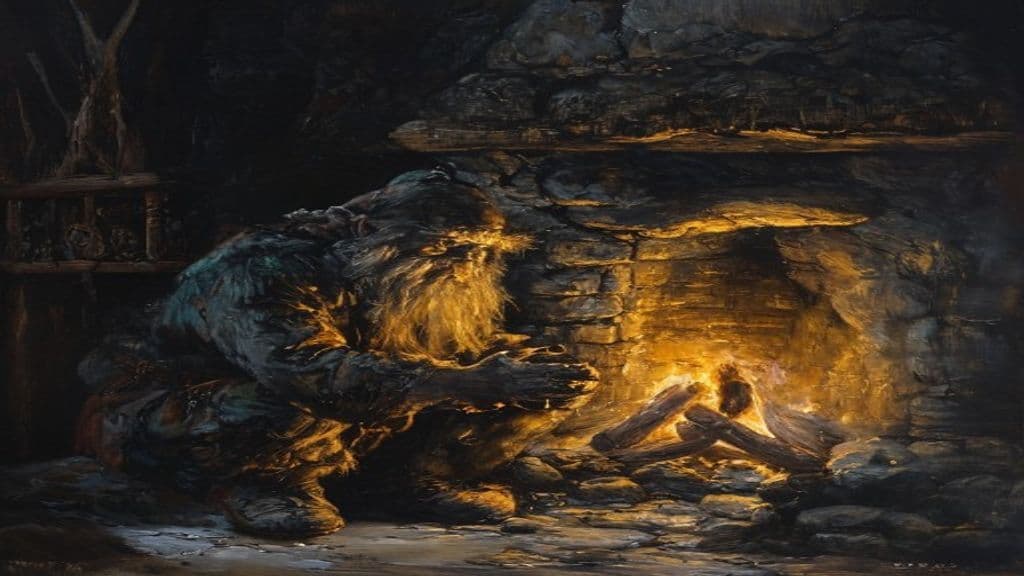
Antero Vipunen
A giant in Finnish mythology with valuable spells and knowledge, possibly associated with underworldly powers. (Note: * Power tier should be Ancient (deity-level) due to possessing "very valuable spells and knowledge", which suggests immense magical power but not necessarily cosmic-level. * Appearance should clarify )
Emuu
Emuu is attested in a brief modern catalogue entry as a "mythical creature from Finnish and Karelian folklores." Beyond this short label, the supplied sources contain no descriptive narratives, attributes, or rituals connected to Emuu.
Etiäinen
In Finnish folklore, an etiäinen is a harbinger that precedes a person, performing actions they will later undertake. (Note: 1. Factual claim in summary about "preceding a person" not explicitly supported by source material. 2. Power tier should be Primordial, as etiäinens are part of everyday life and associated with every)
Flogdrake
A Scandinavian firedrake or "fly‑dragon" associated with evening streaks of light in the sky and with tunnelling mountain lairs that hide ore and treasure. Primarily attested in Swedish folklore, it participates in a pan‑European motif of fiery serpents and is sometimes linked with household or earth spirits in nearby traditions.
Hongatar
A Finnish haltija (localized spirit) associated with the bear: presented in runic songs as the mother or progenitor of the bear, and named for the honka pine used to hang bear skulls during peijaiset (bear funeral/feast). She is an invited guest of those rites and forms part of a family/network of tree-linked female haltijas in Finnish/Karelian oral tradition.
Ilmatar (Luonnotar)
Ilmatar, also called Luonnotar, is a female spirit of the air and a nature-spirit figure in the Finno-Karelian epic tradition as compiled in the Kalevala. In Elias Lönnrot's Kalevala she is presented as the virgin mother who is impregnated by sea and wind and becomes the mother of the culture-hero Väinämöinen, though regional runic variants sometimes name other maternal figures for Väinämöinen.
Kanteletar
The Kanteletar is a collection of Finnish folk poetry compiled by Elias Lönnrot in the 19th century. (Note: - Remove Power tier: Minor Spirit (the source material does not describe any supernatural or spiritual aspects) - Summary: needs slight revision for accuracy - Appearance, Abilities, Sensory cues, Wea)
Kihovauhkonen
A seer or prophet in Finnish mythology, tasked with foreseeing and warning of impending cataclysmic events. (Note: 1. Power tier: should be Lesser (local spirit) based on typical depiction in folklore. 2. Ability description: while it makes prophecies, there's no indication of a Primordial power level for such abi)
Lalli
A historical figure from Finnish medieval legend, responsible for killing Bishop Henry in the late 1150s. (Note: - Power tier: Greater (not Lesser), as Lalli's actions have significant historical and cultural impact. - Sensory cues: none mentioned in source material, so should be deleted or clarified. - Weakness)
Metsänpeitto
A lesser spirit in Finnish folklore that conceals people and animals within the forest, making them invisible to those searching for them. (Note: - Change Power tier: Minor Spirit -> Lesser (According to the provided power tier classification, Lesser corresponds with a local spirit, which seems more fitting given Metsänpeitto's role in conceali)
Mythologia Fennica
A collection of Finnish myths and legends that includes various gods and goddesses, forming the foundation of Finnish mythology. (Note: - Power tier should be Ancient (deity-level) since it's a collection of gods and goddesses. - Summary needs to be more specific and accurate, e.g., "A collection of Finnish myths and legends compiled )
Napakivi (Finnish)
A traditional Finnish name for a standing stone in the middle of a field. (Note: 1. Power tier should be Primordial (Natural feature fits within this category, as it's an unaltered aspect of the environment). 2. Add sensory cues: The unique shape or positioning of the stone may pr)
Community Record
- [1]Metsänhaltija (Metsänväki) — Haltija. Wikipedia, article 'Haltija' (section on metsänhaltija / metsänväki), accessed via provided source URL.wiki