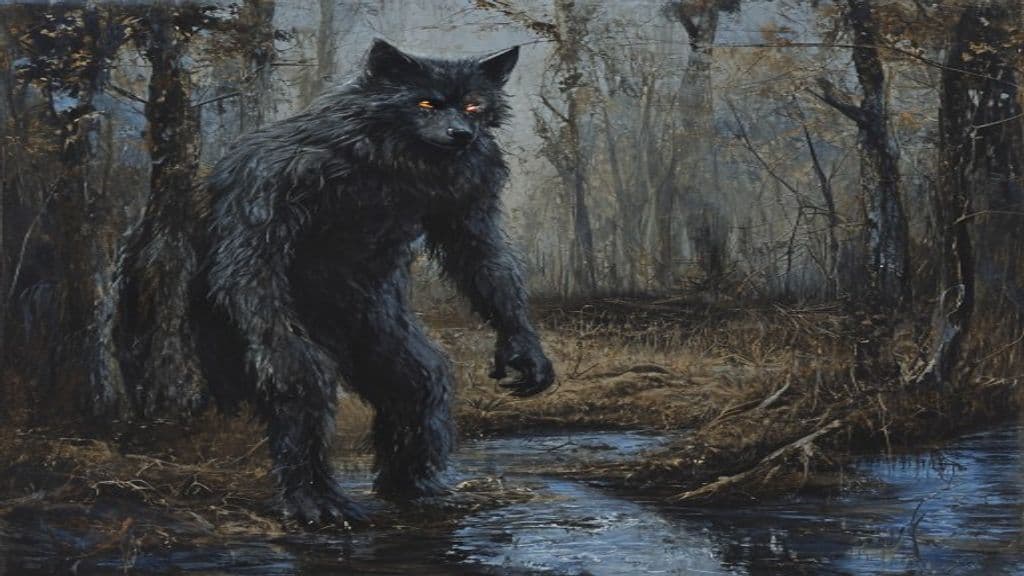
The Michigan Dogman appears in modern regional lore with an alleged first reported witness event dated to 1887 in Wexford County; subsequent notable years cited in accounts include 1937 (Paris, Michigan), 1967 (Manistee/Cross Village), and a cluster of reports in 1993–1994 (Grand Haven). The modern consolidation and spread of the Dogman legend were significantly amplified after a 1987 radio song by Steve Cook, which he later acknowledged was created as an April Fools' prank; callers to that radio program subsequently reported similar encounters and the story entered wider local and later national media circulation. Some modern retellings assert an older presence in areas used historically by Odawa people, but the supplied sources do not document premodern indigenous names, rituals, or ethnographic attestations tying the creature to Odawa traditions.
Accounts collated in the sources describe a bipedal figure roughly seven feet tall with a human-like torso and a canine head; eye color is variably reported (blue, amber, or glowing red in some reports), and fur color descriptions vary (gray or dark gray). Witness descriptions are inconsistent across reports: some emphasize a doglike face rather than a lupine visage, while others use more wolf-like or generalized canine terms. Observers report the creature sometimes standing or moving bipedally and in other instances seen on all fours. The corpus presents no single canonical portrait, and variations between eyewitness reports are noted in the sources.
Reported behaviors and capacities in the sources are primarily observational and folkloric rather than documented supernatural powers: stalking or recurring presence in wooded and rural landscapes; a distinctive vocalization described repeatedly as a howl that sounds like a human scream; bipedal locomotion though some sightings include quadrupedal posture; elusiveness illustrated by at least one report of a vehicle collision in which only gray fur was found in the grill and no corpse recovered. Some accounts describe an aversion to loud noise. There are no consistent claims in the provided material of world-altering powers, ritual magic, or systematic harm to large numbers of people; reports of attacks are limited and sometimes ambiguous in the recorded sources.
Weaknesses
- conditionaversion to loud noise (folkloric claim)
Wards
- ritualloud clapping or making loud noise
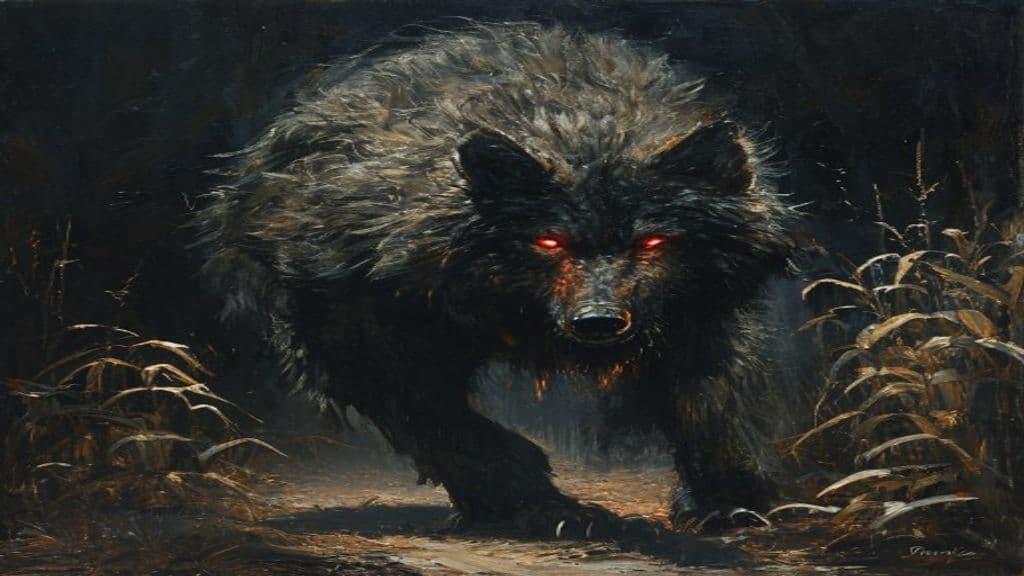
Beast of Bray Road
A contemporary North American cryptid localized to Walworth County, Wisconsin, described in witness reports and popular media as a wolf-like, humanoid or hybrid creature associated with Bray Road and surrounding rural areas. It exists both as reported phenomenon and as a piece of local folklore and popular-culture storytelling.

Werewolf
A figure of European folklore of a human who can change into a wolf or wolf–human hybrid, variously portrayed as voluntary shapeshifter, cursed afflicted person, or clinical delusion (lycanthropy). Belief in werewolves was entwined with medieval and early modern witchcraft accusations and persisted into Gothic and popular fiction.
Metsänväki
A Finnish term attested in fragmentary sources referring either to the animate power of the forest or to forest-dwelling spirits/creatures; sources supplied are brief and inconsistent about whether it denotes an impersonal force or a class of beings.
Mettekoe
Mettekoe is a contemporary processional giant created in Petit-Enghien, Belgium in 2022 that functions as a civic mascot for a charitable association concerned with orangutan conservation and as a participant in gatherings of giants and contemporary art events.
Metztli
Metztli (Nahuatl: Mētztli) is the Nahuatl term for the Moon and in the supplied sources is described as a god or goddess associated with the moon, the night, and farmers in Aztec/Nahuatl cultural context. The available material treats Metztli both as the celestial Moon and as a lunar deity, but supplies no detailed myths, iconography, or ritual corpus.
Mezzetino
Mezzetino is a commedia dell'arte stock character from 16th‑century Italian popular theatre, a member of the Zanni servant class known as a scheming, often musically inclined servant and flirt. The role circulated into French and English stages and appears in visual arts (notably Watteau) and decorative arts.
Miasma (Ancient Greek)
In ancient Greek religion, a miasma is a malevolent force arising from human wrongdoing that can cause catastrophe and has an independent life. (Note: - The draft states that a miasma causes catastrophe, disease, famine, or war, which is not supported by the source material. - Power tier: Primordial (not Ancient), since it's described as having an ")
Michael
Michael is presented in the supplied sources as a masculine given name and disambiguation headword applied to people, historical rulers, cultural works, places, and other uses; the provided material treats it as an onomastic item rather than as a single supernatural being.
Mictlāntēcutli
Mictlāntēcutli (Mictlantecuhtli) is the Aztec lord and ruler of Mictlan, the lowest northern region of the dead. He functions as a principal underworld authority who receives the deceased, figures in myths about the bones of former humans, and appears widely in Aztec calendrical and ritual iconography.
Mictēcacihuātl
Mictēcacihuātl is an Aztec death deity, consort of Mictlāntēcutli, who is described in the sources as watching over the bones of the dead and presiding over the ancient festivals of the dead; modern accounts link her figure to the evolution of those festivals into the contemporary Day of the Dead.
Mideia (Midea)
Mideia (Ancient Greek Μιδεία / Μιδέα) is a name appearing in ancient Greek tradition applied to several mytho-geographic and genealogical figures: notably a nymph described as mother of Aspledon by Poseidon and multiple eponymous or mortal women whose names are attached to towns or genealogies. The name also denotes ancient place-names in Boeotia and Argolis preserved in Homeric and later geographical accounts.
Midnight Beauty
Attested in the supplied corpus only as a terse label — a single-line Wikidata entry calling 'Midnight Beauty' a "temptress ghost of Brazil." No supporting folkloric narratives, rituals, or detailed descriptions are present in the provided materials.
Mielikki
Mielikki is a Finnish forest-personification variously described as the Mistress of the Forest (Metsän emäntä) and a metsänhaltija whose favour is sought by hunters and shepherds. She is portrayed in runic songs and the Kalevala as a giver of game, a healer of animals, and a localized spirit who inhabits particular trees such as spruces.
Mikelats
Mikelats (also spelled Mikelatz / Mikelat) is a figure in Basque mythic narratives, typically presented as one of two brothers born to the goddess Mari in some tellings and taught by a cave‑dwelling teacher named Etsai; in modern retellings he is characterized as the 'profane' counterpart to the 'sacred' Atarrabi and his name is used locally as that of a festival giant (erraldoi) in Mendillorri.
Community Record
- [1]Michigan Dogman — Wikipedia. Wikipedia, 'Michigan Dogman' entry (accessed via provided research notes).wiki
- [2]Michigan Dogman — Wikidata. Wikidata entry for Michigan Dogman (brief descriptor as 'alleged werewolf in Wexford County, Michigan').other
- [3]Dogman in Sacramento / Elk Grove, CA — Archive recording. Archive: Dogman in Sacramento / Elk Grove, CA (recorded folkloric/archival material referencing Dogman sightings and folk practices).folk
- [4]HR20260104 Scum Puppy - Boo Hag — Archive. Archive recording referenced in research notes containing discussions of Dogman and related folklore.folk
- [5]Skeptoid #477: Wag the Dogman — Archive. Skeptoid episode and archival material discussing the Dogman legend and media origins.other