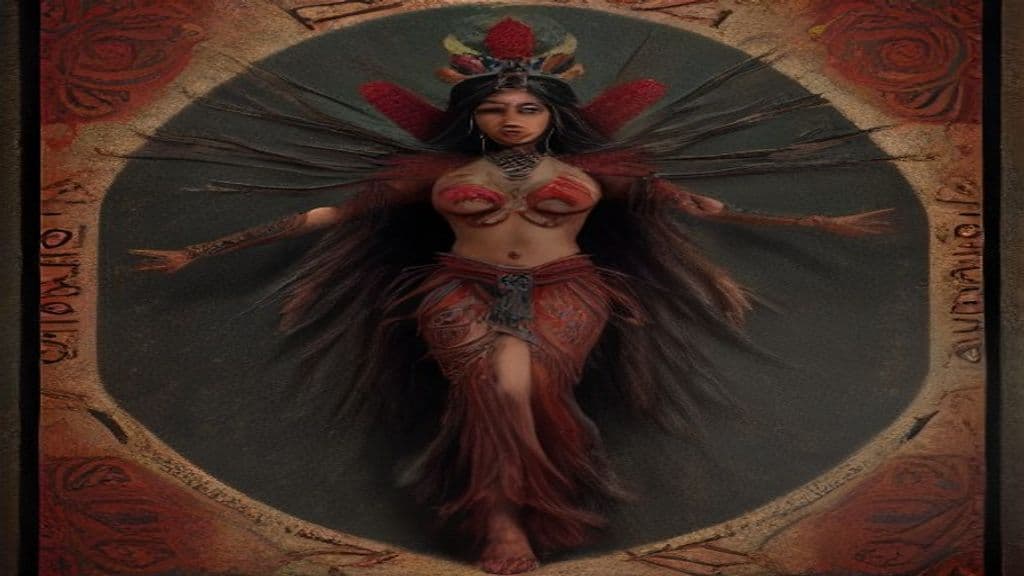
In Aztec cosmology Mictecacihuatl is attested as the named female counterpart and consort of Mictlāntēcutli, the god of the dead; together they preside over Mictlān, the lowest level of the underworld. This pairing is recorded in modern summaries of primary pictorial sources and manuscript commentaries (for example the Fejérváry‑Mayer codex commentary), which place Mictlāntēcutli and Mictecacihuatl together in the northern direction (Mictlampa), identified as the 'place of the dead.' Secondary reference works and summaries (including contemporary encyclopedic entries) describe her in these institutional, dyadic terms rather than as an isolated minor spirit.
Primary excerpts supplied do not provide a detailed textual inventory of Mictecacihuatl's iconography in prose; however, manuscript tradition and codex commentaries that organize cosmic directions explicitly name Mictecacihuatl alongside Mictlāntēcutli in pictorial material (e.g., Fejérváry‑Mayer commentary). The sources therefore support that she is present in Aztec pictorial‑codex contexts as the female counterpart to the lord of Mictlān; specific attribute lists or standardized visual formulas are not detailed in the provided summaries.
The sources describe Mictecacihuatl chiefly in institutional and functional terms: as a death deity and the consort/co‑ruler with Mictlāntēcutli who together govern Mictlān, the underworld (Wikipedia summary; codex commentary). Scholarship and public‑facing discussions included in the supplied materials also place her within the longer cultural memory of death personifications that inform later Mexican death imagery (for example in discussions of antecedents to Santa Muerte and Day of the Dead symbolism), but the excerpts do not ascribe to her specific mythic acts, magical powers, or named interactions with the living beyond her role as a ruler of the dead's realm.
Mictlāntēcutli
Mictlāntēcutli (Mictlantecuhtli) is the Aztec lord and ruler of Mictlan, the lowest northern region of the dead. He functions as a principal underworld authority who receives the deceased, figures in myths about the bones of former humans, and appears widely in Aztec calendrical and ritual iconography.
Tláloc
Tláloc (Classical Nahuatl: Tláloc) is the Aztec god of rain, water, and earthly fertility, venerated as a giver of life and sustenance and feared for his power over destructive weather such as hail, thunder, and lightning. He is closely associated with mountaintop shrines (notably Cerro Tláloc), caves, springs, and ritual implements and was a central focus of offerings and impersonatory ritual in central Mexican religious practice.
Metztli
Metztli (Nahuatl: Mētztli) is the Nahuatl term for the Moon and in the supplied sources is described as a god or goddess associated with the moon, the night, and farmers in Aztec/Nahuatl cultural context. The available material treats Metztli both as the celestial Moon and as a lunar deity, but supplies no detailed myths, iconography, or ritual corpus.
Mezzetino
Mezzetino is a commedia dell'arte stock character from 16th‑century Italian popular theatre, a member of the Zanni servant class known as a scheming, often musically inclined servant and flirt. The role circulated into French and English stages and appears in visual arts (notably Watteau) and decorative arts.
Miasma (Ancient Greek)
In ancient Greek religion, a miasma is a malevolent force arising from human wrongdoing that can cause catastrophe and has an independent life. (Note: - The draft states that a miasma causes catastrophe, disease, famine, or war, which is not supported by the source material. - Power tier: Primordial (not Ancient), since it's described as having an ")
Michael
Michael is presented in the supplied sources as a masculine given name and disambiguation headword applied to people, historical rulers, cultural works, places, and other uses; the provided material treats it as an onomastic item rather than as a single supernatural being.
Michigan Dogman
A regional cryptid and folkloric beast from Michigan popularized in late 20th-century media and oral reports, described as a bipedal, canine-headed figure reported in rural and wooded areas. The figure functions in local legend and contemporary folklore rather than in documented scientific or premodern ethnographic sources.
Mideia (Midea)
Mideia (Ancient Greek Μιδεία / Μιδέα) is a name appearing in ancient Greek tradition applied to several mytho-geographic and genealogical figures: notably a nymph described as mother of Aspledon by Poseidon and multiple eponymous or mortal women whose names are attached to towns or genealogies. The name also denotes ancient place-names in Boeotia and Argolis preserved in Homeric and later geographical accounts.
Midnight Beauty
Attested in the supplied corpus only as a terse label — a single-line Wikidata entry calling 'Midnight Beauty' a "temptress ghost of Brazil." No supporting folkloric narratives, rituals, or detailed descriptions are present in the provided materials.
Mielikki
Mielikki is a Finnish forest-personification variously described as the Mistress of the Forest (Metsän emäntä) and a metsänhaltija whose favour is sought by hunters and shepherds. She is portrayed in runic songs and the Kalevala as a giver of game, a healer of animals, and a localized spirit who inhabits particular trees such as spruces.
Mikelats
Mikelats (also spelled Mikelatz / Mikelat) is a figure in Basque mythic narratives, typically presented as one of two brothers born to the goddess Mari in some tellings and taught by a cave‑dwelling teacher named Etsai; in modern retellings he is characterized as the 'profane' counterpart to the 'sacred' Atarrabi and his name is used locally as that of a festival giant (erraldoi) in Mendillorri.
Mikula Selyaninovich
Bogatyr and plowman from the Novgorod Republic bylina cycle, associated with strength and courage. (Note: - Power tier: Ancient (due to being a bogatyr and having deity-level abilities associated with courage) - Origin story: should be included - Appearance: should be described based on source material - )
Community Record
- [1]Mictēcacihuātl (Wikipedia). "Mictēcacihuātl (Nahuatl pronunciation: [mik.teː.kaˈsi.waːt͡ɬ], meaning 'Lady of the Dead'), in Aztec mythology, is a death deity and consort of Mictlāntēcutli, god of the dead and ruler of Mictlān, the lowest level of the underworld."; "Her role is to watch over the bones of the dead and preside over the ancient festivals of the dead."; "Mictēcacihuātl was represented with a flayed body and with jaw agape to swallow the stars during the day."; "These festivals evolved from Mayan traditions into the modern Day of the Dead after synthesis with Spanish traditions. She now presides over the contemporary festival as well."wiki
- [2]Our Lady of the Holy Death (archive). Archive notes and program material discussing connections between pre-Hispanic death figures and modern death cults (referenced in the supplied corpus as contextual material).other
- [3]The Day of the Dead (archive). Program and summary material linking ancient festivals of the dead to modern Day of the Dead commemorations (used in supplied corpus summaries).other
- [4]Day Of The Dead: From Aztec Goddess Worship To Modern Mexican Celebration - Latino Rebels. Secondary discussion of continuity and syncretism between pre-Hispanic death festivals and modern Day of the Dead, cited in the supplied corpus.other
- [5]Mictecacihuatl (Codex Mythica card and notes). Modern summary and representation referencing the deity among mythic figures (included in supplied corpus list).other
- [6]Mictecacihuatl — Scott Murphy (art). Contemporary artistic depiction and commentary included in the supplied corpus.other
- [7]Wikidata: Mictlancihuatl. Wikidata entity summary for Mictlancihuatl / Mictēcacihuātl.wiki
- [8]Códice Fejérváry‑Mayer (archival summary). Fejérváry‑Mayer commentary: 'Al norte (Mictlampa) lugar de los muertos, lugar de Mictlantecuhtli y Mictecacihuatl.'other