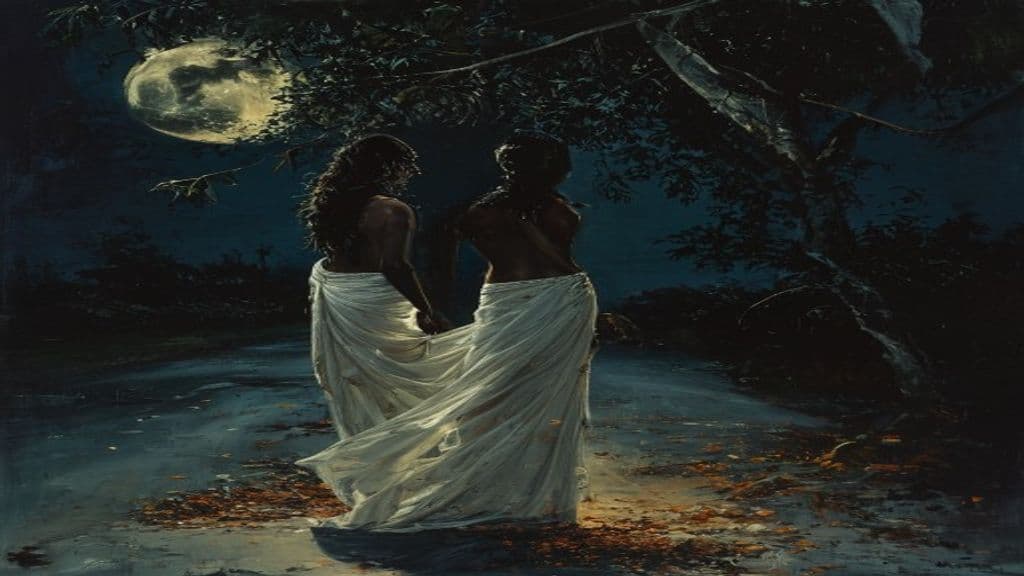
Across South India, the Mohini is the ghost of a woman who was deeply wronged in love — abandoned on her wedding day, betrayed by a lover, or driven to suicide by grief. Her beauty, which was her greatest gift and greatest vulnerability in life, persists after death as her weapon.
She is one of the most reported entities in contemporary South Indian urban supernatural accounts — spotted on deserted roads, at crossroads, near mango groves and tamarind trees. Her presence in news reports of mysterious night-road deaths is a cultural constant.
The Mohini appears as a young woman of extraordinary beauty in fine dress, often in a white or light-coloured silk sari. She stands at the roadside, apparently in distress — the classic encounter is a male traveller stopping to ask if she needs help.
Witnesses who escaped report that her feet do not touch the ground, and that she has a faint glow perceptible in peripheral vision. Those who look directly into her eyes are said to be immediately lost.
Her power is in her eyes and voice. A man who meets her gaze is rendered incapable of resistance. She can appear to be a stranded traveller, a weeping woman, or even a known acquaintance.
In Kerala accounts, she is associated with the tamarind tree and can cause men to climb the tree in a trance and fall. In Tamil Nadu she is more often reported leading men into bodies of water.
Weaknesses
- symbolIron ring or nail on the person
- conditionNot meeting her gaze directly
Wards
- substanceNeem leaves carried while travelling at night
- mantraRecitation of Hanuman Chalisa while on deserted roads
Community Record
- [1]Female Supernatural Entities in Kerala Folk Narrative. Nair, K.R. (1989). Ghost traditions of coastal Kerala. Trivandrum: Kerala Sahitya Akademi.academic
- [2]Mohini (ghost) — Wikipedia. Wikipedia contributors. Mohini (ghost). Wikipedia, 2024.wiki