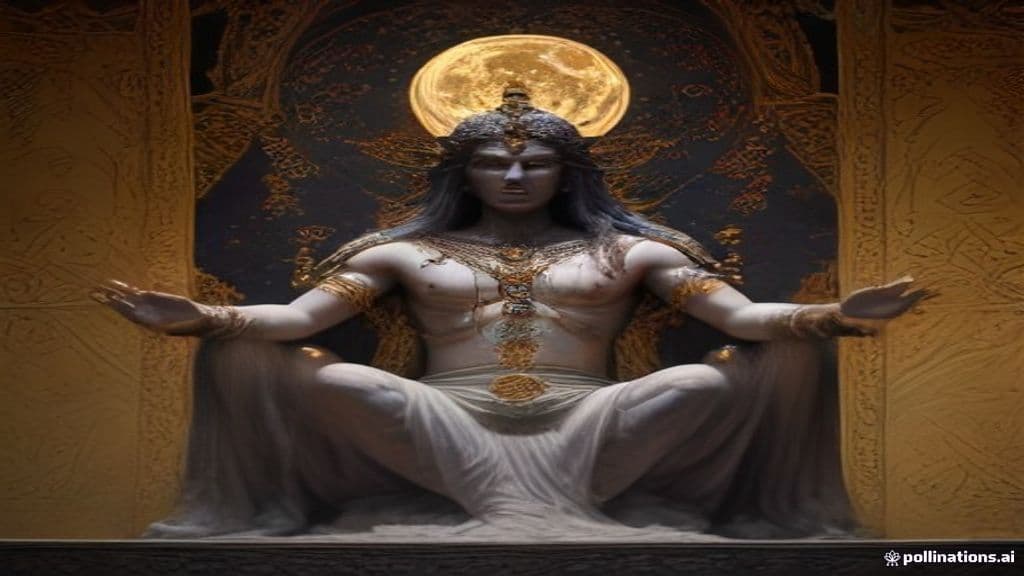
As a category rather than a single mythic persona, the 'moon god' does not have one universal origin story in the provided sources. Comparative surveys note that many cultures personified the Moon and incorporated it into their celestial hierarchies; Source 1 and Source 7 list numerous local lunar divinities (for example Soma, Aglibol, Almaqah, Saggar, Wadd, Mah) indicating multiple independent origin-narratives attached to particular names. In the monotheistic material cited (Psalm 136), the Moon is described as created by God and assigned to 'rule over the night,' showing how some traditions subsume lunar agency into a creator deity's ordering of the cosmos rather than treating the Moon as an independent origin-mythic god (Sources 3–5).
The supplied sources do not provide a consistent or detailed iconographic description for a generic lunar deity. The comparative and list-oriented materials emphasize names and roles across cultures (Source 1; Source 7) rather than a shared physical form; the biblical source treats the moon as a created 'light' without anthropomorphic detail (Sources 3–5). Consequently, no single appearance can be reliably reconstructed from the provided texts.
Across the surveyed materials, lunar deities are principally associated with rulership or regulation of the night and with calendrical/timekeeping functions: Psalm 136 states God made the moon and stars 'to rule over the night' (Sources 3–5). Comparative treatments note that lunar gods have a range of culturally specific functions — in some traditions they serve calendrical or timekeeping roles, are associated with fertility cycles, serve as omen-bearers, or aid navigation — but these attributions are presented as variable and tied to particular named deities rather than universal powers (Source 1; Source 7). The corpus also includes modern polemical debates concerning whether certain Near Eastern or Arabian figures were lunar cults, which speaks to historical claims about political or cultic prominence in specific regions but does not establish a universal set of supernatural abilities (Sources 6, 8–12).
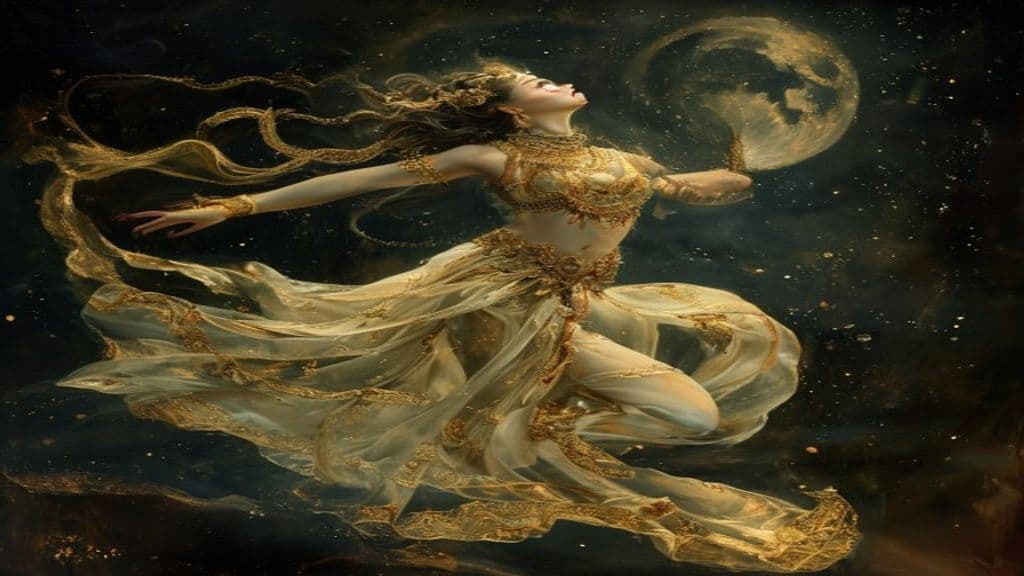
Apsara
Celestial dancers and water nymphs of Hindu cosmology — beautiful semi-divine beings who dance at the court of Indra and, by his command, descend to earth to distract sages from excessive asceticism.

Almaqah
Almaqah was the principal national deity of the ancient Sabaean kingdom (Saba') in southwestern Arabia, venerated as a celestial tutelary god with strong dynastic, oracular, and vegetative associations. His main cultic center was the Awwam Temple near Marib; his worship extended into the northern Horn of Africa (Dʿmt, Aksum). Scholarly treatments debate whether his primary identification is lunar, solar, or syncretic.
Community Record
- [1]Moon god (Wikipedia). Wikipedia, 'Lunar deity' (list and comparative discussion of moon gods)wiki
- [2]Wikidata: lunar deity. Wikidata entry defining 'lunar deity' as 'deity representing the Moon'other
- [3]God Is Good | Psalm 136 (archive recordings). Archive recordings of Psalm 136 which contains the phrase that God 'made the great lights; the sun to rule over the day; the moon and stars to rule over the night'literary
- [4]God Is Good | Psalm 136 (alternate archive). Archive recording of Psalm 136 (same liturgical text cited for moon's role)literary
- [5]God Is Good | Psalm 136 (third archive). Archive recording of Psalm 136 (cited for theological assignment of the moon to rule the night)literary
- [6]List of lunar deities (Wikipedia). Wikipedia list enumerating named lunar deities across cultures (examples: Soma, Aglibol, Almaqah, Saggar, Wadd, Ay Ata, Mah)wiki
- [7]Comparative Index to Islam: MOON GOD (Answering-Islam). Comparative/polemical web essay discussing claims about moon-god origins in Arabian religionother
- [8]Comparative Index to Islam: MOON GOD (alternate mirror). Mirror of the comparative/polemical essay on claims of Arabian moon-god worshipother
- [9]Rebuttals to 'Rahmanan (RHMNN) - An Ancient South Arabian Moon God?'. Response/rebuttal addressing claims that certain Arabic divine names derive from an ancient South Arabian moon godother
- [10]ALLAH MOON GOD? — Proof Islam's 'Allah' Is A Pagan Moon God. Polemical essay asserting a claimed moon-god origin for 'Allah' (present in the corpus as part of the debate)other
- [11]Appendix 5: Is Allah the moon god as claimed by Robert Morey?. Critical appendix addressing claims that 'Allah' derives from a moon god (part of the modern debate present in the sources)other
- [12]Islam: pagan origin and Moon god worship (Bible.ca). Website presenting the thesis that Islam preserved a pre-Islamic Arabian moon god (included among polemical materials in the provided corpus)other