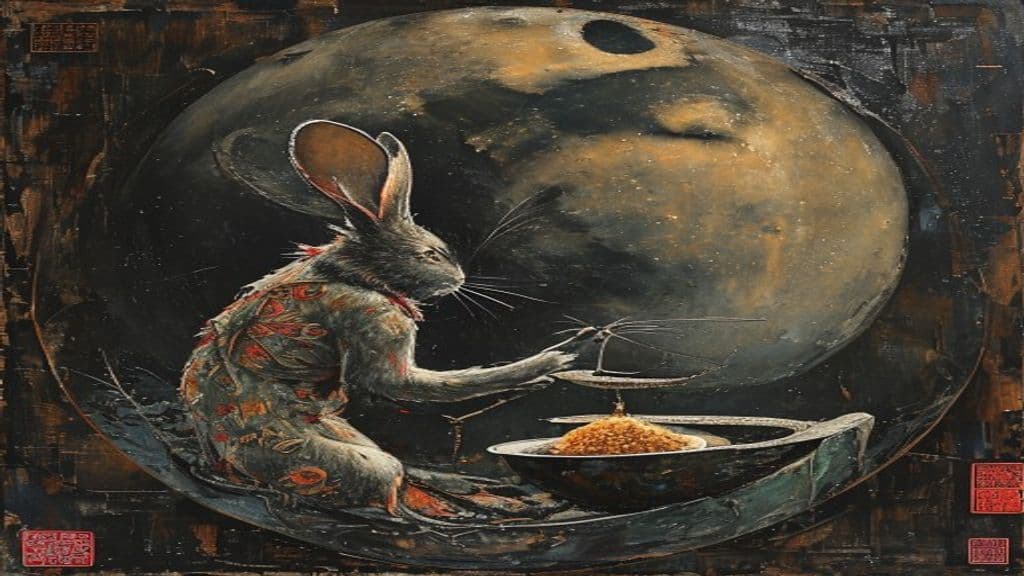
The Moon rabbit is associated with the markings on the near side of the Moon in various Eastern Asian and indigenous American cultures.
In some traditions, it's described as pounding ingredients for elixir or rice cakes, while others depict dark markings on the near side of the Moon. In Chinese folklore, Yutu is a companion to the Moon goddess Chang'e, but this may be a separate entity.
Pounds elixir or medicine for mortals and occasionally foodstuffs in various cultural traditions: - Pounds ingredients for elixir or rice cakes in Chinese folklore. - Pounds ingredients for mochi or tteok in Japanese and Korean folklore. - Pounds the elixir of immortality in Vietnamese folklore.
Alux (aluxoʼob)
The alux (plural aluxoʼob or aluxob) is a small, place-bound sprite or spirit in Maya tradition of the Yucatán Peninsula, Belize, and Guatemala, conceived as knee-high, miniature, traditionally dressed Maya-like beings created by ancient gods and normally unseen but able to assume physical form to communicate or frighten humans.
Báigǔ Jīng
The White Bone Demon of Journey to the West — a skeletal demoness who shapeshifts into innocent humans three times to attempt to capture and devour the monk Tripitaka.
Chi (螭)
Chi (螭) is attested in the provided sources only as an entry on a general disambiguation page identifying 螭 as "a dragon" within a Chinese lexical/mythological listing. No further mythological, ritual, or descriptive information about this entity is present in the supplied materials.
Cizin (Kisin)
Cizin (also spelled Kisin and attested under many related names such as Ah Puch, Yum Cimil, Hun-Came) is an important Maya death deity associated in the sources with death and earthquakes. Scholars have labeled this death figure ‘God A’ and link him to a broader set of Maya death gods attested across regional traditions.
Dawn deities
A cross-cultural category of divine figures associated with dawn, morning, or the morning star; these figures personify the transition from night to day and may be integrated into local pantheons or syncretized with solar deities in some traditions.
Dragon (Long)
Long (龍, "dragon") is a pervasive cultural and artistic motif that appears in Taoist sacred-geographical contexts, Chinese literature, and modern exhibitions; the provided sources treat it as part of the broader mythic imagery present around Taoist sites and ritual scenes rather than as a single, consistently described doctrinal entity.
Fire-breathing monster
A cross-cultural mythic category of monster defined by the ability to expel flame (or fire-like phenomenon) from the mouth or nostrils. Appears in multiple traditions (e.g., Greco-Roman, Hebrew/Biblical, Anglo‑Saxon, Japanese, Philippine, Native American, West African, Mapuche) and in modern fantasy as a recurring trope.
Gumiho (Nine‑tailed fox)
A fox‑spirit in Korean storytelling derived from wider East Asian nine‑tailed‑fox motifs. Traditionally depicted as a shapeshifting fox that can take human form (commonly female in many stories), the gumiho appears across older folktales and numerous contemporary Korean media where it functions variously as trickster, predator, or sympathetic protagonist.
Household deity
A household deity is a deity or spirit that protects the home and its members, cared for inside domestic spaces and integrated into everyday household ritual. The category spans distinct cultural instantiations — hearth goddesses, ancestral family kami, and animistic house-spirits — and is characterized by reciprocal relations of offering and protection rather than cosmic sovereignty.
Huli jing (Fox spirit)
Huli jing (狐狸精), commonly rendered in English as "fox spirit," are shapeshifting supernatural beings from Chinese folklore and mythology. Classified among the broader class of yāoguài, they are morally ambivalent figures that may be benevolent, malevolent, or trickster-like depending on the tale and context.
Hùndùn
The primordial chaos of Chinese cosmogony — sometimes personified as a faceless deity of the center, sometimes as the undifferentiated void from which all things emerged and to which they return.
Igong Bonpuri
A supernatural being described in traditional shamanic narratives from Jejudo, Korea. Similarities with Buddhist mythology suggest it may be a type of Korean cultural cosmological entity. (Note: 1. Remove "Similarities with Buddhist mythology suggest it may be a type of Korean cultural cosmological entity" from summary as it's not directly supported by source material. 2. Power tier is Minor )
Community Record
- [1]