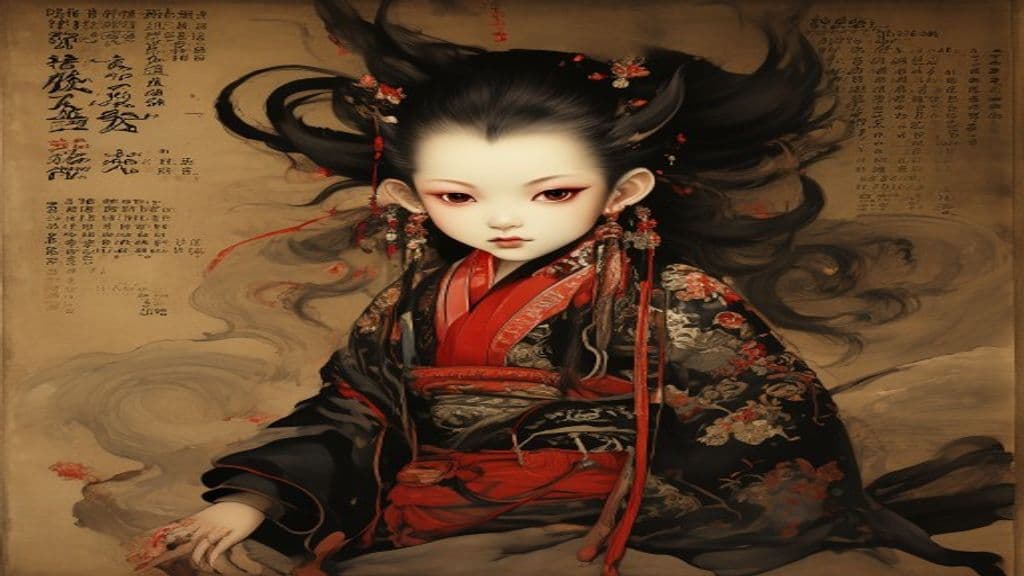
In classical Chinese texts cited in the sources, mōryō appear as a class of animate non‑human beings associated with landscape and with the dead; the Huainanzi furnishes a physical description while the Compendium of Materia Medica (Bencao Gangmu) supplies behavioral notes linking them to corpses. Japanese folkloric usage absorbs and adapts these Chinese descriptions: by the Edo period mōryō appears in anecdotal collections (e.g., Mimibukuro by Negishi Shizumori) where the term is applied in accounts of corpse‑stealing and other uncanny occurrences. The term functions as a flexible collective category rather than a single uniform entity across periods and sources.
A Classical Chinese description preserved in cited sources (Huainanzi) says mōryō have the shape of a three‑year‑old child, are dark red in color, have red eyes, long ears, and beautiful hair. Compendial texts summarized in the sources focus less on visual detail and more on behavior (for example, corpse‑eating) rather than providing alternate standardized appearances.
According to the Compendium‑derived summary cited in the sources, mōryō are said to 'like to eat the innards of the dead' and to go underground to consume the brains of corpses; this behavioral characterization underlies later Japanese conflations of mōryō with corpse‑stealing yōkai. Japanese anecdotal material (Edo‑period Mimibukuro) uses the label in stories of corpses disappearing at funerals. The sources do not provide evidence of cosmic or deity‑scale powers; descriptions emphasize grave‑afflicting and nature‑tied agency.
Weaknesses
- substanceoak (pressing oak to the neck kills mōryō)
- otherfear of tigers (recorded as a trait in Compendium summary)
Wards
- substanceoak (Compendium of Materia Medica notes oak can kill mōryō; the sources record this as a vulnerability rather than a documented ritual use)
- symboltiger imagery or invocation (sources record mōryō are fearful of tigers; no prescribed ritualic use is given in the provided materials)
Mātaatua
A legendary voyaging canoe in Māori tradition, sent from Hawaiki to bring supplies of kūmara (sweet potato) to Māori settlements in New Zealand. (Note: - Power tier: Reduce to Greater (powerful regional) as there is no indication that it's on a cosmic or deity-level in the source material. - Sensory cues: Specify what is meant by "strong sense of anc)
Māui
Mythological culture hero and demigod from Māori tradition, credited with slowing down the sun. (Note: - Power tier should be Lesser (not Primordial), given Māui's described abilities are consistent with a local spirit or powerful regional entity, rather than cosmic. - No physical description exists in)
Māui
Māui is a Polynesian culture hero and trickster figure, presented in many island traditions as a demi-divine ancestral transformer whose exploits (for example, acquiring fire and lengthening the day) explain key natural and cultural features. He is rarely the object of sustained worship and appears with varying parentage, status, and episode details across regional traditions.
Māui-tikitiki-a-Taranga
Māui-tikitiki-a-Taranga is a Māori culture hero, demigod, and trickster renowned in Māori and wider Polynesian tradition for his cleverness and extraordinary deeds. His name links him genealogically to his mother Taranga (tikitiki = 'topknot') and he is also called Māui-pōtiki (the youngest). Sources describe him as possessing superhuman strength and the ability to shapeshift into animals such as birds and worms.
Māyā Sītā (Chāyā Sītā)
Māyā Sītā or Chāyā Sītā is an illusory substitute for the goddess-heroine Sītā found in later Purāṇic and bhakti retellings of the Rāmāyaṇa. Created within the epic world by divine agency (often Agni or Rama), she functions as an ontological replica who endures the abduction and captivity in Sītā’s stead in order to preserve the real Sītā’s purity and to reconcile devotional concerns about Rama’s and Sītā’s reputations.
Mīšaru
Mīšaru is the Mesopotamian divine hypostasis of justice and rectitude. Named from the Akkadian root ešēru, he functions both as the abstract concept of correct rulings and as an active cultic deity invoked in temple worship, divination, and state ritual lists across Mesopotamia.
Mṛtyu
Personification of death in Hindu tradition, often associated with Mara and Yama. (Note: - Power tier: Primordial may be an overestimation; although Mṛtyu is associated with deities like Mara and Yama, its specific role as personification of death implies a more local or regional power le)
Mẫu Thượng Ngàn
Ruler of the Forest Palace among the spirits of the Four Palaces in Vietnamese indigenous religion. (Note: - Power tier should be Greater (powerful regional), not Primordial (cosmic). - Appearance is missing from the source material. - Abilities could be more specific and detailed based on her role as rule)
Mụ bà (Mười hai Bà mụ)
A collective of twelve female tutelary figures in Vietnamese folk religion who act as midwives and household guardians of newborns, responsible for teaching infants early life skills and auspicious traits. They are ritually acknowledged in some regions at a special ceremony when a baby is one month old.
Na Tuk Kong (Datuk/Datuk Gong)
Na Tuk Kong, commonly called Datuk or Datuk Gong, are place-bound guardian spirits venerated in parts of the Malay Peninsula and nearby areas. Practised mainly among overseas Chinese communities in Malaysia and Singapore, the cult blends Malay animistic/keramat practices with Chinese folk-religious forms and honours individual local guardian presences tied to particular features of landscape or neighbourhood.
Naaga
Naaga is not attested in the provided sources as a folkloric or supernatural being; the name appears only as a modern proper noun used for a 2003 Telugu film, an organizational acronym (NAAGA) in a media segment, a film-certificate entry, and as a music track title.
Naale Baa
Naale Baa (Kannada: ನಾಳೆ ಬಾ, Nāḷe Bā, lit. 'Come Tomorrow') is a vernacular Karnataka urban and rural legend about a night-roaming malevolent spirit or witch that approaches houses, often calling at doors in the voices of kin to lure occupants outside. The principal popular preventive measure is to write the phrase "Naale Baa" on doors and walls so the being will allegedly read it and defer its visit.
Community Record
- [1]Mōryō — Wikipedia (summary of Huainanzi and Compendium of Materia Medica; Edo‑period anecdotes). Wikipedia: Mōryō (articles summarizing classical Chinese descriptions in the Huainanzi and Compendium of Materia Medica and Japanese folkloric uses including Mimibukuro anecdotes)wiki
- [2]Mōryō — Wikidata. Wikidata: Mōryō (structured data entry linked to articles on mōryō / 魍魎)wiki