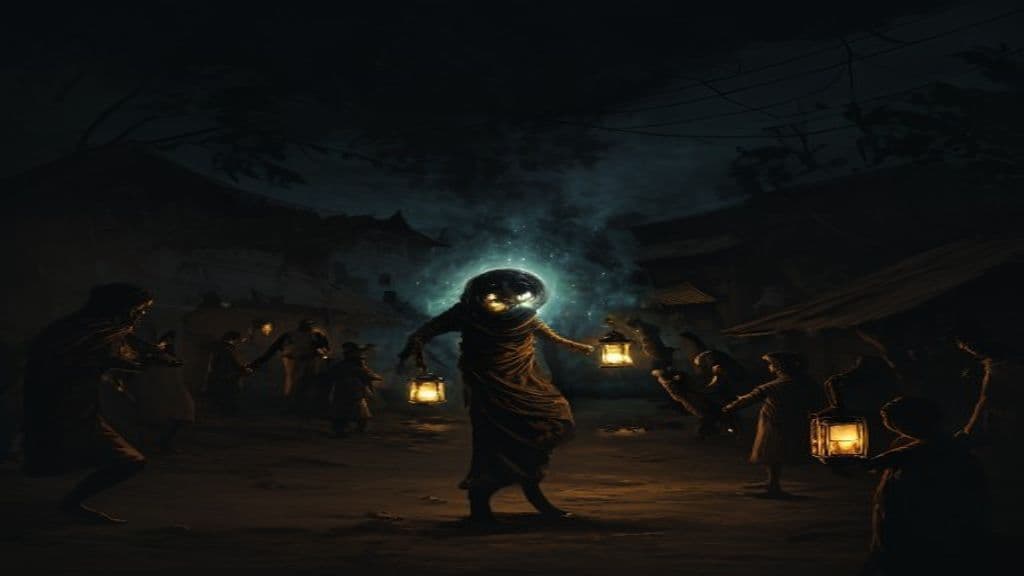
In the summer of 2002, reports began emerging from villages in eastern Uttar Pradesh of a mysterious entity attacking people at night — scratching or burning their faces while they slept or sat in darkness. The descriptions varied: a glowing object, an insect of unnatural size, a small humanoid figure.
Within weeks the panic had spread across hundreds of villages. Power outages intensified the fear. Vigilante groups formed to hunt the entity. Several people — suspected of being the Muhnochwa in human disguise — were beaten to death by mobs. The Indian government dispatched scientific investigation teams; their findings pointed to insects, nervous system responses to fear, and mass suggestion, but the entity had already embedded itself in folk memory.
Witnesses described several incompatible forms: a glowing orb the size of a cricket ball, a dark insect with metallic wings, a small dark hand reaching from shadow. The inconsistency of descriptions is itself considered significant — either pointing to mass hysteria or to a shapeshifting entity.
Scratches found on victims were real and documented by medical examiners. Whether their cause was supernatural, insect, or self-inflicted in panic remains contested.
The Muhnochwa's attacks are short and sharp — a brief contact leaving three or four parallel scratches on the face, neck, or hands. Victims report no warning and no pain at the moment, discovering the marks only afterward.
Its most potent weapon proved to be fear itself: once the hysteria reached a critical mass, sightings self-propagated through communities with no further stimulus required.
Weaknesses
- substanceBright light — the entity was never reported under electric illumination
Wards
- conditionStaying indoors with lights on
Agiya Baital
The fire-form of the Vetala — a cremation ground spirit of UP and Bihar that manifests as a wandering flame rather than a corpse-inhabitor, leading night travellers off roads and into marshland or flames with a dancing fire that seems always just ahead.
Bhunni
The female guardian-spirit of agricultural fields in Bihar and eastern UP — her presence ensures fertile soil and good harvest, but she is territorial and punishes those who plough without permission, steal crops, or use chemical methods that poison the soil she inhabits.
Brahmpret
The ghost of a Brahmin who died before fulfilling his dharmic obligations — more powerful than any ordinary preta, the Brahmpret retains Sanskrit learning, ritual authority, and the capacity to curse. The most feared ghost-class in North Indian villages.
Kachcha Kalwa
North Indian spirit of those who died 'raw' — violently, accidentally, or before their destined time. Unable to rest, the Kachcha Kalwa attaches to survivors and causes a trail of accidents, illness, and misfortune until properly appeased through rites at the site of death.
Kshetrapala
Fierce guardian deity of fields, village boundaries, and agricultural territory — an aspect of Shiva or Bhairava who punishes trespass with epidemic illness and crop failure. Every North Indian village once had a Kshetrapala shrine at its boundary stone; his is the first rite performed before plowing season.
Mahapreta
The 'great ghost' — in Bihar and UP folk classification, a Mahapreta is a preta of exceptional power, born from a death involving multiple injustices simultaneously: wrongful killing, incomplete rites, and unresolved family debt combined. It commands lesser spirits and can cause harm across an entire lineage.
Masaan
Cremation ground spirit of North India — born from improperly conducted last rites, the Masaan haunts funeral pyres and can possess the living, causing wasting illness. Referenced in classical Ayurvedic texts and the subject of the acclaimed 2015 film.
Nathiya
Ghost of a young bride who died before her first Diwali as a wife — still wearing her wedding nose ring (nath), she haunts the marital home she never truly inhabited, causing illness in subsequent brides and making the household unwelcoming to new marriages.
Pandubba
The 'water-drowner' of UP and Bihar — a jal pret (water ghost) that lurks in wells, ponds, and river bends, grabbing the ankles of swimmers and washing those who lean over still water. The most feared water-edge presence in Bhojpuri folk belief.
Mr. Tumnus
A faun of Narnia who befriends Lucy Pevensie, hesitates to obey the White Witch's orders, is arrested and petrified under her rule, and is later restored by Aslan and serves as a royal adviser to the Pevensies.
Mtskhetos
Epic hero and legendary founder of the city of Mtskheta in Georgian mythology, son of Kartlos. (Note: - Power tier: Minor Spirit (since there's no indication of deific or powerful regional abilities) - Abilities and behaviors: lack of specific information on his abilities and behaviors means they shou)
Mujina (貉)
A Japanese folkloric shapeshifting creature associated with badger-like and tanuki-like animals; classed among yōkai, mujina perform transformations, illusions, and pranks, and in some tales repay kindness or enact retribution when harmed.
Community Record
- [1]The Muhnochwa Panic of 2002. Bartholomew, R.E. & Wessely, S. (2002). Protean nature of mass sociogenic illness: From possessed nuns to chemical and biological terrorism fears. British Journal of Psychiatry, 180(4), 300–306.academic
- [2]Muhnochwa — Wikipedia. Wikipedia contributors. Muhnochwa. Wikipedia, 2024.wiki