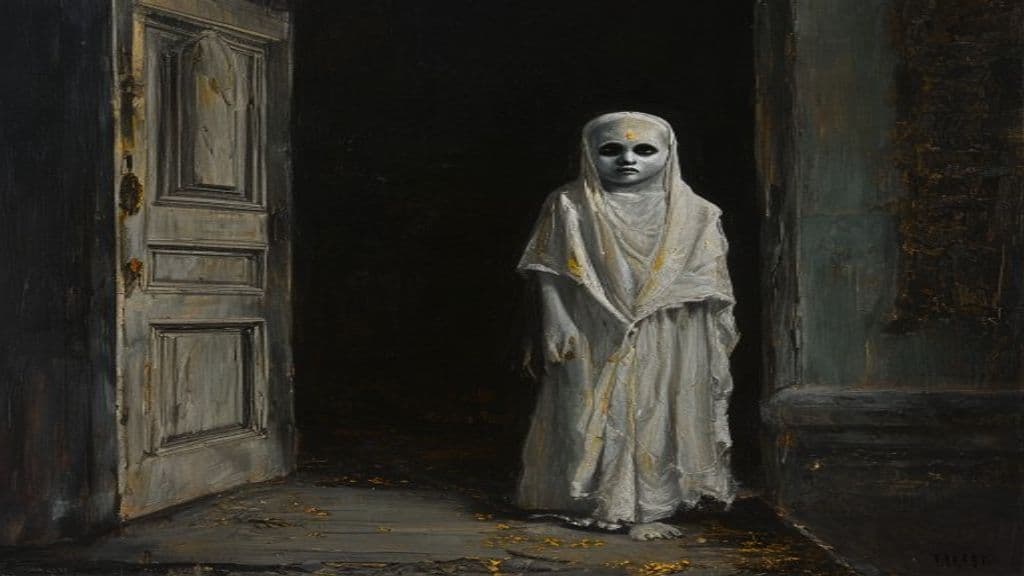
In Konkani and Marathi tradition, a boy who dies before his Munja — the sacred thread ceremony (upanayana) that marks his entry into adult religious life — cannot complete the crossing into the afterlife. He is a soul suspended between states: no longer a child, never granted the rites of a man.
Without the thread, he cannot be received among the ancestors. He lingers near his family home, drawn to warmth and food, often attaching himself to a living relative — most often a maternal uncle — who unconsciously carries him forward through life.
Munjya typically manifests as a small boy of the age he died, wearing the white dhoti prepared for the Munja ceremony he never received. His forehead bears the turmeric and sandalwood paste marks applied in preparation for the rites.
He is rarely frightening in form — more pitiable. His eyes hold a confused longing. He may appear in dreams before revealing himself in waking life.
Munjya can cause minor chaos in a household — souring milk, hiding objects, pulling at sleeping relatives. He is not malicious so much as desperately attention-seeking. If acknowledged and given offerings of food, he becomes protective of his chosen family member.
He possesses a child's cunning and the ability to move between the living world and the liminal space of the unresolved dead.
Weaknesses
- ritualPosthumous Munja ceremony
Wards
- substanceTurmeric and rice offering at the threshold
- ritualNaming the spirit and speaking to it directly
Community Record
- [1]Konkani Folk Belief and Ritual Practice. Pereira, R. (1997). Folk traditions of the Konkan coast. Goa University Press.academic
- [2]Munjya (2024 film) — cultural notes. Wikipedia contributors. Munjya. Wikipedia, 2024.wiki