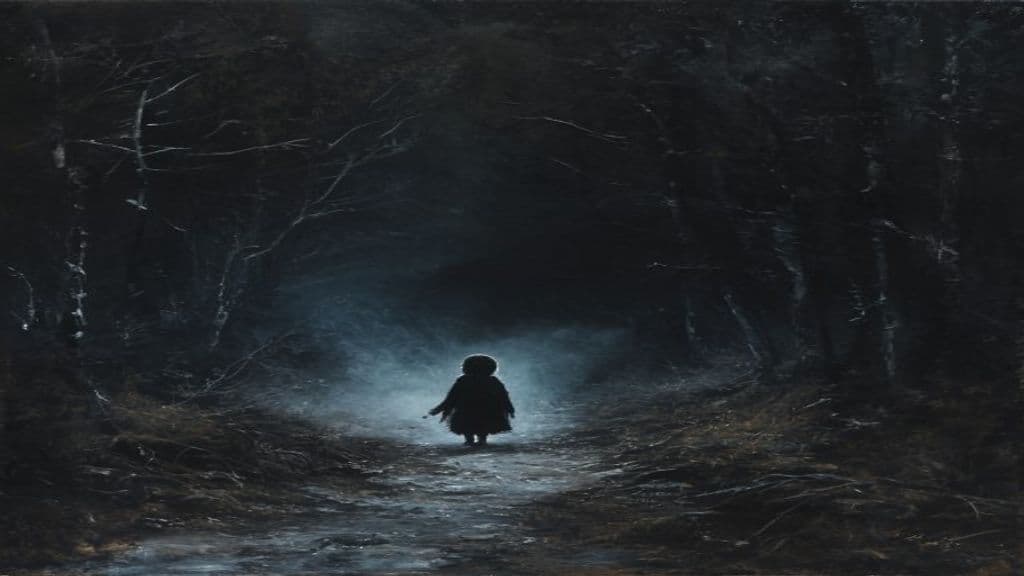
A myling (Swedish) or utburd (Norwegian, meaning 'carried-out one') is the spirit of an infant who was killed or abandoned before baptism. The spirit would follow travelers at night, jumping on their backs and growing heavier with every step until the carrier collapsed and died. The only release was burial in consecrated ground.
Appears as a small child, sometimes visible, sometimes only felt as an increasing weight. May manifest as a crying sound in the forest. Some accounts describe it as glowing faintly or visible only as a small light in the distance.
Could leap onto a traveler's back and increase in weight to crush them. Its crying could lead searchers astray into bogs and drowning. In some accounts it could call out the name of a potential carrier and compel them to carry it to a churchyard.
Weaknesses
- ritualCarrying it to consecrated ground and burying it properly
- mantraSpeaking its name (if known)
Wards
- ritualNever traveling alone at night past sites of abandonment
- symbolBaptismal cross worn on person
Ancient Kings of Finland
In early literary sources, the Ancient Kings of Finland are described as hypothetical or mythical monarchic systems associated with ancient Finland. (Note: 1. Power tier: Lower to Primordial (given the lack of specific abilities and behaviors) 2. Abilities and behaviors are described as 'generally vague', so this section should be reworded or removed 3. )
Household deity
A household deity is a deity or spirit that protects the home and its members, cared for inside domestic spaces and integrated into everyday household ritual. The category spans distinct cultural instantiations — hearth goddesses, ancestral family kami, and animistic house-spirits — and is characterized by reciprocal relations of offering and protection rather than cosmic sovereignty.
Huldra
A seductive forest spirit of Scandinavian folklore — beautiful from the front but with a cow's tail or hollow back — who lures men into the wilderness, sometimes to their ruin.
Nisse (tomte / tomtenisse / tonttu)
A Scandinavian household and farmstead spirit tied to a particular homestead; a small, human‑like custodian who performs chores, protects livestock and property in return for annual ritual food offerings (notably Yule porridge), and who can become dangerous if offended or neglected.
Näcken
A shape-shifting water spirit of Scandinavian lakes and rivers who plays enchanting violin music to lure the unwary to drown, often appearing as a beautiful man or white horse.
Mutya (TV series character)
Mutya is a fictional child mermaid character from a 2011 Philippine television drama who is portrayed as the love child of a human woman and a prince of an underwater kingdom; the narrative emphasizes her liminality between human society and a seaworld royal realm rather than a traditional folkloric ontology.
Mušḫuššu
The Mušḫuššu (Sumerian MUŠ.ḪUŠ; Akkadian mušḫuššu) is a named Mesopotamian hybrid creature — a composite serpentine monster — attested in Sumerian and later Babylonian art and myth. It functions primarily as a sacred emblem and mythic adversary-turned-attendant of major gods (notably Marduk) and appears in cultic, monumental, and astral contexts (e.g., the Ishtar Gate and the Bašmu/Hydra constellation).
Mycene
Mycene (Greek Mykēnē) is an eponymous female figure in Greek myth identified as a daughter of the river-god Inachus and the wife of Arestor. She is presented in the tradition as the naiad or local woman who gives her name to the city of Mycenae and functions as a place-bound genealogical figure rather than a universal deity.
Mydon
Mydon is a mortal warrior-figure named in the corpus of ancient Greek epic, attested as a defender of Troy in the Iliad. He appears only briefly in the surviving summaries and reference entries as a named casualty, and may represent one or more minor Homeric combatants who share the name.
Mynes
Mynes is a name applied to at least two mortal figures in Greek myth: a king of Lyrnessus slain by Achilles in the Trojan-cycle tradition (husband of Briseis), and a Lacedamonian genealogical figure recorded as father/ancestor in early Athenian genealogies (father of Pedias). He is a human/mythical mortal rather than a supernatural being.
Myrine (Myrina, Myrinna)
Myrine (variants Myrina, Myrinne, Myrinna) is a personal name attested in ancient Greek mythic tradition applied to several distinct women — including an Amazon queen, a possible eponym for the city of Myrina on Lemnos, a woman buried in the Troad mentioned in the Iliad, and a priestess of Aphrodite who was said to become a myrtle tree. The string also appears in modern contexts (fictional characters, corporate names, and a taxonomic genus) but these are non-mythic usages of the name.
Myrtilus
Myrtilus is a heroic figure in Greek myth, known as the charioteer of King Oenomaus of Pisa and commonly described as a son of Hermes. He sabotaged Oenomaus's chariot, causing the king's death; Pelops then threw Myrtilus into the sea, and the dying charioteer pronounced a curse that, in tradition, haunted Pelops' descendants. His body was said to have been recovered and honored at a sanctuary of Hermes, and local topography and stellar identifications (Myrtoan Sea, a taraxippus at Olympia, and a later association with the constellation Auriga) are recorded as variants.
Community Record
- [1]Swedish Legends. Afzelius, Arvid August. 1839. Swenska Folkets Sago-Häfder. Stockholm.folk
- [2]Restless Dead. Lecouteux, Claude. 2011. The Return of the Dead. Inner Traditions.academic