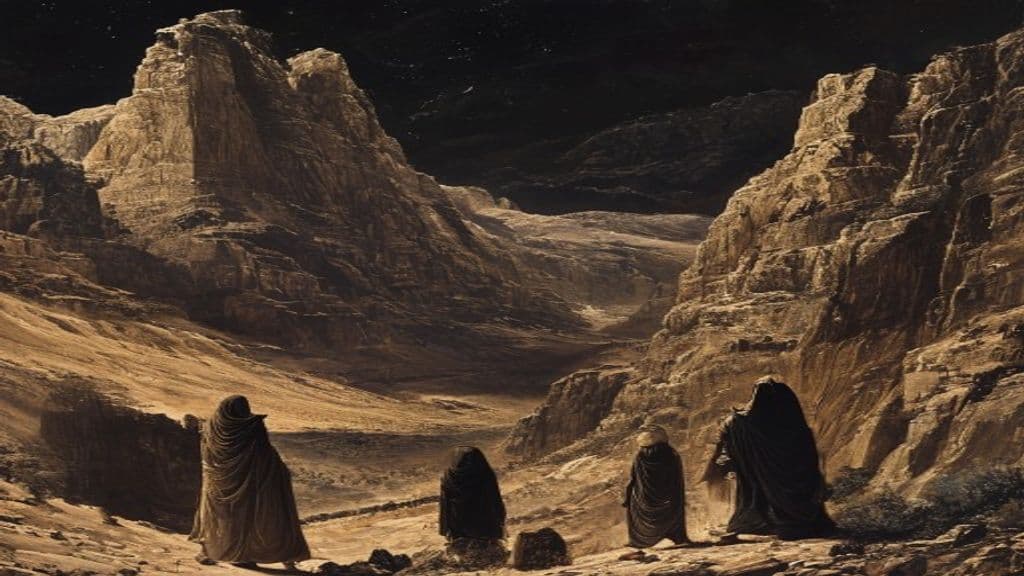
The Nabateans established their kingdom in the third century BCE, and their religious practices were shaped by the cultural exchange with neighboring civilizations. The region's unique geography, marked by mountains, oases, and trade routes, contributed to the development of a distinct polytheistic tradition.
Due to their aniconic worship practices, images or depictions of Nabataean gods may not exist or be nonexistent.
The Nabateans believed in multiple local gods and deities with various roles, but specific abilities are unknown. They performed sacrifices and conducted rituals to appease these deities.
Frankish Paganism
A polytheistic tradition that evolved among the Franks until the 7th century, influenced by Germanic and Greco-Roman components. (Note: - Remove "Minor Spirit" power tier (inconsistent with polytheistic tradition and influence from Greco-Roman components) - Summary should include Frankish paganism's decline and eventual replacement by)
Mẫu Thượng Ngàn
Ruler of the Forest Palace among the spirits of the Four Palaces in Vietnamese indigenous religion. (Note: - Power tier should be Greater (powerful regional), not Primordial (cosmic). - Appearance is missing from the source material. - Abilities could be more specific and detailed based on her role as rule)
Mụ bà (Mười hai Bà mụ)
A collective of twelve female tutelary figures in Vietnamese folk religion who act as midwives and household guardians of newborns, responsible for teaching infants early life skills and auspicious traits. They are ritually acknowledged in some regions at a special ceremony when a baby is one month old.
Na Tuk Kong (Datuk/Datuk Gong)
Na Tuk Kong, commonly called Datuk or Datuk Gong, are place-bound guardian spirits venerated in parts of the Malay Peninsula and nearby areas. Practised mainly among overseas Chinese communities in Malaysia and Singapore, the cult blends Malay animistic/keramat practices with Chinese folk-religious forms and honours individual local guardian presences tied to particular features of landscape or neighbourhood.
Naaga
Naaga is not attested in the provided sources as a folkloric or supernatural being; the name appears only as a modern proper noun used for a 2003 Telugu film, an organizational acronym (NAAGA) in a media segment, a film-certificate entry, and as a music track title.
Naale Baa
Naale Baa (Kannada: ನಾಳೆ ಬಾ, Nāḷe Bā, lit. 'Come Tomorrow') is a vernacular Karnataka urban and rural legend about a night-roaming malevolent spirit or witch that approaches houses, often calling at doors in the voices of kin to lure occupants outside. The principal popular preventive measure is to write the phrase "Naale Baa" on doors and walls so the being will allegedly read it and defer its visit.
Naamah
Naamah is a name attested in the Hebrew Bible for several mortal women and later reworked in Jewish mystical and folkloric literature as a feminine supernatural figure associated in Zoharic material with the archangel Samael and with erotic/nocturnal motifs; in some later traditions she is linked with unions to angelic or fallen figures that produce classes of spirits (shedim/sedim).
Naberius
Naberius is a marquis-ranked spirit in the Western grimoral/Goetic tradition (Lesser Key of Solomon) described as commanding legions and teaching arts—especially rhetoric—and associated with restoring or (in one source) removing honors. He appears in canine and corvine forms and is catalogued among early modern demonological lists.
Nabu
Nabu is the Mesopotamian deity of writing, scribes, wisdom, and the rational arts; a divine scribe and announcer who records destinies, serves as an oracle, and is identified with the planet Mercury in Babylonian astrological tradition.
Nacht-Alb
A German-language folkloric night-being invoked in older parlance to explain sudden nocturnal terror in children; described in archival material as a fabled visitor that frightens sleeping children and is associated with what modern medicine calls pavor nocturnus.
Nachzehrer
A German revenant who gnaws its own shroud in the grave while draining the life-force of surviving family members, causing them to waste away one by one.
Naga
Divine serpent beings of Hindu, Buddhist, and Jain cosmology — powerful guardians of water, earth, and underground treasures. Revered as deities in South and Southeast Asia.
Community Record
- [1]Nabataean Religion. Wikipediawiki