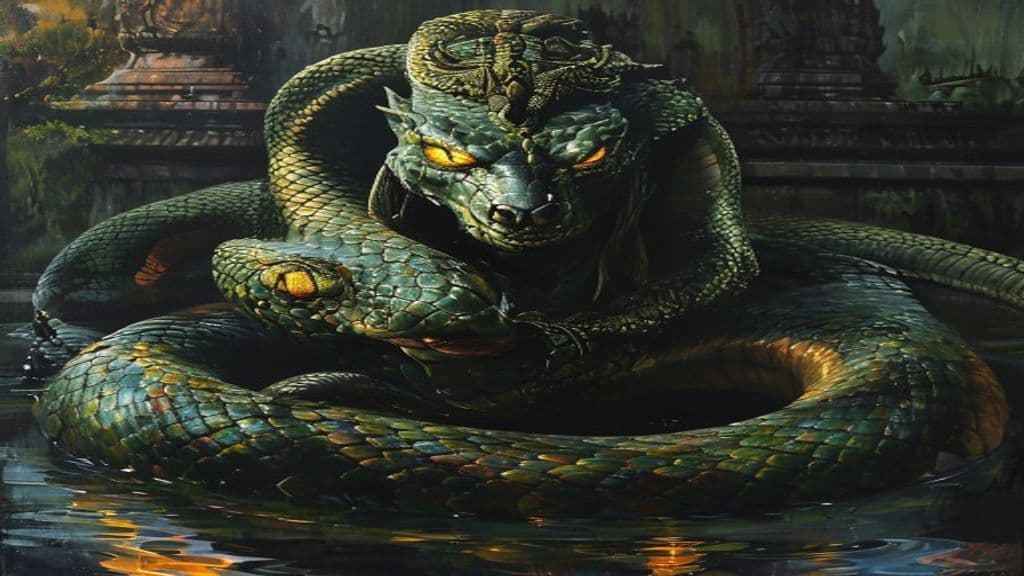
Born from the great sage Kashyapa and his wife Kadru, the nagas are among the earliest beings in the cosmos. Their king Shesha holds the world on his thousand hoods; Vasuki served as the churning rope of the cosmic ocean.
Human from the waist up, serpent below. In full serpent form, a massive cobra with a jeweled crest. The hood spreads wide and is marked with divine patterns. The most powerful have multiple heads.
Control over rain, rivers, and fertility. Guard vast underground treasures. Can grant boons or curses of great potency. Their poison can kill or cure. Serve as cosmic guardians of the underworld realms.
Weaknesses
- mantraGaruda Mantra (their ancient enemy is Garuda the eagle)
Wards
- ritualNag Panchami — milk offerings and prayers to naga deities
- substanceMilk and turmeric offered at anthill

नवग्रह शांति (Navagraha Śānti)
Navagraha Shanti is a Hindu/Jyotisha-related shanti (appeasement) ensemble of practices aimed at propitiating the nine planetary deities (navagraha) to obtain peace and prosperity and to mitigate adverse planetary influences (kundali dosha). It appears in temple, household, and specialist priestly contexts and may be performed as puja, homam, yantra energization, or accompanied by dana.
Hindu · South Asia (India and Sri Lanka; regional variants documented)

Upanayana / Yajnopavita (यज्ञोपवीत, yajñopavīta)
Upanayana (yajnopavita, the sacred thread ceremony) is a Hindu initiation or investiture rite traditionally associated with beginning Vedic study. The supplied source excerpt discusses nāga beliefs and long-standing nāga-related rituals in South Asia but does not describe Upanayana procedures or link the sacred thread ceremony to protections against nāgas.
Hindu · South Asia
Community Record
- [1]Nagas: The Ancient Ones. Sivaramamurti, C. 1967. Nagas in Indian Art. National Museum of India.academic
- [2]The Mahabharata. Vyasa. c. 4th century BCE. Mahabharata. (Ganguli, K.M., trans. 1896)literary