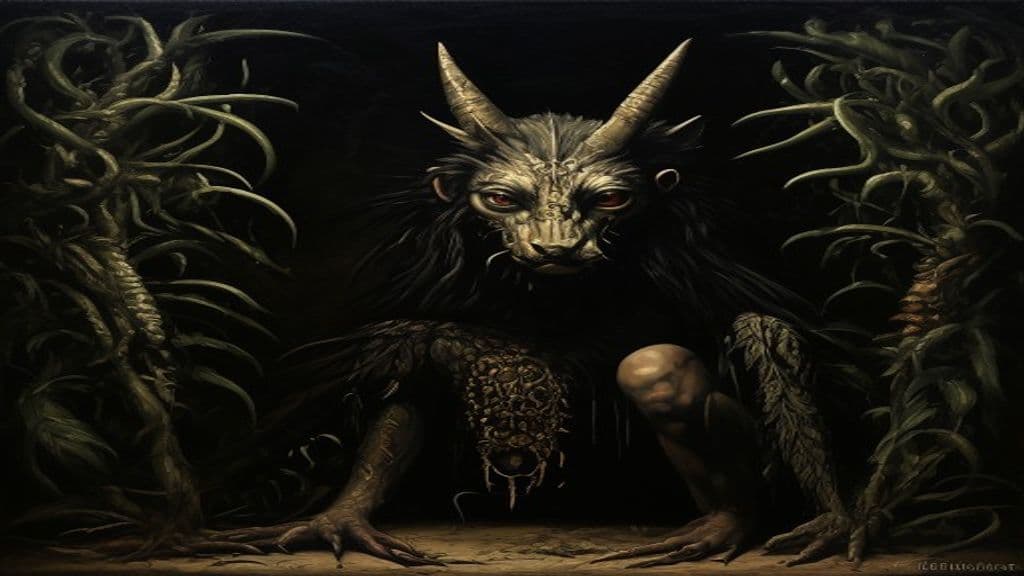
The provided sources do not record a single origin myth for the nahual. Within the same Mesoamerican cosmological framework referenced in the sources, the nahual concept is embedded in tonalism: individuals are understood to have a linked animal aspect (tonal) and the practice or capacity called nagualism involves accessing that tonal connection to gain power and spiritual insight. The available materials describe this cosmological linkage as the mechanism by which humans relate to animal counterparts but do not supply a fuller mythic genealogy or creation narrative.
Source material gives a functional rather than fixed visual description: a nahual appears as an ordinary human in daily life and, when shapeshifted, appears as the specific animal that is their tonal counterpart. The supplied notes do not list particular animal forms or a standardized visual stereotype; they emphasize variability by account and region. No definitive catalogue of animal types or consistent transformed appearance is provided in the cited materials.
The primary ability documented in the sources is shapeshifting: a nahual is a human being who can assume the form of their tonal animal counterpart. Nagualism is specifically tied to the belief that one can access power and spiritual insight by connecting with that tonal animal within. The provided sources do not enumerate additional supernatural powers, standardized moral behaviors, or consistent community roles, and they note that practices and prominence vary by locality and account.
Nagual (Maya tradition)
A human shapeshifter in Maya tradition who transforms into their tonal animal counterpart. (Note: - Power tier: Greater (not Ancient, as it's regional rather than deity-level) - Sensory cues: unknown (according to source material, not explicitly stated) - Weaknesses: no information provided - Ward)
Naga (water deity) — Buddhist tradition
The provided source treats Nagas as members of the general category "water deities": mythological beings associated with bodies of water such as seas, great rivers, springs, and wells. The excerpt does not supply tradition-specific origins, physical descriptions, or detailed functions for Nagas in Buddhist texts.
Naga People (Lanka)
A class of super-humans inhabiting a subterranean world in Sri Lankan tradition, often depicted as serpents. (Note: 1. Power tier should be Primordial instead of Ancient, given their association with serpent symbolism and cosmic significance in Sri Lankan and Indian mythology. 2. Add sensory cues based on source ma)
Naga fireball (Bang Fai Phaya Nak)
A seasonal luminous phenomenon observed along the Mekong River, locally attributed to phaya nak (giant river serpents, Nāga) and described as glowing reddish balls that rise from the water and disappear after ascent. Scientific and skeptical commentators characterize it as an atmospheric/visual phenomenon and advance alternative explanations such as tracer rounds, flare guns, marsh gases, or plasma-like effects.
Nagam / Naagam (lexical attestation)
The string 'Nagam' or 'Naagam' appears in the provided sources as a toponym, personal name, and media title; the supplied materials do not document a serpent deity, supernatural being, or folk-belief content for 'Nagam' in South Indian tradition.
Nagin
Nagin refers in the supplied sources to the female form of the South Asian serpent-being (Nāginī / Nagini) and to popular-media uses of that figure (film and television). Sources identify Nāginī as the feminine form of Nāga, note a locally worshipped form (Nagini or Naiṇī Devī) in the Central Himalaya, and link the term to folkloric shape‑shifters called Ichchadhari Nāgas as well as to multiple cinematic and television adaptations.
Nagini (Nāginī / Nāgnī / Naiṇī Devī)
Nāginī denotes a female member of the Naga, a class of semi-divine serpent beings in Indian religion and mythology. The form Nāgnī or Naiṇī Devī is recorded as the name of a serpent goddess worshipped in the valley of the Pindar river in the Indian Himalaya. The lexical form also appears in unrelated modern usages listed on the same disambiguation page.
Naiad
A class of female nature-spirits in ancient Greek religion whose being is bound to particular bodies of fresh water (springs, wells, fountains, streams). Naiads are local, embodied presences venerated in community cults and invoked in rituals of purification, healing, and life-cycle events, yet they may also act harmfully toward humans.
Naimiṣāraṇya (forest)
Sacred forest in Hindu tradition, mentioned in major epics like the Ramayana and Mahabharata. (Note: 1. Summary needs clarification that it's specifically mentioned in Hindu epics, not "major epics" which could be misleading. 2. Power tier should be Primordial or Ancient, as a sacred forest mentioned)
Naka moli
A term attested in an archive discussion of Lahaina (Malu'ulu o Lele) that appears associated with the place's cultural significance; the supplied sources do not define the term or describe it as a specific supernatural being. The only direct textual evidence in the provided material is the phrase "the Naka moli" linked to Lahaina and to a statement that the place "is rich in cultural traditions and history kept alive through generations."
Nakchhong
Nakchhong (नाक्छोङ) is the shamanic tribal priestly office of the Khambu Rai (Kirat) community. Serving as the main priest of the Sakela (Sakewa) shrine, Nakchhong functions as an intermediary between the living and ancestral/local spirits and leads seasonal rites such as Udhauli and Ubhauli.
Nala (Ramayana)
Nala is a named vanara (monkey-like being) in the Ramayana tradition chiefly credited as the architect-engineer who designed and supervised the construction of the Rama Setu (the bridge from Rameswaram to Lanka). He also participates as a warrior in the Lanka campaign; traditions vary over whether certain miraculous properties (stones floating) belong to Nala alone, to his brother Nila, or to both.
Community Record
- [1]Nahual. Wikipedia, 'Nagual' (accessed via provided research notes)wiki
- [2]Nahual (Wikidata entry noted in research materials). Wikidata entry referenced in research notes (not treated as a folkloric source for the nahual concept)other
- [3]Ep # 86: Edición # 10 del programa Melómanos por Radio TGD (archive reference to lexical occurrence). Archive.org item cited in research notes noting contemporary cultural use of the name 'Alux Nahual'; does not provide folkloric detailother