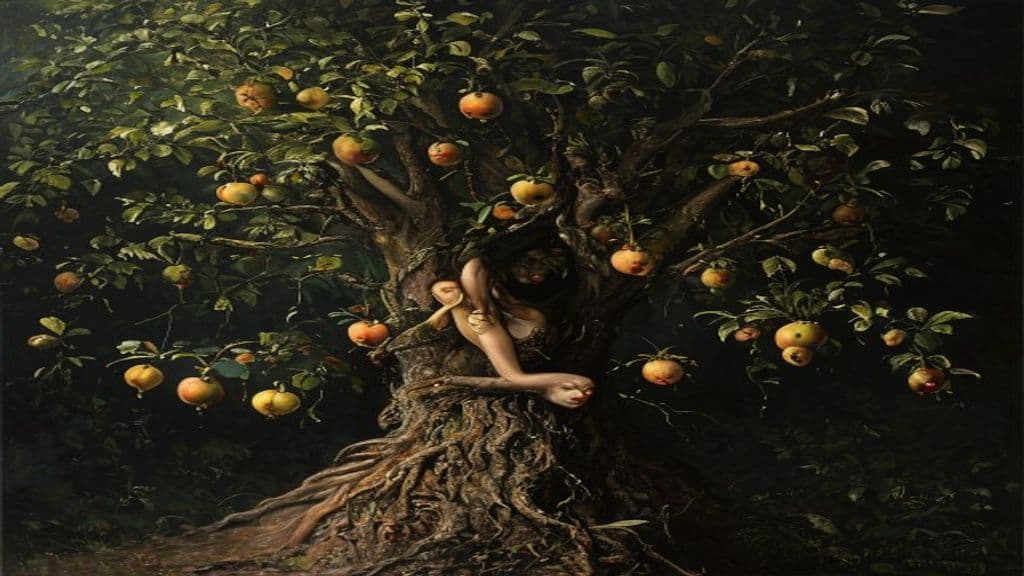
The Nariphon is a tree that appears in the Himaphan, a mythical forest. The exact origin of this entity is unclear.
The Nariphon takes on a human-like form, with its fruit being young female creatures attached by their head from the tree branches. The physical appearance of the tree itself is not described in detail.
There's no direct information about the abilities or behaviors of the Nariphon. However, Gandharvas (male beings in Buddhist mythology) cut the fruits and take them away, suggesting some interaction between these entities.
Nanna Tala
Nanna Tala is a sacred ancestral woman-figure associated with a perennial spring in the Nafusa (Western) Mountains of Libya. Treated as a holy woman and local ancestor, her burial-mound and the spring above it serve as a locus of pilgrimage, offerings, healing practice, and communal ritual that also registers moral or ritual correctness.
Nanook
Nanook is the Inuit name applied to the polar bear and, in Inuit religious descriptions, the spiritual master associated with bears who regulates human–bear relations, deciding whether hunters deserve success and punishing violations of hunting taboos.
Nanshe
Nanshe is a Sumerian/Mesopotamian goddess associated with marshes and the sea, the fishes and water‑birds of those biomes, and with divination (notably dream interpretation), social justice, and civic welfare. Her primary cult center was the city Nina (Tell Zurghul); she appears across a long Mesopotamian chronology from the Uruk period into the first millennium BCE.
Napakivi (Finnish)
A traditional Finnish name for a standing stone in the middle of a field. (Note: 1. Power tier should be Primordial (Natural feature fits within this category, as it's an unaltered aspect of the environment). 2. Add sensory cues: The unique shape or positioning of the stone may pr)
Naraka Yaksha (hellish Yaksha)
The term 'Naraka Yaksha' is not attested in the provided source; it would, hypothetically, denote a yaksha-like being associated with an infernal loka. The supplied material only discusses the general loka concept and does not document any specific entity called Naraka Yaksha.
Narantaka and Devantaka
Narantaka (narāntaka, 'destroyer of men') and Devantaka (devāntaka, 'destroyer of gods') are named asuras, sons of the rakshasa-king Rāvaṇa, who fight on Rāvaṇa's side in the Yuddha Kanda of the Valmiki Rāmāyaṇa. Their roles in the surviving sources are martial: Narantaka is slain by Aṅgada and Devantaka is killed by Hanuṃan’s mace in the epic war.
Nasnas
A half-human djinn creature of Arab folklore — possessing only half a face, one arm, one leg, and half a torso — descended from the union of a shaitan and a human, moving by leaping and highly dangerous to encounter.
Nastes
No folkloric or mythological evidence for an entity called 'Nastes' is present in the supplied sources; the token appears only as the title of contemporary electronic/industrial music tracks by the artist Subjected.
Nasu (Zoroastrianism)
In Zoroastrian cosmology, Nasu is a daeva associated with corpse matter and decay at a cosmic level. (Note: 1. Power tier should be Primordial (supported) but description needs clarification. 2. Clarify which abilities are described in the sources to ensure consistency. 3. Sensory cues and wards seem consis)
Nat
A nat (နတ်; nat) is a spirit-being venerated in Myanmar alongside Buddhism, encompassing deified humans and nature spirits. Nats form an institutionalized pantheon (notably the canonical 37 Great Nats) and function as village, household, lineage, and landscape guardians whose worship is expres sed through shrines, festivals, and mediumship.
Nathiya
Ghost of a young bride who died before her first Diwali as a wife — still wearing her wedding nose ring (nath), she haunts the marital home she never truly inhabited, causing illness in subsequent brides and making the household unwelcoming to new marriages.
Naubolus
Naubolus is a proper name attested in two distinct domains in the supplied sources: a modern zoological genus of South American jumping spiders and a mythographic personal name appearing in Greek genealogical lists (not portrayed as a supernatural being). The sources do not present Naubolus as a spirit, deity, or monster and provide no ritual or cultic material.
Community Record
- [1]