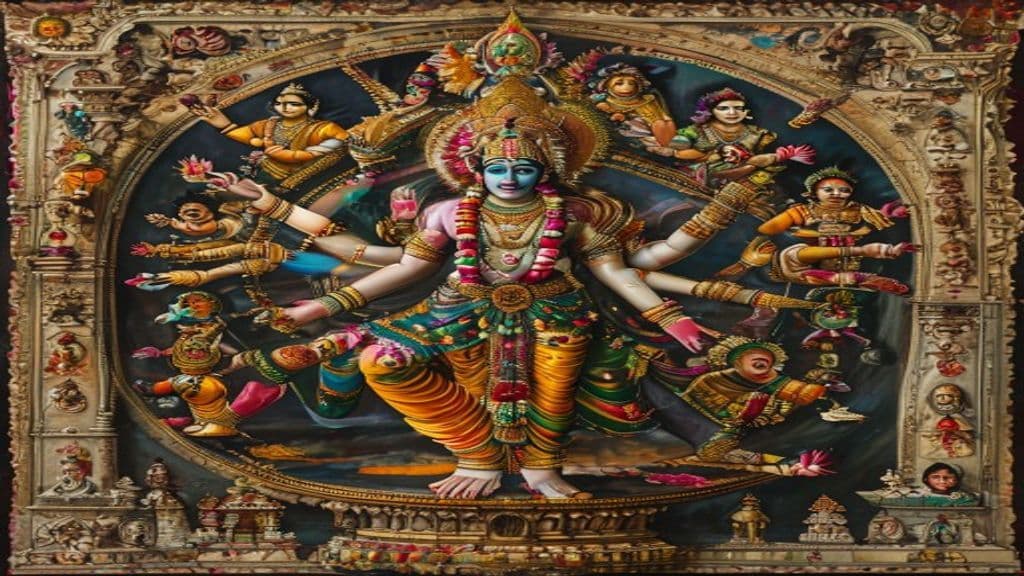
The term Navagraha combines nava ('nine') and graha (a term used for planets and literally glossed as 'seizer' or 'one who lays hold of'). Its conceptual formation draws on Vedic recognition of Sun and Moon and on later incorporation of planetary concepts; historical syntheses with Hellenistic, Babylonian and Indo‑Iranian astral ideas contributed to the full ninefold set. Rahu and Ketu, the two lunar nodes (chaya‑grahas or 'shadow' grahas associated with eclipses), were integrated into the canonical nine over a long process of cosmological development that reached medieval stabilization by around the early medieval period.
In ritual and temple art each graha is anthropomorphized with distinguishing attributes, colours, mounts (vahanas), arms and weapons; iconographic programmes developed from roughly the 5th–12th centuries CE. Typical motifs cited in textual and temple sources include Surya shown standing or seated in a chariot drawn by seven horses and holding lotuses (often wearing northern‑style boots and armour in classical depictions); Chandra riding a chariot sometimes pulled by an antelope or shown with a hare and carrying a lotus; Mangala (Mars) with a red complexion riding a ram and bearing a trident and mace; Shani (Saturn) depicted in dark blue or black; Rahu and Ketu depicted as the chaya‑grahas conventionally rendered in serpentine or partially dismembered forms (Rahu as a severed head and Ketu as a headless torso with a serpent tail). Regional variation exists (for example, South Indian Shaiva temple arrangements differ from North Indian lintel guardians) and full iconographic detail varies by period and locality.
Within Jyotisha the Navagraha are treated as causal agents in astrological theory: they 'rule' particular rasis (zodiac signs), govern domains of life, and preside over temporal regimes such as dashas (planetary periods). Traditional classification distinguishes natural benefics (for example Jupiter, Venus, Mercury and the waxing Moon in many schemata) and natural malefics (for example Mars, Saturn and the shadow planets, with variations including the Sun); adverse configurations are termed dosha. Beyond technical computation the grahas function as objects of worship and ritual propitiation—texts, stotras and homams address them to gain favor or mitigate harm—and they are embedded in temple practice, pilgrimage circuits and devotional music.
Weaknesses
- ritualGraha śānti practices (propitiatory rites to mitigate adverse influence)
- mantraNavagraha mantras and stotras (textual recitation used as remedial measures)
- ritualNavagraha Homam (fire ritual performed by a priest as a corrective rite)
- otherPilgrimage to Navagraha shrines / installation and worship in Navagraha mandapa (temple-based remedy)
Wards
- mantraNavagraha mantras and stotras (prescribed recitations listed in manuscript catalogues)
- ritualNavagraha Homam Puja (scheduled homam with priest and offerings shown in contemporary temple/priestly practice)
- ritualRegular temple worship and installation in Navagraha mandapa; visiting Navagraha temple circuits
- otherDevotional musical performance (Dikshitar's Navagraha kritis) used in propitiatory contexts
Adi (asura)
Adi is attested in modern reference works as the name of an Asura who 'appears in the Matsya Purāṇa.' Beyond this single-line citation in secondary sources, no descriptive material about the figure is provided in the supplied research notes.
Adi Shakti
Adi Shakti (also Adi Parashakti, Mahadevi, Adya Shakti) is the primordial feminine power in Hindu/Shakta theology, regarded as the ultimate reality (Para Brahman) and the source from which all goddesses and gods manifest. She is both an impersonal cosmic principle (Mulaprakriti) and a focus of devotional invocation in temples, mantras, and pilgrimage sites such as Shakti Peethas.
Adi Vinayaka
Adi Vinayaka (Ādi Vināyaka; also called Nara Mukha Vinayaka) is a named iconographic and devotional form of the Hindu god Ganesha portraying the deity with a human head, described in sources as the form before the episode of decapitation by Shiva. It is rarely worshipped and appears in a small number of South Indian shrines and in devotional/musical repertoires.
Aditi
Aditi is a major Vedic goddess in Hindu tradition who personifies the boundless, infinite cosmic principle and functions as the maternal matrix from which many celestial deities (the Ādityas and other groups) are born. In the Vedic hymns she is invoked as a protective liberator who guards petitioners, provides wealth and safety, and frees devotees from hindrances such as sin and sickness.
Agni
Agni is the Vedic personification of fire in Hindu tradition: a sacred, mediating principle that manifests as terrestrial fire, atmospheric lightning, and celestial sun, and that receives and conveys sacrificial offerings. Prominent in the Rigvedic corpus, Agni functions as sanctifier, witness of rites of passage, and a transformational inner principle in later Upanishadic literature.
Ahalya
Ahalya is a mytho-legendary woman of South Asian (primarily Hindu) narrative tradition, described as created by the god Brahma, married to the sage Gautama, seduced (or tricked) by Indra, cursed by her husband, and ultimately redeemed by Rama. Her tale is a locus for themes of creation, desire, curse/penance, and redemption and she is counted among the ritual-mnemonic panchakanya.
Aindri (Indrani / Shachi / Paulomi)
Aindri (commonly rendered in sources as Indrani, also called Shachi or Paulomi) is a Hindu goddess presented as the queen-consort of Indra. She is depicted in the available material as a courtly queen associated with beauty, pride and kindness who also appears in at least one account as an active martial participant in the devas' battles with asuras.
Akshayavata
In Hindu mythology, Akshayavata is a sacred banyan tree and/or lake that symbolizes eternal life. It is mentioned in both Hindu and Jain traditions and associated with the Puranas. (Note: - The power tier should be "Greater" or at least "Ancient", as it is associated with the Puranas, which are considered ancient texts. - No specific physical description is provided, but that doesn't m)
Alakshmi
Alakshmi is an inauspicious female supernatural figure in Hindu tradition, presented as the negation or shadow-counterpart of the prosperity-goddess Lakshmi. She personifies poverty, grief, jealousy and social discord and is managed in domestic ritual and festival practice.
Alamelu
Alamelu (also Alamelu Manga / Alarmel Mangai) is a South Indian devotional name for the goddess Padmavati, identified in sources as an avatar of Lakshmi and the consort of Venkateswara; the name is also used widely as a female personal name and in titles of cultural works in Tamil and Telugu contexts.
Amrita (Buddhist tradition)
In the context of Indian religions, particularly within Hinduism and Buddhism, Amrita is a divine elixir that grants immortality and eternal life. (Note: - Power tier should be Ancient (deity-level), not Primordial. - Origin story appears accurate but lacks specificity on when Amrita was first mentioned in the Rigveda; add more detail. - Abilities are )
Ananta (Infinite)
Ananta (Sanskrit: अनन्त, 'without end') is primarily an epithet of Vishnu and a symbolic principle of infinity that is personified as the cosmic serpent Shesha. In Puranic imagery Ananta/Shesha forms the multi‑headed couch and canopy for Vishnu as he rests on the cosmic waters between cycles of creation (pralaya), and thus underwrites cyclical cosmogenesis.
Community Record
- [1]Navagraha. Wikipedia entry 'Navagraha'wiki
- [2]Navagraha Mantra Navagraha Stotra (M‑1384) — Sarasvati Mahal catalogue / Ramtek collection. Catalogued manuscript listing: 'Navagraha Mantra Navagraha Stotra' (Kavikulguru collection)other
- [3]An Alphabetical Catalogue of the Sanskrit Manuscripts in the Sarasvati Mahal Library, Thanjavur — vol. 24. Sarasvati Mahal manuscript catalogue (Thanjavur)other
- [4]Navagraha temples. Wikipedia entry on Navagraha temple circuitswiki
- [5]The Navagraha Shrines of Tamilnadu (templenet). Templenet: description of the Tamil Nadu Navagraha circuit and temple arrangementsother
- [6]Navagraha Homam Puja (HTCC of KC). Contemporary temple/service page describing Navagraha Homam scheduling and item listsother
- [7]Navagraha (Dikshitar's Navagraha kritis). Collection and commentary on Dikshitar's Navagraha kritis (musical/devotional compositions)other
- [8]Hinduism StackExchange thread on graha incense/offering preferences. Contemporary devotional Q&A discussing offering traditions associated with grahasother
- [9]Mantra Jyotish (archival text in Bengali). Archival text relating mantra and astrological practiceother