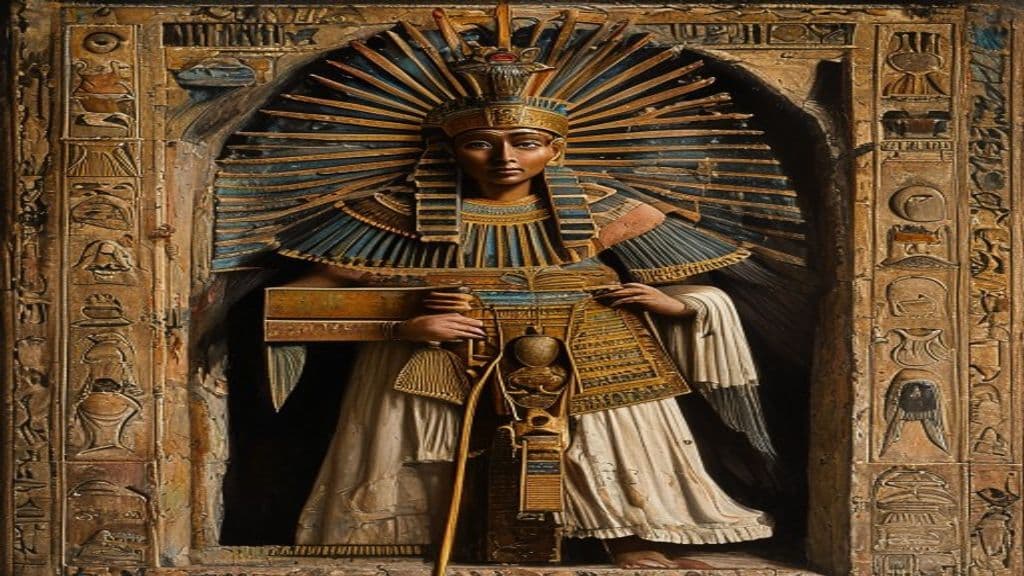
Nebethetepet is not recorded with an independent mythic origin in the supplied sources. In Heliopolitan cosmology she is described conceptually as the personified female principle through which the creator god Atum acts — in effect, Atum's 'hand' in the original creative act — rather than as a separate creator with a distinct narrative. Her name and functions place her within the family of Heliopolitan creator aspects and within the wider tendency in Egyptian religion to personify functional divine forces.
Attestations of Nebethetepet in material culture are limited. A menat counterpose object labels a small goddess beneath an elaborate light-shrine and depicts her wearing a sistrum-box-style crown with plant decoration; the object includes Hathor emblems (menat/aegis features, a winged sun-disk, frontal Hathor emblem and nearby seated cats). A late-period statue wearing a shrine-shaped sistrum sound-box crown has been variably identified as either Nehemet-aui or Nebethetepet, so that particular identification remains uncertain. Overall, iconographic links tie her visually to Hathor cult paraphernalia (sistrum, menat) but surviving representations are limited and partly ambiguous.
Sources describe Nebethetepet primarily as an aspect or personification rather than as an independently acting, miracle-performing deity. Her recorded functions are (1) personification of Atum's hand — the female creative principle enabling the original act of creation — and (2) association with offerings, reflected in her epithets 'Lady of the Offerings' or 'Satisfied Lady'. The supplied material records no independent myths, miraculous deeds, or narrated interactions with humans beyond her cultic and titular roles.
Atum
Atum is the primordial self-created deity of ancient Egyptian religion who emerges from the primeval waters (Nu) and brings forth the first gods. Associated with the primeval mound (benben) and the evening aspect of the sun, Atum functions as an origin and as a figure tied to funerary literature and royal afterlife ideology.
Hathor
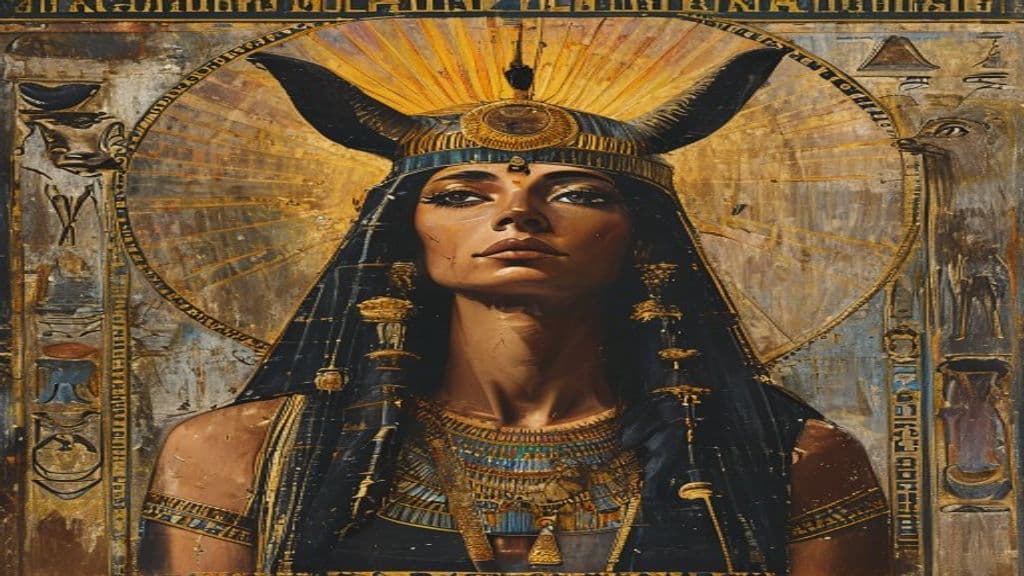
Hathor (Ancient Egyptian ḥwt-ḥr, 'House of Horus') is a major polyvalent goddess of ancient Egypt associated with the sky, maternal and royal motherhood, music, joy, fertility, and the Eye of Ra; she appears in multiple local manifestations and assisted the deceased into the afterlife.
Aani
Aani (ancient Egyptian jꜥnr) is the lexical term for the baboon in ancient Egyptian language and functions in religious contexts as an animal icon and theophoric epithet. Attested repeatedly in Egyptian texts and images, the baboon image is used to represent or denote aspects of gods such as Thoth, Hapy, Khonsu, and Osiris rather than implying the animal itself is an independent deity.
Aker
Aker is an ancient Egyptian personification of the horizon and an earth and underworld deity who is described in surviving summaries as guardian of the eastern (Bakhu) and western (Manu) horizons, marking liminal boundaries between day and night and between the living world and the netherworld.
Akhty
Akhty (also read Netjer-akhty) is an ancient Egyptian deity identified with the northern bald ibis and linked to the akh (the transfigured, luminous human spirit). Attested from early 2nd dynasty inscriptions and in Old Kingdom personal names and priestly titles, Akhty was associated with the evening horizon and believed to guide the setting sun and carry the deceased's spirit into the night sky.
Amaunet (Amunet)
Amaunet (also spelled Amunet, Amonet) is a primordial female deity of ancient Egyptian religion, attested from early religious texts and represented as the feminine counterpart and consort of the god Amun. She is presented in sources as a pre-creation or primeval principle associated with hiddenness; Thebes is recorded as a principal center of her cult into the late dynastic and Ptolemaic periods.
Amenhotep, son of Hapu
Amenhotep, son of Hapu was a historically attested 18th‑Dynasty official who was posthumously venerated and integrated into Egyptian temple cult as a deified, local healing intercessor. His cult appears in Thebes and resurges in the Ptolemaic period, represented in votive reliefs, chapels, and statues.
Ammit
Ammit is an ancient Egyptian funerary guardian-demon of the Duat who stands at the Hall of Two Truths during the weighing of the heart. Feared and not worshipped, she awaits the verdict and consumes hearts judged impure, thereby preventing the deceased from joining the blessed dead.
Ammut
Ammut is an ancient Egyptian chimeric creature associated with the Judgment of the Dead; traditionally described as a composite of lion, hippopotamus, and crocodile, she is said to consume the souls or the symbolic heart of those judged unworthy, preventing admission to the afterlife. Modern artistic and speculative retellings recast Ammut as a large scavenging semi‑aquatic animal whose corpse‑consuming habits inspired funerary beliefs.
Amset (Imsety)
Amset (Egyptian Imsety) is one of the four sons of Horus in ancient Egyptian mortuary religion, a named funerary guardian commonly associated with protection of the liver and represented as the human-headed canopic-jar lid in mummification and afterlife iconography.
Amun
Amun is a major ancient Egyptian deity whose name (imn) means 'the hidden one.' Originating as a local Theban tutelary god, he rose to national prominence and was syncretized with the sun‑god Ra (Amun‑Ra), becoming a transcendent, self‑created creator and king of the gods closely tied to royal legitimation and personal petitionary religion.
Amun-Re
Amun-Re is a major ancient Egyptian state deity formed by syncretism of Amun with the sun-god Re. Attested from the Old Kingdom and rising to prominence as the patron god of Thebes by the 11th Dynasty, Amun-Re is closely tied to pharaonic kingship, temple cult, and oracular activity (notably at Siwa).
Amunet
Amunet (jmnt) is a primordial Egyptian goddess originally one of the female members of the Ogdoad of Hermopolis whose name means ‘The Hidden One.’ In later Theban religion she became a localized consort and cult companion of Amun, serving protective and liturgical roles in royal coronation, Sed festivals, temple liturgies, and funerary invocations.
Ancient Egyptian corkscrew-horned sheep
An extinct ovicaprine form identified in modern scholarship as Ovis longipes palaeoaegyptiacus and depicted in early pharaonic art; its distinctive loosely spiralling horns were adopted as the horn-type for several ram-headed Egyptian deities and persisted in iconography after the animal vanished from the record.
Community Record
- [1]Nebethetepet. Wikipedia: Nebethetepetwiki
- [2]Wikidata: Nebethetepet (Q19302). Wikidata item Q19302other
- [3]Statue of a goddess, probably Nehemetaui or Nebethetepet (catalog entry). Museum/catalog description (archive.org): Statue of a goddess, probably Nehemetaui or Nebethetepetother
- [4]Menat counterpose for attachment to the missing aegis of a goddess (catalog entry). Museum/catalog description (archive.org): Menat counterpose labeled Nebethetepetother