
Accounts vary. Hesiod names the creature as offspring of Orthus and an ambiguous female monster (variously interpreted as Chimera, Echidna, or Ceto) and records traditions that connect the beast to Hera's animus toward Heracles. Other classical sources present variant parentage: Apollodorus records Typhon as parent, while Aelian (citing Epimenides) and Hyginus give a version in which the lion was 'sprung from' Selene (the Moon) at Hera's request. Some traditions further integrate the lion into a monstrous genealogy that includes figures such as the Theban Sphinx, Cerberus, the Lernaean Hydra, and (in one source) Ladon as a sibling.
Described in classical summaries as a large, formidable lion with golden fur and a hide impervious to mortal weapons. Artistic traditions repeatedly show Heracles in close hand-to-hand combat with the beast and later depicted wearing its pelt as a mantle and identifying attribute.
The lion's hide/fur was said to be impenetrable to mortal weapons—arrows and sword-blows would not kill it—and its claws were described as 'sharper than mortal swords,' capable of cutting through strong armour. Behaviorally it lived at Nemea and terrorized the hills and inhabitants there; in myth it functions as a targeted adversary whose presence may be attributed in some accounts to divine agency (notably Hera's hostility).
Weaknesses
- conditionweapons ineffective
- othercan be killed by close physical force (strangulation) — narrative solution used by Heracles
- otherits own claw can be used to cut the impervious hide (per Athena's counsel in some accounts)
Wards
- ritualvotive sacrifice promise (Cleonae)
- ritualMolorchos' vow (shepherd)
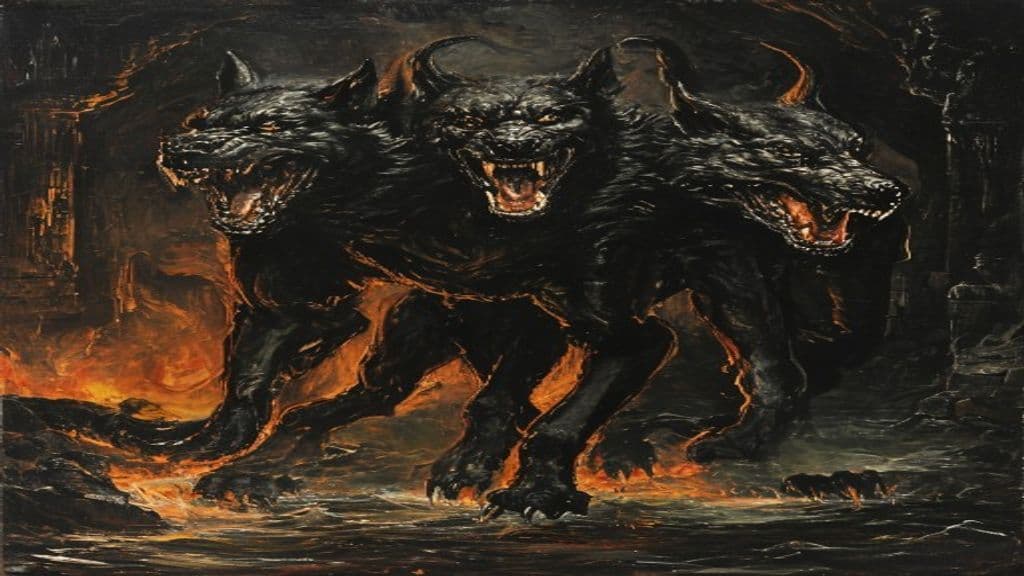
Cerberus
The three-headed hound of Hades, guardian of the underworld's gates — welcoming the dead in but allowing no shade to leave and no living mortal to enter uninvited.

Lernaean Hydra
A multi-headed serpentine chthonic water-monster of Greek myth associated with the marshes and spring of Lerna; famed as the adversary slain by Heracles in his second Labour, notable for poisonous breath and blood and for regenerative heads (accounts vary).

Ladon
Ladon is listed in the provided sources as "one of the dragons in Greek mythology." The available materials are disambiguation-style and also show the name Ladon applied to other, distinct referents (a husband/father figure, a hunting-dog, rivers, and a French commune); the supplied excerpts contain no narrative details about the dragon Ladon.
Community Record
- [1]Nemean lion - Wikipedia. Wikipedia: Nemean lionwiki
- [2]Hercules Strangling the Nemean Lion - Cleveland Museum of Art (archive caption). Cleveland Museum of Art caption (archive.org)other
- [3]The Labors of Hercules (archive items). Archive.org collection of labors imagery and captionsother
- [4]Hercules and the Nemean Lion (Wikipedia artwork/legend summary). Wikipedia: Hercules and the Nemean Lionwiki