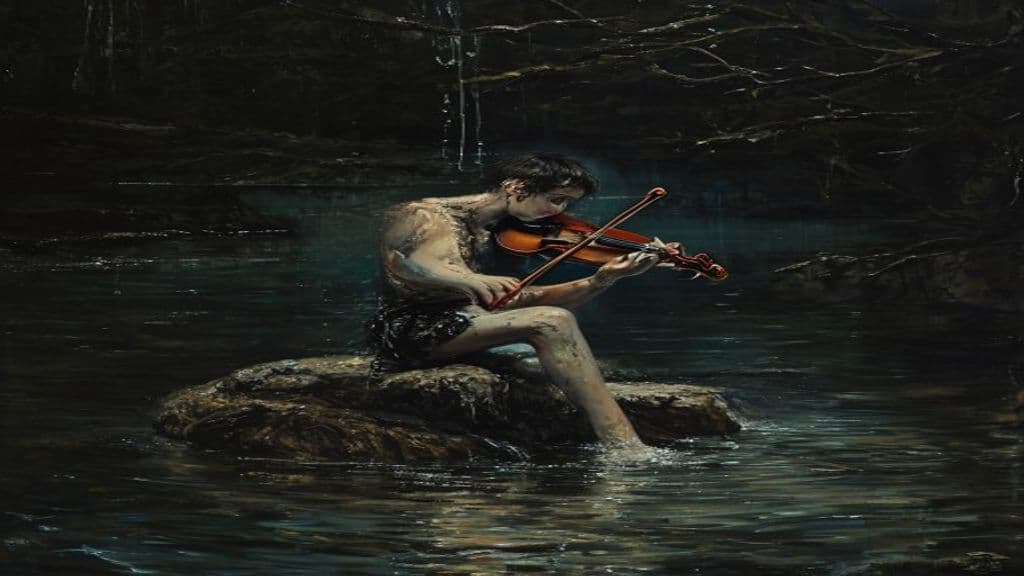
The Näcken (Swedish) or Nøkk (Norwegian/Danish) is one of the most feared water spirits in Scandinavian tradition. He dwells in lakes, rivers, and waterfalls, particularly deep pools. He is master of music — his violin-playing is so beautiful it cannot be resisted — and uses it to pull listeners into the water. He could be contracted to teach violin in exchange for offerings, but the price was dangerous.
Most commonly a beautiful, pale-skinned young man, naked or in fine clothing, playing a violin while sitting on a rock in the water. He could also appear as a white horse standing in shallow water (an invitation to ride him to drowning), or as a piece of driftwood. Water dripped constantly from his clothing and hair.
His music was irresistible — those who heard it would dance until they dropped dead, or wade into the water to be drowned. Could shape-shift into a horse, a man, or floating debris. Masters musicians who made contracts with him gained supernatural skill. Could control the currents of rivers.
Weaknesses
- mantraCalling him by name breaks his enchantment
- ritualOffering of snaps (alcohol) poured into the water
Wards
- substanceSteel carried when crossing bridges
- ritualSpitting in the water before swimming
Ancient Kings of Finland
In early literary sources, the Ancient Kings of Finland are described as hypothetical or mythical monarchic systems associated with ancient Finland. (Note: 1. Power tier: Lower to Primordial (given the lack of specific abilities and behaviors) 2. Abilities and behaviors are described as 'generally vague', so this section should be reworded or removed 3. )
Baldr
Baldr (Old Norse Baldr; Old English Bældæġ; Old High German Balder/Palter) is a god in Germanic mythology. In the Norse branch he is named as a son of Odin and Frigg and as a member of the Aesir, attested alongside brothers such as Thor and Váli in the supplied sources.
Black Shuck
A spectral black dog of East Anglian legend, with glowing red or green eyes. Its appearance is an omen of death. Its howl has been heard on clifftops during storms for centuries.
Deutsche Mythology
A collection of mythological narratives representing the collective myths, legends, and beliefs of ancient Germanic cultures. (Note: 1. Power tier: Primordial (Deutsche Mythology as a collective mythological narratives does not have supernatural abilities and behaviors attributed to it; rather, it contains those of individual Germa)
Domar (Dómarr)
Domar (Old Norse Dómarr, 'Judge') is a legendary Swedish king of the Yngling dynasty attested in medieval Scandinavian genealogical sources. He is presented as a mytho-historical ancestral ruler whose long and peaceful reign follows the sacrificial death of his father Domalde and whose own death was marked by cremation at Fyrisvellir and erection of a memorial stone at Uppsala.
Dragon (Long)
Long (龍, "dragon") is a pervasive cultural and artistic motif that appears in Taoist sacred-geographical contexts, Chinese literature, and modern exhibitions; the provided sources treat it as part of the broader mythic imagery present around Taoist sites and ritual scenes rather than as a single, consistently described doctrinal entity.
Draugr
In Nordic folklore the draugr (plural draugar; anglicized draug) is an archaic term for a malevolent revenant — a dead person who returns and remains active in the world of the living. Accounts emphasize variability: traits, behaviours, and descriptions change between stories and across regions, especially in early medieval Icelandic sagas and surviving Norwegian folklore.
Dís (dísir)
In Norse/North Germanic tradition, a dís (pl. dísir) is a collective term for female supernatural beings whose roles range from protective ancestral spirits and fertility figures to fate‑linked women comparable to valkyries or norns; they are invoked in both private and public cult (notably the dísablót) and can be benevolent or hostile toward humans.
Eystein Halfdansson
Eystein Halfdansson (Old Norse: Eysteinn Hálfdansson) is presented in Norse king-list and saga tradition as a semi-legendary Norwegian petty king of the House of Yngling who ruled Romerike and acquired Vestfold by marriage. He is depicted as a dynastic ruler and Viking raider whose death is attributed in Snorri's Ynglinga saga to a magical act performed by King Skjöld of Varna.
Fenrir
The monstrous wolf son of Loki, bound by the gods with a magical ribbon until Ragnarök — when he will break free and swallow Odin, and the world.
Fylgja
A supernatural accompanying spirit in Old Norse tradition tied to a person's or family's fate and fortune. The fylgja appears most often as a female human figure or as an animal, commonly in dreams, and functions as an omen-bearing presence connected to destiny rather than an agent that alters fate.
Household deity
A household deity is a deity or spirit that protects the home and its members, cared for inside domestic spaces and integrated into everyday household ritual. The category spans distinct cultural instantiations — hearth goddesses, ancestral family kami, and animistic house-spirits — and is characterized by reciprocal relations of offering and protection rather than cosmic sovereignty.
Community Record
- [1]Svenska Folkvisor. Geijer, Erik Gustaf & Afzelius, Arvid August. 1814–1817. Svenska Folkvisor. Stockholm.folk
- [2]Norse Mythology. Lindow, John. 2002. Norse Mythology: A Guide to Gods, Heroes, Rituals, and Beliefs. Oxford University Press.academic