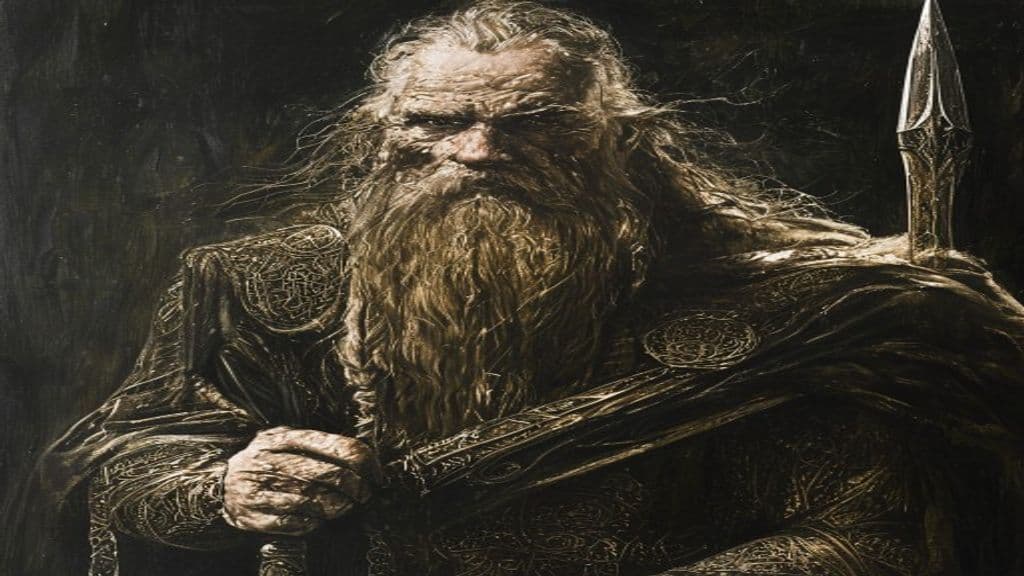
In the mythic corpus summarized in the Prose Edda and Poetic Edda, Odin and his brothers Vili and Vé slay the primordial being Ymir and fashion the world from his body; Odin and his brothers also give life to the first humans, Ask and Embla. Odin occupies a central, kingship-like position among the Æsir and is tied to cosmogonic acts of creation and to the eschatological cycle culminating in Ragnarök, where he leads the einherjar and is fated to be killed by the wolf Fenrir.
Odin is commonly depicted in the sources as long-bearded and sometimes as an old man; he is characteristically shown or described as having only one eye, having sacrificed the other for wisdom. Prose Edda material associates him with a spear and with the gold ring Draupnir (in the corpus of stories summarized by the sources). He is frequently accompanied by animal familiars—two ravens, Huginn and Muninn, and two wolves, Geri and Freki.
Odin is portrayed as a seeker and dispenser of wisdom (notably sacrificing an eye for greater knowledge), a source of poetic inspiration and ecstatic/frenzied prophetic states (the theonym derives from Proto-Germanic *wōðaz 'possessed, inspired'), and as lord of warfare and of certain dead warriors whom he receives into Valhöll. He commands or is associated with Valkyries who choose the slain, leads the einherjar in the mythic final battle of Ragnarök, and participates in mythic rulership and legitimizing genealogies in later euhemerized texts. Historical and traveller accounts record cultic practices directed to him, including reports of human sacrifice.
Weaknesses
- conditionFate at Ragnarök (killed by Fenrir)
- conditionNeed for costly sacrifice to gain wisdom (sacrificed an eye)
Wards
- otherNo specific wards attested in provided sources

Valkyrie
The valkyrie (Old Norse valkyrja, “chooser of the slain”) is a set of semi-divine female figures in Old Norse poetry and saga who choose warriors slain in battle, guide the chosen to Odin’s hall (Valhalla), and serve the einherjar there. Literary and archaeological sources depict them as armed riders, occasional lovers of men in swan‑maiden episodes, and in older imagery as fate‑weaving death spirits.
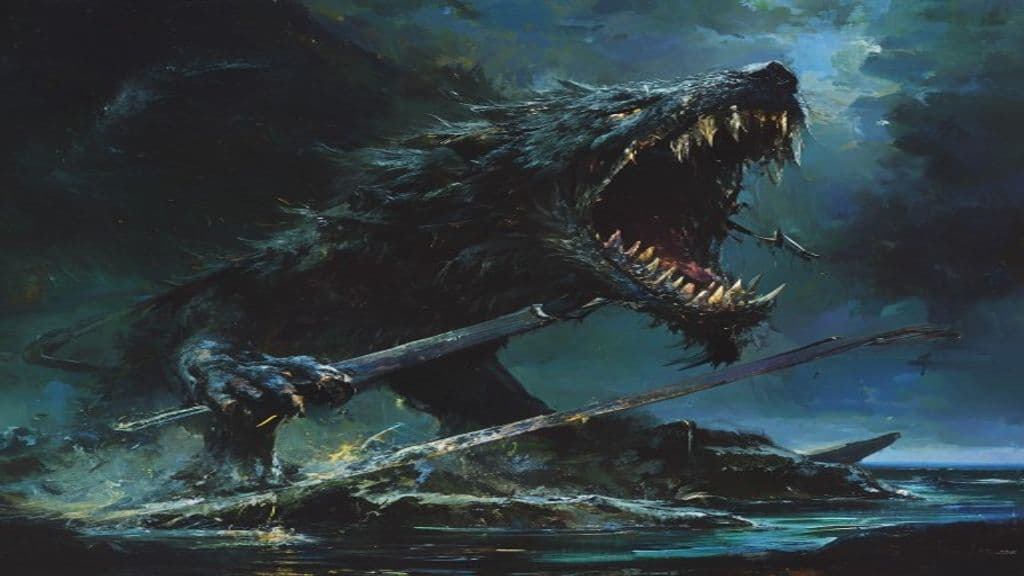
Fenrir
The monstrous wolf son of Loki, bound by the gods with a magical ribbon until Ragnarök — when he will break free and swallow Odin, and the world.
Andvari
Andvari is a dwarf from Old Norse sources (attested in the 12th century) who lives beneath a waterfall, hoards gold, owns a magical ring called Andvaranaut, can change into a pike, and curses the gold when it is stolen—events that set in motion tragic outcomes in Norse heroic narrative.
Angrboða
Angrboða is a jötunn (giantess) in Norse myth attested briefly in the Poetic Edda and Prose Edda as the partner of Loki and the mother of three world‑shaping offspring: Fenrir, Jörmungandr, and Hel. Surviving medieval attestations are sparse; most descriptions of her beyond genealogy derive from modern retellings and popular culture.
Ask and Embla
In Norse myth Ask (Askr) and Embla (Embla) are the first human man and woman, fashioned from wood/trees by the gods at the beginning of the cosmos and endowed with the gifts that make them human; they serve as the progenitors of humankind in the Norse cosmological narrative.
Atter
In Norse tradition, Atter refers to various forms of poison, corruption, or noxious influence that can manifest physically or morally. (Note: * Power tier should be Primordial only for its ability to cause cosmic-scale harm (e.g., societal consumption). However, most of its described abilities fall under Greater or Lesser powers, implying A)
Aurboða
Aurboða is a jötunn (giantess) in Norse mythology attested as the wife of the jötunn Gymir and mother of the jötunn Gerðr; the name also appears separately as one of the nine maidens in the poem Fjölsvinnsmál. Her name is debated etymologically as either 'gravel-bidder' (aurr + boða) or, in an alternative reading, 'gold-bidder' (aur + boða).
Auðumbla
Auðumbla is the primeval cow of Old Norse cosmogony attested in the Prose Edda: she nourishes the primordial jötunn Ymir with rivers of milk and by licking salty rime-stones reveals Búri, an ancestor of the gods. Her name and role link fertility, nourishment, and the emergence of key lineages in the Norse origin narrative.
Baduhenna
Baduhenna is a named female deity attested once in Tacitus (Annals) as having a sacred grove (lucus) in ancient Frisia; modern scholarship interprets her name as linking a battle element with the matronal name-element and therefore views her as a local matron-like goddess with associations to war and a cult-site.
Baldr
Baldr (Old Norse Baldr; Old English Bældæġ; Old High German Balder/Palter) is a god in Germanic mythology. In the Norse branch he is named as a son of Odin and Frigg and as a member of the Aesir, attested alongside brothers such as Thor and Váli in the supplied sources.
Barri
Barri (also attested Barrey/Barey) is a mythic place-name in Old Norse tradition, named in Skírnismál and Snorri Sturluson’s Gylfaginning as the rendezvous-site where Freyr and Gerðr will meet nine nights after prior events. The term is etymologically ambiguous between a grove/wood and an island or a grain-field, and scholars debate whether its semantic field evokes woodland or agricultural fertility.
Baugi
Baugi is a jötunn (giant) in Old Norse myth who appears as a secondary actor in the mead of poetry narrative preserved in Skáldskaparmál and the þulur. He is presented as the brother of Suttungr, provides and uses an auger named Rati to bore into the mountain Hnitbjörg, and figures in Odin's (Bölverk’s) bargain and deception to obtain the mead of poetry.
Beli
Beli is a jötunn (giant) in Old Norse myth known chiefly as an adversary slain by the god Freyr. Attestations are fragmentary: he appears in Eddic and skaldic references as the named foe of Freyr and as an element in kennings, and scholars treat the fuller myth as largely lost.
Bergelmir
Bergelmir is a jötunn in Norse mythology, attested as a descendant of the primordial giant Aurgelmir (Ymir) and portrayed as the survivor who preserves the frost-jötunn line after the primeval flood caused by Ymir's death. He appears in two primary Old Norse contexts: the poem Vafþrúðnismál (where he is implied to be an infant laid in a lúðr) and Snorri Sturluson's Gylfaginning (where he and his wife escape on a lúðr).
Community Record
- [1]Odin. Wikipedia, 'Odin' (summary of Norse mythic and historical attestations, Prose/Poetic Edda material, etymology and cultural reception).wiki
- [2]Odin (Wikidata entry). Wikidata entry for Odin (basic identifier and cross-references).other
- [3]The Poetic Edda. Völuspá 22, translated by Andrew Cautheryliterary