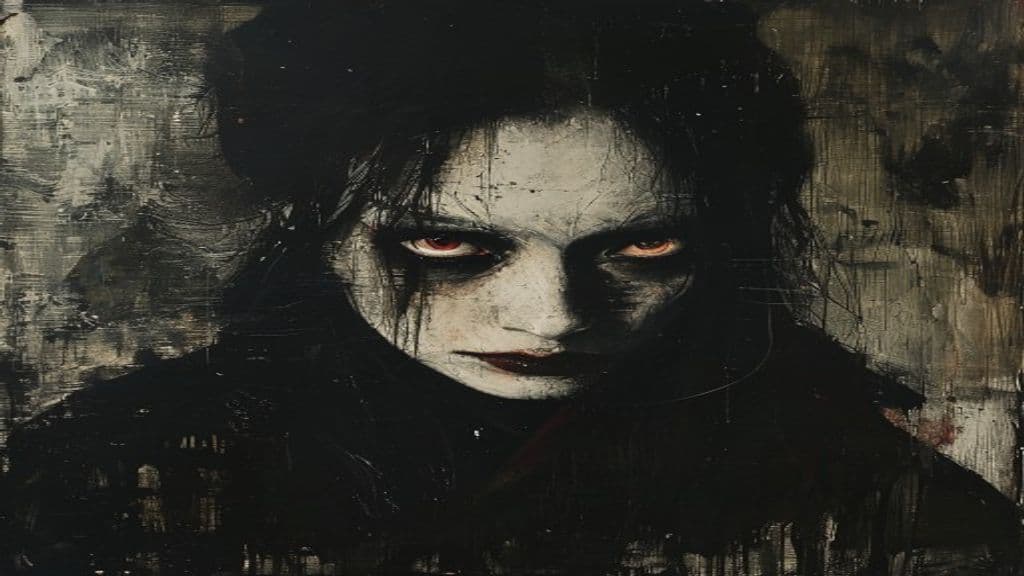
Belief in onryō develops within Japanese cosmologies that link emotional imbalance or untimely/unjust death to harmful spiritual agency. Historical records and later narratives attribute episodes of tatari to the wrath of the dead (examples in court histories include Prince Nagaya, Fujiwara no Hirotsugu, Prince Sawara, and Sugawara no Michizane). The related idea of ikiryō—a soul or spirit becoming unbalanced and separating from the body when hatred or resentment accumulates—provides the conceptual mechanism by which the living become or produce onryō.
Accounts emphasize variation but point to recurrent cultural motifs: onryō are often depicted as wronged women in literary and theatrical contexts. Performing arts use visual conventions such as the hannya Noh mask to represent a female onryō; modern popular imagery commonly shows a young woman in white burial kimono with long, disheveled black hair obscuring the face (the "stringy-haired ghost girl" trope). There is no single canonical physical template recorded in the surveyed sources.
Sources characterize onryō chiefly by their capacity to harm the living as retribution: injuring or killing those who wronged them and, in some descriptions, causing large-scale effects such as natural disasters to accomplish vengeance. They are described as acting to 'redress' grievances and are often said to take vengeance so forcefully that they 'take the spirits from the dying bodies' of victims (phrase attested in the referenced summary). The tradition emphasizes motive—revenge for past injury—more than a fixed catalog of supernatural techniques.
Akashaguma
Akashaguma is presented in the available sources as a child-like house guardian spirit in the Japanese yokai tradition, closely comparable to the regional zashiki-warashi. It is associated with domestic interiors (parlors or storage rooms) and with bringing prosperity to households where it dwells.
Azukibabaa
Azukibabaa (あずきばばあ, "bean hag") is a Japanese yōkai represented as an old-woman figure whose presence is signaled by the sound of azuki beans being handled (azukiarai). Found in regional folk narratives around Kantō and nearby prefectures, she lures or unnerves night travelers and in some localities is said to scoop up or swallow passersby.
Bakeneko
The bakeneko (ばけ猫, "changed cat") is a Japanese yōkai classed as a kaibyō (supernatural cat). Folklore presents it as a household cat that, through age, long residence, or other local conditions, acquires uncanny abilities such as shapeshifting, speech, and vengeance against cruel humans.
Betobeto-san
A Japanese yōkai manifesting as the sound of footsteps that follow lone travelers at night. Traditionally regarded as non‑harmful: walkers are advised to step aside and address it politely to have the footsteps pass.
Chōchinbi
Chōchinbi (提灯火, "paper-lantern fire") are regionally reported Japanese atmospheric spirit-lights treated as a variety of onibi. Tales describe them as lantern-like floating flames seen near footpaths, rice fields, riverbanks, and graveyards, sometimes vanishing when approached and sometimes associated with animal yōkai or resentful human spirits.
Hannya (般若)
Hannya is a traditional Japanese Noh mask type and the theatrical/folkloric embodiment of a woman transformed into a resentful, jealous spirit. The mask represents a stage of metamorphosis into an onryō-like figure, visually marked by horns and a leering mouth, and is situated at the intersection of Noh theatre, ritual dance (kagura), and Buddhist-influenced folk belief.
Hito-gitsune
A household-associated small carnivore spirit from western Japan (Chūgoku region) that attaches to certain families, providing wealth in belief but causing illness, behavioral change, social stigma, and transmission across households. It is represented in regional traditions as a marten/fox/weasel‑like possessing spirit rather than a singular individualized deity.
Inugami
Inugami (犬神) are Japanese household-associated dog-spirits that appear in western Japan. In folklore they may be intentionally created by kodoku/kojutsu rituals or become hereditary household possessors that attach to people, animals, or objects and produce illness, jealousy, or social stigma.
Ishinagenjo
Ishinagenjo is a Japanese coastal folkloric phenomenon in which fishermen hear the sound and feel the effects of a huge stone crashing into the sea though no stone is ever found. Sources treat it variously as an episode of yōkai activity (sometimes linked to sea-witch figures such as the Iso Woman) or as an illusion/perceptual error recorded in fisherfolk accounts from several coastal localities.
Isonade
A large, shark-like sea monster from Japanese regional folklore (notably Matsuura and other parts of western Japan). Its body is said to remain hidden beneath the waves, with only a huge, barbed tail fin visible; it approaches boats stealthily, can snare sailors with its hooked tail, capsize vessels, strike beaches, and is associated with fierce winds when it appears.
Japanese wolf
An endemic subspecies of gray wolf historically inhabiting Honshū, Shikoku, and Kyūshū, remembered in Japanese natural history and folklore as both a biological predator and a liminal spiritual figure associated with mountain deities and occasional protective roles toward travelers.
Kamaitachi
A class of Japanese yōkai associated with sudden cutting winds and whirlwinds that cause sharp, initially painless wounds. Narratives vary by region: kamaitachi may be imagined as weasel-like creatures riding dust devils, trios of mischievous gods, animated sickles (tsukumogami), or other local spirit causes.
Community Record
- [1]Onryō. Wikipedia: Onryō — summary paragraph describing nature, typical depiction, abilities, temperamentwiki
- [2]Kuroneko (1968). Archive: Kuroneko (1968) — film summary identifying the story as concerning the vengeful spirits, or onryō, of a woman and her daughter-in-law who died at the hands of samurailiterary
- [3]Wikidata: Onryo (Q111569754). Wikidata entry listing modern uses of the term 'Onryo' (e.g., titles); indicates contemporary popular-culture usage but provides no folkloric detailother
- [4]Pro Wrestling KAGEKI - 2000/04/21 VHS. Archive: Pro Wrestling KAGEKI — example of modern/pop-culture uses of the term 'Onryo' in event naming; contains no folkloric detailother
- [5]Pro Wrestling KAGEKI - 2002/06/23 - Osaka Estrella. Archive: Pro Wrestling KAGEKI — additional example of contemporary uses of the term 'Onryo' outside folkloric contextother
- [6]Stringy-Haired Ghost Girl (trope). Trope summary supporting modern imagery of long-haired white-clad female ghostfolk
- [7]Konjaku Monogatarishū tale summary and historical examples (compiled in source notes). Summarized tale 'How a Man's Wife Became a Vengeful Ghost and How Her Malignity Was Diverted by a Master of Divination' and historical references (Prince Nagaya, Hirotsugu, Prince Sawara, Sugawara no Michizane) as cited in the primary compiled sourceliterary
- [8]Notes and archival mentions of modern cultural uses (wrestling, performances). Archival materials and pages cited in source notes showing contemporary use of the term 'Onryō' in performer/stage names (illustrative of cultural resonance)other