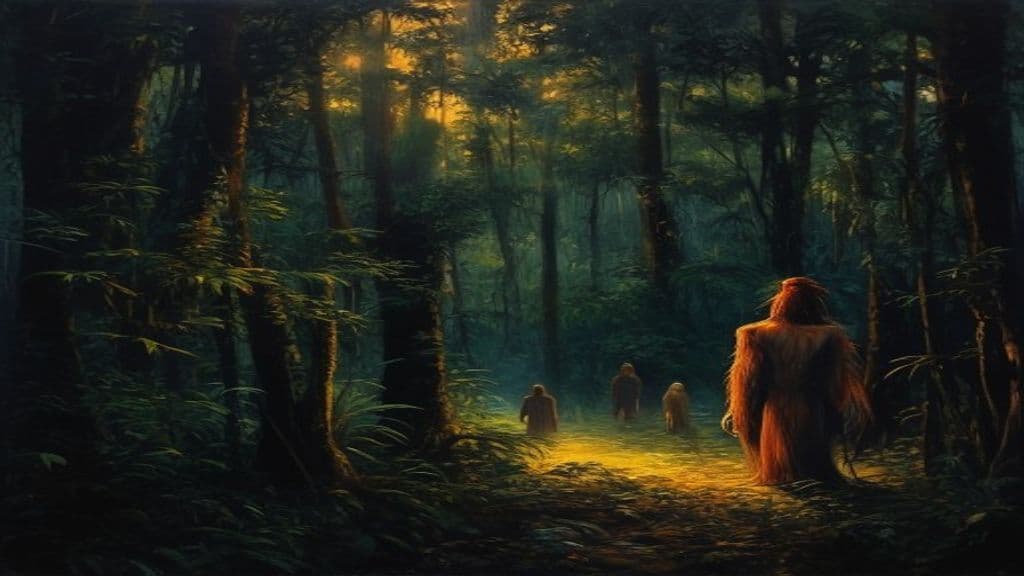
The Orang Bunian ('whispering people' or 'invisible people') are described in Malay tradition as a race of supernatural humans who coexist with the ordinary world but in a dimension slightly removed from it. They are not malevolent by nature but are dangerous because contact with them is disorienting and their time moves differently. People who enter their realm may return years later believing only hours have passed. They are said to be beautiful, to have their own society, and to live in the forest, mountains, or deep wilderness.
Appear as beautiful, tall humans when they choose to be seen. Their skin is often described as unusually light. They dress in fine clothing. Their communities are heard rather than seen — music, laughter, the smell of cooking — with no visible source.
Could render themselves and their entire settlement invisible. Could lure humans into their realm where time passes differently. Could interbreed with humans in some traditions. Their world could be accidentally entered by those who urinated in the forest without asking permission.
Weaknesses
- ritualAsking permission before urinating in the forest prevents attracting them
- ritualBomoh's ritual to negotiate the return of abducted persons
Wards
- ritualSaying 'permisi' (excuse me) aloud before entering forest
- substanceIron carried in wilderness
Hantu
Hantu is a Malay and Indonesian lexical and conceptual category for spirits and invisible beings that includes ancestral souls, animistic nature spirits, and, in modern usage, ghosts or demons. The term covers many named subtypes (e.g., Hantu Raya, Hantu Tinggi) whose forms and roles vary across local traditions.
Hantu Penanggal (Penanggalan)
A nocturnal vampiric entity in Malay ghost myth, the penanggalan appears as a floating disembodied woman's head with trailing organs and entrails and is said from a distance to twinkle like a ball of flame.
Hantu Pocong
A Southeast Asian folkloric ghost understood as a dead body wrapped in an Islamic burial shroud (kain kafan), commonly associated with improper funerary procedure or unresolved death-related matters. Representations range from a hopping wrapped corpse in popular media to esoteric readings that interpret the phenomenon as residual energetic or liminal-layer disturbance.
Jin (Malay/Javanese spirit)
No information about a Malay or Javanese spirit called 'jin' is present in the provided source. The supplied material discusses Malaysian Malay ethnicity and does not contain data on supernatural beings, their appearance, abilities, rituals, or cultural role.
Langsuir
A Malay banshee-vampire — the spirit of a woman who died in childbirth, transforming into a beautiful owl-woman who sucks the blood of infants through a hole in the back of her neck.
Penanggalan
A Malay vampire consisting of a detached human head with dangling organs that flies at night to feed on the blood of infants and new mothers, then soaks its organs in vinegar to reattach.
Pontianak (Kuntilanak)
A Southeast Asian female vengeful spirit common in Malay‑language traditions, often portrayed as the restless ghost of a woman who died in traumatic circumstances; she commonly appears as a beautiful woman who may reveal a monstrous form and is associated with banana and banyan trees.
Toyol
A malevolent fetal spirit used as a supernatural familiar in Malay and Javanese black magic — typically stolen or purchased from a dukun, fed blood, and set to steal from neighbors.
Opochtli
Opochtli is an Aztec deity whose name means "The Left" or "The Left-Handed." He is associated with fishing, hunting, and the technologies of lacustrine and marsh livelihoods, credited with inventing the atlatl, the fishing net, the canoe pole, and the bird snare, and is commonly depicted riding a dolphin. He is described in some sources as a representative or attendant aspect of the rain god Tlaloc and is directionally linked to the south in Aztec ritual geography.
Ops
Ops is an ancient Roman earth and fertility goddess personifying abundance, stored grain, and the material prosperity produced by agricultural labour; she is traditionally the consort of Saturn and is attested in cult as Ops Consiva with festivals and sanctuaries in Rome.
Orang Minyak
Orang Minyak ('oily man') is a Malay folkloric figure — a nocturnal human-shaped assailant described as coated in shiny black grease who abducts and is blamed for rapes of young women. Accounts vary between supernatural cursed figures and human criminals or warlocks, and the legend functions as a cautionary nocturnal threat in Malay-speaking communities.
Orang Pendek
Orang Pendek is a figure from Sumatran tradition and modern cryptozoology described either as a short, ground-dwelling bipedal primate inhabiting remote forests of Sumatra or, in some indigenous accounts, as a supernatural 'short ghost' (Hantu Pendek) used in oral lore and cautionary tales.
Community Record
- [1]Malay Magic. Skeat, Walter William. 1900. Malay Magic. Macmillan.academic
- [2]Ghosts of the Malay Peninsula. Gimlette, John D. 1923. Malay Poisons and Charm Cures. J. & A. Churchill.folk