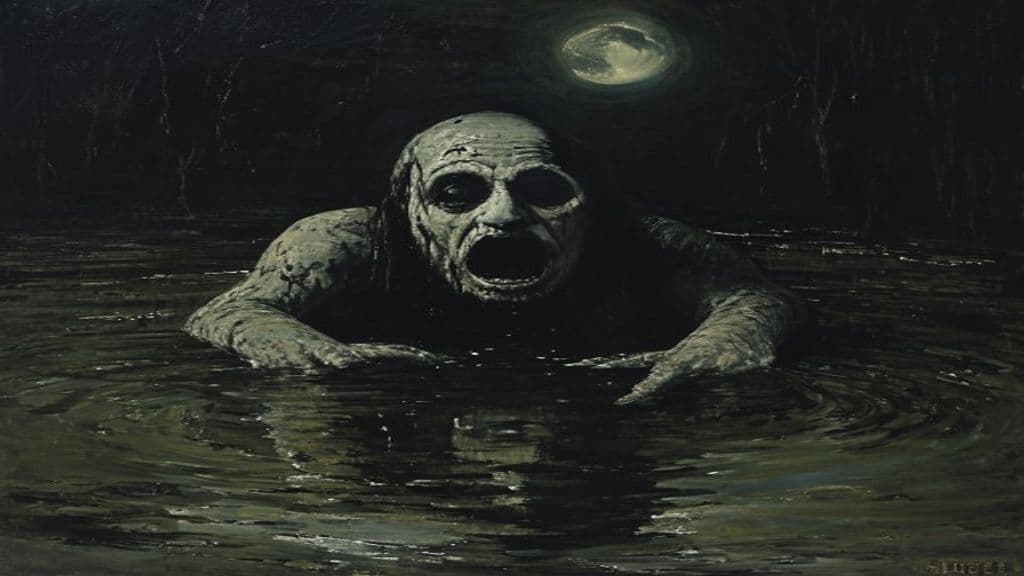
In Bhojpuri and Maithili folk belief, the Pandubba is the spirit of a person who drowned — either by accident, by being pushed in, or by suicide in water. The name derives from 'pan' (water) and 'dubba' (one who submerges or drowns), making it a precise descriptive classification rather than a proper name.
Unlike the Brahmpret or Masaan, the Pandubba is not tied to a family or a specific injustice. It haunts the body of water where it drowned and acts on anyone who comes close, driven by the compulsion to re-enact its own death in others. Old wells near abandoned villages in eastern UP are considered especially dangerous — the water has nowhere to flow, and the pret has nowhere to go.
The Pandubba is rarely seen above the waterline. When glimpsed, it appears as a pale, bloated figure just below the surface of still water — looking up. Witnesses describe the moment of recognition: bending over a well or pond's edge and seeing a face that is not a reflection.
In some Bihar accounts it manifests as an unusually cold current in otherwise warm water, or as a hand-shaped depression on the surface that moves against the current.
The Pandubba's method is contact and pull. It grabs an ankle, a wrist, or the hem of a garment of someone at the water's edge, drawing them in. The pull is described as irresistible — not because of supernatural strength but because it coincides with a sudden vertigo or disorientation in the victim.
It cannot leave the water body it inhabits. This territorial limitation is its most documented characteristic — the danger ends at the waterline. Villagers with wells known for drownings traditionally mark the surrounding ground with a ring of sesame ash to remind themselves of the boundary.
Weaknesses
- substanceSesame ash ring around the water body
- ritualShraddha performed at the water's edge on the drowning anniversary
Wards
- substanceIron nail dropped into the water before bathing
- conditionNever approach still water alone at twilight
Community Record
- [1]Ghosts: Life and Death in North India. Freed, R.S. & Freed, S.A. (1993). Ghosts: Life and Death in North India. Anthropological Papers of the American Museum of Natural History, 72.academic
- [2]The Popular Religion and Folk-Lore of Northern India. Crooke, W. (1896). The Popular Religion and Folk-Lore of Northern India, Vol. 1. Archibald Constable, Westminster.academic