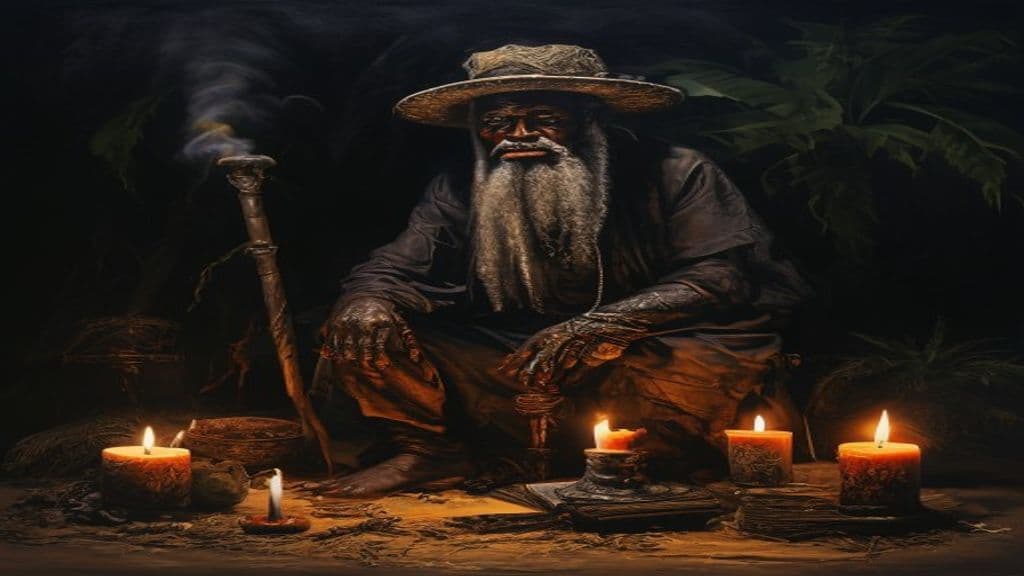
Papa Legba derives from the West African orisha Eshu-Elegbara of the Yoruba and Fon peoples, brought to Haiti through the Atlantic slave trade. He is the first spirit to be saluted in every ceremony, because he alone holds the keys to the cosmic gate.
In Haitian Vodou he is often depicted as an old man on crutches, smoking a pipe, accompanied by a dog. Despite his worn appearance he is a god of immense power and wisdom.
An old man in a ragged hat, leaning on a walking stick or crutch, smoking a pipe. A small dog accompanies him. In his Yoruba origin (Eshu) he may appear younger and more mischievous, often with red and black clothing.
Opens and closes the gate between worlds — without his permission no other loa can answer prayers. Polyglot of all languages (divine and human). Stands at every crossroads, physical and metaphysical. Mischievous; teaches through tricks.
Weaknesses
- conditionCannot be approached without proper salutation — but is never truly hostile
Wards
- ritualOfferings of rum, tobacco, coffee, and grilled peanuts at the crossroads
- mantraPapa Legba, ouvri baryè pou mwen (Papa Legba, open the gate for me)

Community Record
- [1]Tell My Horse. Hurston, Zora Neale. 1938. Tell My Horse: Voodoo and Life in Haiti and Jamaica. J.B. Lippincott.folk
- [2]Divine Horsemen. Deren, Maya. 1953. Divine Horsemen: The Living Gods of Haiti. McPherson.academic