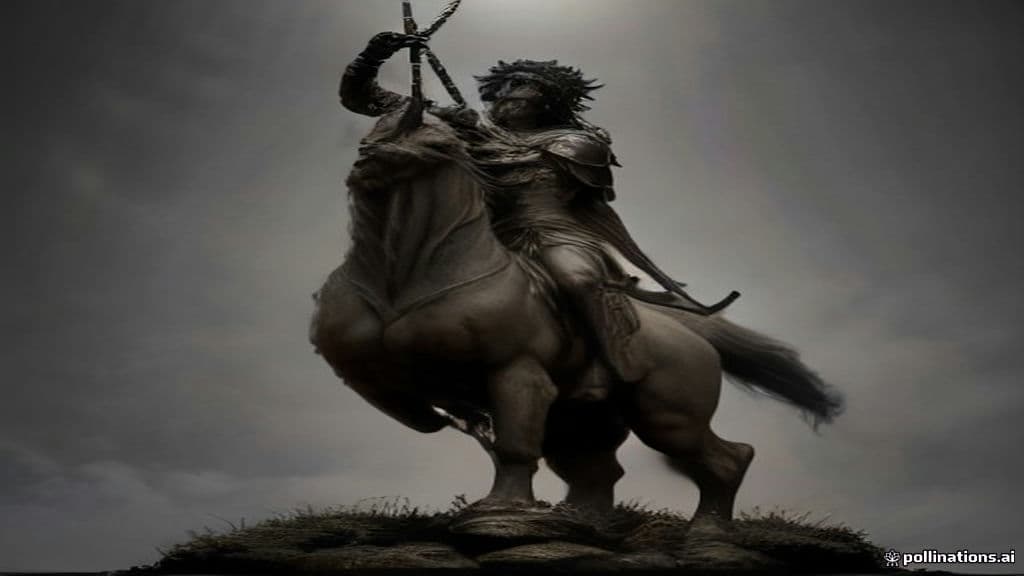
Phaeocomes is not presented in the supplied sources as having an independent cosmogonic origin or a body of separate mythic tales; rather, he is introduced as one of the named centaur combatants in Ovid's catalogue of the battle between Centaurs and Lapiths in Book XII of the Metamorphoses. The supplied materials record him only within that narrative context and do not provide a separate genealogical or cultic origin.
In the poetic descriptions quoted in the sources Phaeocomes is depicted as a centaur whose human upper body and continuing covering over the equine part are protected by six lions' hides fastened or joined together as armor, and who carries an enormous wooden club. Translators emphasize the stitched or fastened assembly of multiple lion hides across his torso and back and compare the club's size to the pulling power of two yoked oxen.
All documented feats attributed to Phaeocomes in the provided sources are martial and physical: he is portrayed as a fierce combatant who uses brute force and trophy hides as both protection and display. The poem narrates him killing opponents in the Centauromachy — including a passage describing him crushing an opponent's skull — and highlights his prodigious strength via the oversized club. The supplied corpus contains no indication that he possesses supernatural powers beyond epic-scale physical prowess.
Weaknesses
- otherNo documented magical weaknesses
Wards
None recorded.
Community Record
- [1]Metamorphoses Book XII: Battle of Centaurs and Lapiths (translation by David Drake). David Drake, Metamorphoses XII: Battle of Centaurs and Lapiths (online translation), passages on Phaeocomesliterary
- [2]Metamorphoses by Ovid, Book XII (Sandys translation). George Sandys translation of Ovid, Metamorphoses Book XII; descriptive lines on Phaeocomes' dress and armamentliterary
- [3]Metamorphoses, Book XII (Internet Classics Archive). Ovid, Metamorphoses Book XII (English translation), Centauromachy passages listing named centaur combatantsliterary
- [4]Pyrenophora / Pyrenophora phaeocomes (Dothideomycetes entry). Dothideomycetes database entry for Pyrenophora phaeocomes (taxonomic usage of the epithet)other
- [5]Pyrenophora phaeocomes (EPPO Q-bank overview). EPPO Q-bank overview entry for Pyrenophora phaeocomes (fungal taxon records)other
- [6]Pyrenophora phaeocomes strain record (EPPO Q-bank). EPPO Q-bank specimen/strain record for Pyrenophora phaeocomesother
- [7]Poetry in Translation: Metamorphoses Index. Index of names in Ovid's Metamorphoses indicating Phaeocomes among named centaursliterary
- [8]Wikipedia: Pyrenophora. Wikipedia entry for the fungal genus Pyrenophora (mentions species epithet phaeocomes)wiki