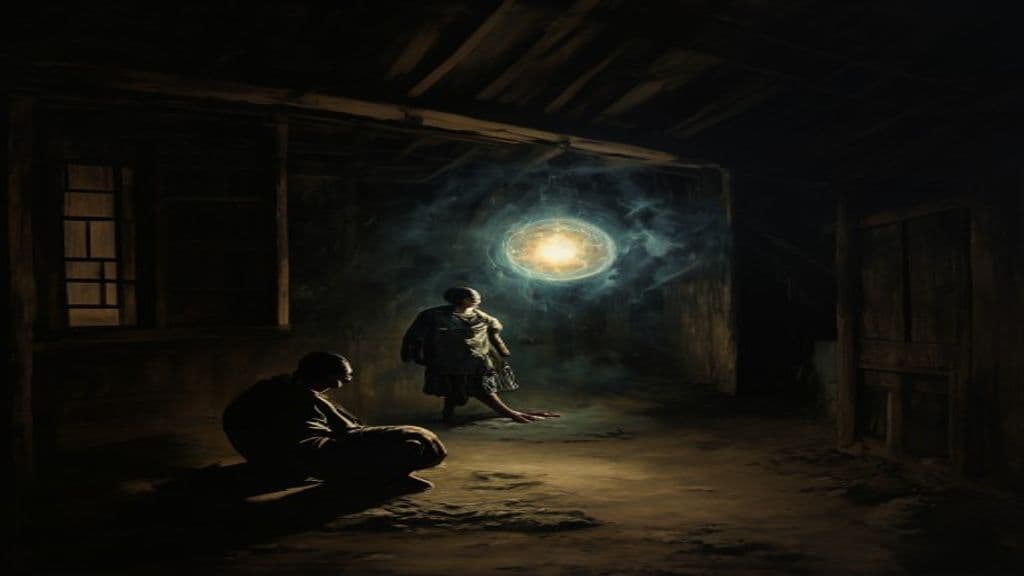
The Phi Pop (ghost that consumes entrails) is distinctive in Thai folklore because it possesses a living host rather than having an independent body. The host is typically a woman who is accused by her community of being a phi pop — she is said to go out at night, dig up fresh graves, and eat the entrails of the newly dead. She may have no knowledge of this during waking hours. The accusation of being a phi pop host has historically led to social exclusion, beatings, and exile.
Has no independent appearance — it inhabits a living human body. The possessed person appears normal except during the possessing episodes, when they may be found near graves at night or eating raw meat. The phi pop is sometimes described as a kind of glowing ball of light that moves from host to host.
Possessed its host to consume raw entrails. Could move from host to host. Could cause illness in people around the host. The possessing entity could sometimes speak through the host when confronted by a monk.
Weaknesses
- ritualExorcism by a monk or spirit doctor (mor phi)
- mantraBuddhist protective chanting
Wards
- ritualBuddhist protective tattoos (Sak Yant)
- mantraDaily merit-making reduces vulnerability
Pheres
Pheres is a mythic genealogical figure in ancient Greek tradition, named as the son of Cretheus and Tyro, brother of Aeson and Amythaon, founder of the city Pherae in Thessaly, and father of Admetus and Lycurgus. He functions as an eponymous ancestral founder whose placement in genealogies links local ruling houses to wider heroic cycles such as the Argonauts and the Alcestis/Admetus narratives.
Phersipnai
Phersipnai (also attested as Persipnei) was the Etruscan queen of the underworld, described in the sources as the consort of the underworld ruler Aita and functionally equivalent to the Greek Persephone and Roman Proserpina. The available references state that the Etruscan name was borrowed from Greek and place her among the ruling figures of the Etruscan chthonic realm.
Phi Am
A vernacular Thai spirit invoked to explain the experience of sleep paralysis: a conscious sleeper who perceives an oppressive presence and is temporarily unable to move. The label links a brief, often frightening nocturnal episode to an unseen agent pressing on the sleeper.
Phi Hua Khat (Rice-Field Ghost)
Phi Hua Khat is presented here as a named rice-field ghost in Thai folkloric terminology supplied by the user; however, the provided source set does not contain any specific attested information about this entity. General statements about Thai ghost beliefs are drawn only from Source 1; no direct descriptions, stories, rituals, or attributes for Phi Hua Khat itself appear in the supplied materials.
Phi Krasue
Phi Krasue is a nocturnal female spirit in Thai/Isan popular belief, depicted as a floating disembodied woman's head with trailing internal organs. Situated within Buddhist-syncretic and local animist worldviews, it functions as a visceral, boundary-enforcing specter in village and regional folklore and continues to appear in contemporary media.
Phi Phong
A ghostly spirit of northern Thai folklore described as the result of black magic gone awry; in modern media a related variant is depicted as a blood‑feeding nocturnal entity. It is framed in sources as arising from failed dark sorcery and appears in contemporary regional horror films.
Phi Tai Hong
Phi Tai Hong (ผีตายโหง) are vengeful, restless spirits in Thai folklore arising from people who die suddenly and violently. They are feared as especially dangerous and difficult to exorcise; the pregnant-woman variant (Tai Thang/Tai Thong Klom) is regarded as particularly malevolent.
Philippine mythical creatures
A broad, plural category of legendary beasts, monsters, and supernatural beings found across more than 140 ethnic groups in the Philippines; these beings occupy local folkloric cosmologies and are distinct from major deities and heroes. They appear in traditional tales and in contemporary retellings and media, which continue to reinterpret and popularize them.
Philoctetes
A mortal Greek hero and famed archer, son of Poeas, who inherits Heracles’ bow and arrows; abandoned because of a festering, foul-smelling wound and later recalled because possession of Heracles’ weapons is prophesied as necessary for Greek victory at Troy. His story appears across epic and tragic traditions (Homeric cycle references; Sophocles’ Philoctetes) and explores themes of suffering, divine causation, healing, and communal obligation.
Philoetius
Philoetius is a mortal cowherd and loyal servant in Homer's Odyssey who tends Odysseus's cattle on Ithaca. In the narrative he exemplifies household fidelity: he brings livestock to the palace, follows Odysseus's orders to secure the hall, hides the suitors' weapons, fights in the slaughter, and is promised freedom and reward for his loyalty.
Philomache (Phylomache)
Philomache (Ancient Greek: Φυλομάχη), also spelled Phylomache, is a mythological mortal woman appearing in classical Greek genealogical traditions as a Minyan princess of Orchomenus who in some accounts is named as the wife of Pelias of Iolcus and mother of Acastus and several daughters. She functions as a dynastic link in heroic-age family networks rather than as a supernatural being.
Philonis
Philonis (Ancient Greek: Φιλωνίς) is a mythic mortal woman from Greek genealogical tradition, variously identified as daughter of Daedalion or of Eosphoros and Cleoboea (and in some accounts as daughter of Deion of Phocus). She is named as the mother of Philammon by Apollo and Autolycus by Hermes and is sometimes equated with figures called Chione, Leuconoe, or Telauge in alternate traditions.
Community Record
- [1]Spirits of the Yellow Leaves. Bernatzik, H.A. 1951. Spirits of the Yellow Leaves. Robert Hale.folk
- [2]Thai Spirit Beliefs. Textor, Robert B. 1973. Roster of the Gods: An Ethnography of the Supernatural in a Thai Village. HRAF.academic