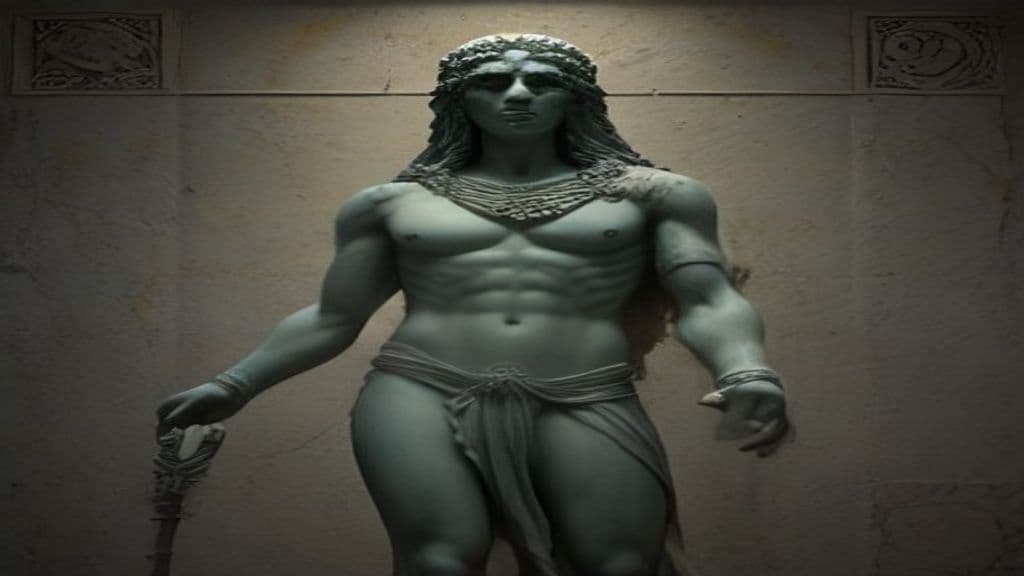
In Hesiodic genealogies Phorcys is a member of the archaic sea generation, born of Pontus (the Sea) and Gaia (the Earth). He is paired with his sister-wife Ceto; together they populate the mythic world with numerous monstrous offspring. Later commentators preserve variant local aetiologies: for example, Servius (reporting Varro) records an older Italian tradition in which a historical king named Phorcos of Sardinia and Corsica was destroyed at sea and imagined by companions to have been transformed into a marine monster or deity.
Literary and iconographic traditions present Phorcys as an archaic hybrid sea-being. Extant Hellenistic–Roman mosaics depict him as a fish‑tailed merman with crab‑claw legs and, in some mosaics, red, spiky skin. Alternative ancient explanatory tales (reported by Servius) describe a half‑man, half‑sea‑ram form in an aition linking a mariner‑king to a monster.
Phorcys's principal role in myth is generative—fathering a host of monstrous children (Hesiod lists the Graeae and the Gorgons among his offspring and associates him with other chthonic monsters; other sources and scholia attribute additional children in variant traditions). He is sometimes shown acting on behalf of his offspring in narrative episodes (a later summary attributes to him an act of restoring Scylla to life by fire in one version). Beyond genealogical functions and monstrous iconography, the provided sources do not catalogue a system of magical powers.
Weaknesses
None recorded.
Wards
- symbolGorgoneion (iconography derived from Medusa, an offspring)
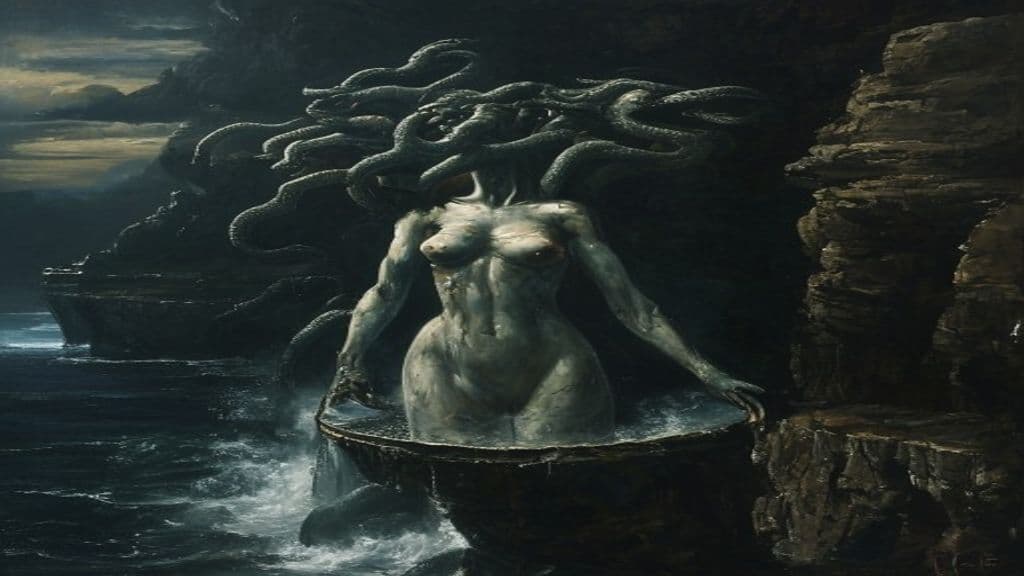
Scylla
A six-headed sea monster lurking in a narrow strait, snatching sailors from passing ships — the original origin of the phrase 'between Scylla and Charybdis.'

Ladon
Ladon is listed in the provided sources as "one of the dragons in Greek mythology." The available materials are disambiguation-style and also show the name Ladon applied to other, distinct referents (a husband/father figure, a hunting-dog, rivers, and a French commune); the supplied excerpts contain no narrative details about the dragon Ladon.

Medusa (the Gorgon)
Medusa, also called Gorgo or the Gorgon, is one of the three Gorgons in ancient Greek mythology. She is described as a mortal woman whose hair is composed of living snakes and whose gaze turns onlookers to stone; she is usually named as a daughter of the sea-associated figures Phorcys and Ceto and sister to Euryale and Stheno.
Community Record
- [1]Phorcys — Wikipedia. Phorcys article, summarizing ancient sources (Hesiod, Homer, scholia, Servius) and modern commentarywiki
- [2]Phorcys — names in ancient sources @ attalus.org. Compiled notes on ancient attestations and variants for the name Phorcysother
- [3]Medusa (Gorgoneion apotropaic use) — archival excerpt. Archive excerpt discussing Medusa, her parentage (Phorcys and Ceto), and the use of the Gorgoneion as an evil‑averting deviceother
- [4]Phorcys (therapsid) — Wikipedia (name reuse). Modern scientific naming reuse noted in source list (modern taxa named after mythic Phorcys)wiki
- [5]Binary Centaur Ceto–Phorcys (astronomical naming). Astronomical usage of the mythic names Ceto and Phorcys for a binary Centaur systemother
- [6]Marvunapp: Phorcys (Marvel Comics). Modern fictional character borrowing the mythic name (listed among modern cultural reuses)other
- [7]Archive: 'TNOs are Cool' (survey mentioning Ceto–Phorcys). Scientific survey mentioning binary object named for Ceto and Phorcys (modern name reuse)other