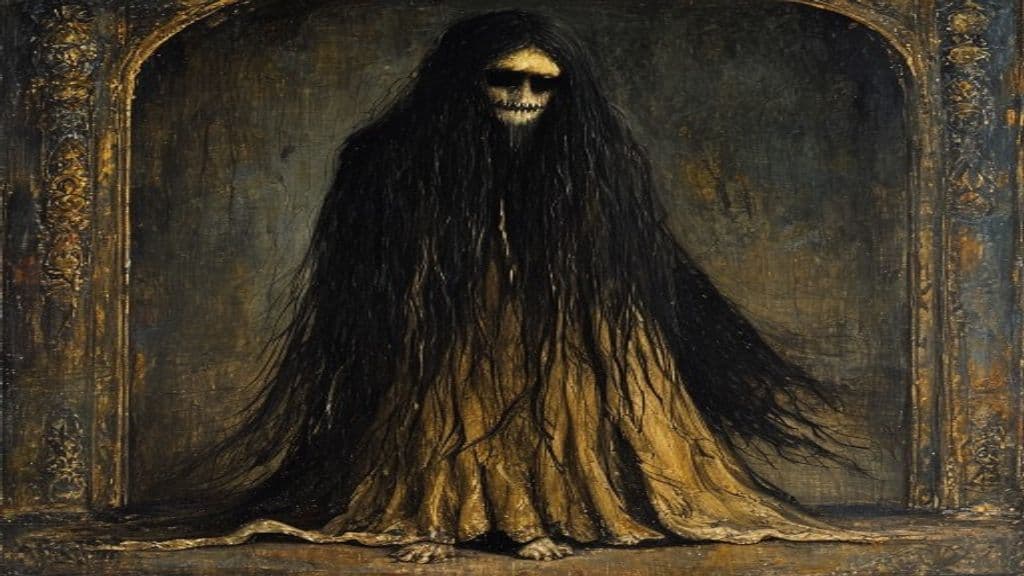
The term Pichhal Pairi is recorded in the cited sources as a regional name applied to the churel figure in northwestern South Asia and parts of Central Asia. The available entries do not provide a specific mythic creation narrative or birth-story for the entity; instead, they present the name and figure as part of the stock of local ghost stories and popular belief about female spirits in the region.
Sources describe Pichhal Pairi as a female apparition presented as a woman with very long hair that covers her face and with feet that point backward. Some versions recorded in the sources add that the spirit may have an inverted face as an additional unsettling trait. The entries also note the alternate local name 'Daan' in some contexts. These visual details — long hair obscuring the face and backward-pointing feet — are given as the defining markers of the figure in the cited material.
The cited sources characterize Pichhal Pairi as a ghostly figure that attacks; some variants of the tales specifically state that it attacks men. Beyond being described as an attacking spirit, the supplied sources do not describe further powers such as speech, shapeshifting, possession, or other supernatural capacities.

Phurba (kīla) spirits / Phurba (kīla)
The phurba (Tibetan) or kīla (Sanskrit) is principally a three‑sided ritual stake/knife used in Indo‑Tibetan Vajrayāna and Bön ritual repertoires as the implement through which hostile or disruptive spiritual forces are bound, restrained, or transformed. Sources describe the instrument as embodying the transformative, wrathful power associated with the meditational deity Vajrakīlaya.
Phuyu (cloud spirits)
Phuyu is presented in the research target as 'cloud spirits' associated with the Inca, but the provided sources are travel accounts that do not supply ethnographic, mythological, or linguistic documentation of such an entity. Any detailed claims about Phuyu are therefore undocumented in the supplied material.
Phylacus
Phylacus (Ancient Greek: Φύλακος, 'guardian') is a name belonging to several mortal figures in Greek mythic genealogies and local cult. Most prominently he is an eponymous founder of Phylace in Thessaly and a hero-ancestor invoked in legendary accounts; in one tradition a hero named Phylacus is said to have a sanctuary at Delphi and to be among the heroic dead who terrified invading Gauls.
Phyleus
Phyleus (Greek: Φυλεύς) is a mortal Elean prince in Greek mythic genealogies. He is known for testifying on Heracles' behalf in the dispute over the Augean stables, for being exiled by his father Augeas, and for leading a colony of Epeans to the island of Dulichium; he is also father of Meges, leader of the Dulichian contingent at Troy.
Phylonomus
Phylonomus (Ancient Greek: Φυλόνομον) is attested in Greek myth as a son of King Electryon and Anaxo and one of the princes of the Perseid lineage; he was killed, together with his brothers, by the sons of Pterelaus in a dispute arising from claims to cattle and ancestral land (tradition represented in Apollodorus and Hesiodic summaries).
Pichal Peri
Shared across North Indian and Pakistani folklore — a female spirit with reversed feet who lures lone travellers off roads at night. One of the most cross-cultural supernatural figures in the subcontinent, appearing in Hindu, Muslim, and Sikh communities alike.
Picolous
Picolous (Ancient Greek Πικόλοος, Pikóloos) is named in late-ancient/Byzantine citations as one of the Gigantes, offspring of Gaia and Uranus. In the preserved tradition he fled the Gigantomachy, came to Aeaea, attempted to attack Circe, and was slain by the sun-god Helios; from his blood the mythic herb moly is said to have sprung.
Pieris
Pieris is listed in the supplied sources only as “Pieris (mythology), a figure in Greek mythology.” The provided materials contain no further description, narratives, attributes, or contextual information about this figure; it is therefore insufficiently attested in the supplied corpus.
Pikker (Pikne)
Pikker (also attested as Pikne) is the Estonian supernatural personification or god of lightning. Attested sources identify the name as referring to lightning and note a likely relation to taboo-euphemism naming practices in the Baltic-Finnic area; beyond this identification, few traditional narratives, iconography, or ritual details are preserved in the supplied materials.
Pikne
Pikne is the Estonian supernatural figure associated with lightning and thunder; treated in tradition as a weather-personification who could be petitioned by priests and farmers for rain and whose name functioned as a taboo euphemism for the dangerous phenomenon of lightning.
Pillan
Powerful, respected male spirits in Mapuche cosmology associated with the realm of good (Wenumapu) and with volcanoes on Earth; they are moral enforcers and benefactors who receive communal ritual attention (ngillatun) and may punish (or allow the wekufe to punish) with drought, flood, earthquakes, or disease. Antü is named as the most powerful Pillan, and female counterparts called Wangulen accompany them.
Pillywiggin
Pillywiggins are very small faery or 'little people' in English and Irish folkloric compilations who function as guardians and personifications of spring flowers and small flora. Described in modern sources as trooping, winged flower-fairies, they are generally benign and largely indifferent to humans, associated with gardens, meadows and the seasonal rhythms of plants.
Community Record
- [1]Pichal peri (Wikipedia). Wikipedia contributors, 'Pichal peri,' Wikipedia, The Free Encyclopedia, https://en.wikipedia.org/wiki/Pichal_periwiki
- [2]Pichal Peri (Wikidata). Wikidata entry Q7190621, 'Pichal Peri,' http://www.wikidata.org/entity/Q7190621wiki