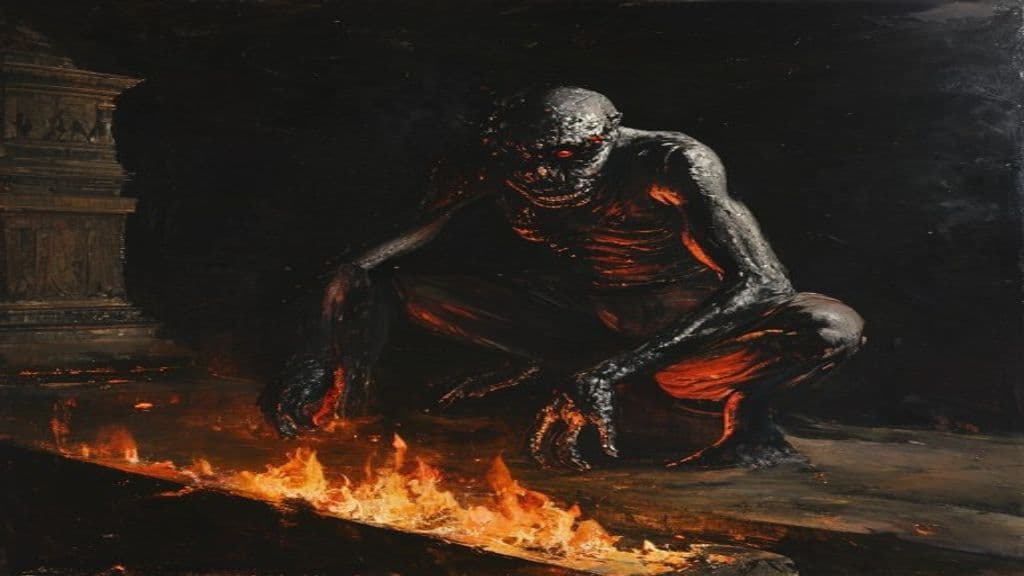
The Pishacha is one of the oldest classified supernatural entities in South Asian tradition, named in the Atharva Veda (c. 1200–1000 BCE) and receiving systematic treatment in the Mahabharata, which lists them alongside Rakshasas, Yakshas, and Gandharvas as one of the four major classes of supernatural being with distinct characteristics, territories, and relationships to humans.
In Ayurvedic medical tradition, 'pishachabadha' is a recognised clinical category — a form of severe mental disturbance caused by Pishacha possession, with specific symptoms, diagnostic criteria, and treatment protocols. The Charaka Samhita and Sushruta Samhita both describe pishachabadha, which positions the Pishach as simultaneously a supernatural and a medical entity — perhaps the earliest example of a being classified in both registers.
The Manu Smriti names 'pishachavivaah' as the worst of the eight forms of marriage — defined as intercourse with a sleeping or unconscious woman — giving the Pishach a specific association with violation of consciousness and will.
The Pishach is described in classical texts as dark, gaunt, with protruding ribs, blood-red or pale eyes, long matted hair, and skin the colour of ash or deep bruise. It feeds on flesh — particularly at cremation grounds — and is described as visible in firelight at the edge of pyres.
In folk tradition it is associated with specific sensory signatures: the sound of bones cracking with no visible source, a gurgling that resembles but is not quite human speech, and a smell that witnesses describe as rotting flowers — organic sweetness beneath decay.
The Pishach possesses people who are sleeping, unconscious, or in states of reduced volition. Ayurvedic texts describe pishachabadha symptoms with clinical precision: wild laughter alternating with violent rage, sudden dramatic changes in facial expression, speaking in unknown languages or in voices different from the patient's own, eating impure or dangerous things, attacking people without cause, and — notably — an inability to recognise family members.
The Pishach can also inhabit recently deceased bodies, causing them to show signs of continued activity. The Pishach Mochan tank in Varanasi — one of the oldest sacred sites in the city — is named for its function as a site where this entity's hold can be broken.
Weaknesses
- ritualPishachamocha Stotra recitation
- substanceSesame and mustard burned near the afflicted person
Wards
- ritualRitual bath at Pishach Mochan tank, Varanasi
- substanceWearing iron on the person, particularly when visiting cremation grounds
Masaan is a cremation-ground spirit, specifically associated with the ash and bones of the dead — its domain is the burning ghat. Pishach is a flesh-eating demon of a broader class; it haunts battlefields, forests, and crossroads, not only cremation grounds.
Community Record
- [1]Pishachabadha in the Charaka Samhita. Sharma, P.V. (trans.). (1981). Caraka Samhita, Vol. 2. Chaukhamba Orientalia, Varanasi.academic
- [2]Pishacha in Vedic and Epic literature. Hopkins, E.W. (1915). Epic Mythology. Karl J. Trübner, Strassburg.academic
- [3]Pishacha — Wikipedia. Wikipedia contributors. Pishacha. Wikipedia, 2024.wiki