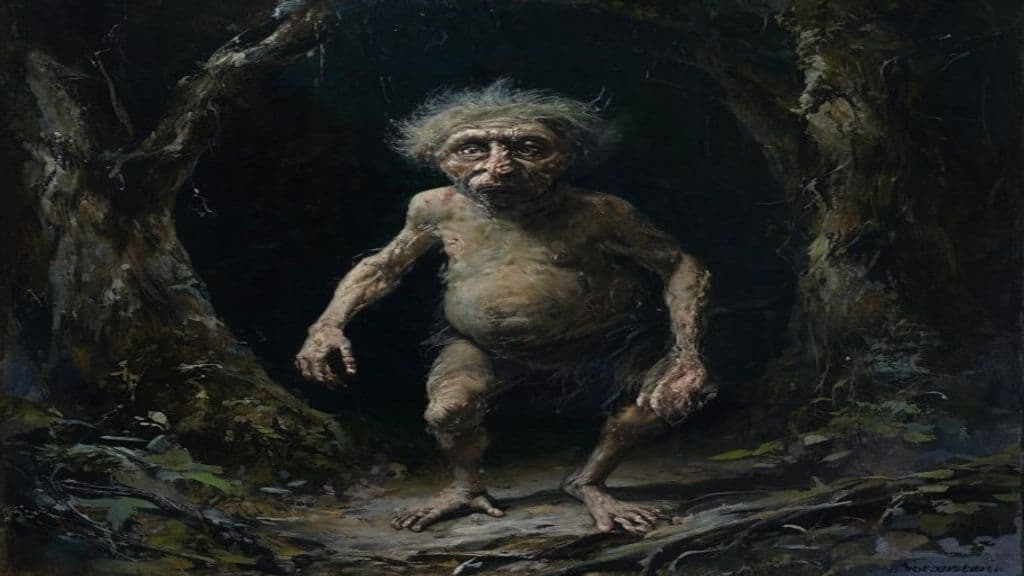
No single origin myth is provided in the available sources. The entity appears in Guaraní-derived popular belief as a long-standing figure of rural cultural heritage across Paraguay and neighboring regions; local names such as Karai Pyhare ('man of the night') and Pyrague ('hairy feet') are recorded, but sources do not give a unified cosmogonic origin.
Accounts commonly describe the Pombero as small, short and ugly, with very short arms and notably hairy hands and feet (the epithet 'Pyrague' highlights 'hairy feet'). Descriptions vary between communities; he is sometimes also said to be difficult to detect, able to pass through narrow openings, or to turn invisible. He may inhabit forests and is also reported to choose abandoned houses, deserted rooms, or empty barns.
Reported abilities and behaviours include stealthy silent approach, invisibility or near-invisibility, squeezing through narrow spaces, imitation of forest and especially nocturnal bird sounds, and a whistle said to announce his coming. Typical mischief attributed to him includes setting loose cattle, stealing eggs, chickens and honey, frightening horses, and scattering provisions such as corn or rice. Some accounts also attribute to him sexual interactions with women—ranging in descriptions from seduction to forced intercourse—and the attribution of certain unexpected or unattractive births to his visits. Depending on treatment, he may be appeased and become protective of household animals and possessions.
Weaknesses
- conditionresponsive to offerings (reciprocal appeasement)
Wards
- substanceCigars
- substanceRum
- substanceHoney
- ritualNightly offerings of rum, cigars, or honey
Polypheme (Polyphemus)
Polypheme (Polyphemus) is a name applied in Greek mythic and later artistic traditions primarily to a cyclops figure tied to the Acis and Galatea narrative and secondly as a variant personal name in heroic genealogies (including as a female name-form associated with Jason's mother). Sources show the name used variably across monstrous, mortal, and artistic contexts rather than as a single unified theological being.
Polyphemus
Polyphemus is the Homeric Cyclops — a one‑eyed giant shepherd who lives outside Greek civic norms, notorious for refusing hospitality and for blinding and being blinded by Odysseus. Later literature reframes him variously as comic, rhetorical, or lovesick, but the core tradition presents him as a liminal, semi‑divine monstrous figure (son of Poseidon).
Polyura dolon
Polyura dolon is a species of large butterfly (rajahs and nawabs group) in the subfamily Charaxinae (Nymphalidae) found across parts of the Indomalayan realm. Sources treat it as a biological species documented in faunal lists, field records, photographic catalogs, and commercial specimen listings rather than a supernatural being.
Polyxenus
Polyxenus (Greek Πολύξενος / Πολύξεινος) is a personal name attested across multiple mortal figures in ancient Greek mythic-historical tradition — notably early priests of Demeter, kings of Elis, a suitor of Helen who fought at Troy, and an alternate name for a son of Jason and Medea. The bearers are placed within legendary genealogies and cultic topography rather than the category of supernatural beings.
Polyxo
Polyxo (Greek Πολυξώ) is a recurring personal name in ancient Greek mythic genealogies and narratives. Rather than a single consistent supernatural being, multiple distinct figures bearing this name appear as Oceanid or Naiad water-nymphs, a Lemnian seeress/nurse, a Maenad, and mortal queens or wives tied to cycles such as the Argonautica, the Danaids, and the aftermath of the Trojan War.
Pomba Gira
Pomba Gira is an Afro-Brazilian female spirit invoked in Umbanda and Quimbanda who personifies feminine sexuality, desire, and liminality; she functions as a consort to Exu, is petitioned for matters of the heart, and is treated with respect because of her reputed wrath and power in ritual possession.
Pontianak (Kuntilanak)
A Southeast Asian female vengeful spirit common in Malay‑language traditions, often portrayed as the restless ghost of a woman who died in traumatic circumstances; she commonly appears as a beautiful woman who may reveal a monstrous form and is associated with banana and banyan trees.
Pontus
Pontus is attested in the supplied sources primarily as a Greek theonym meaning "sea" (Πόντος, Póntos) and as a geographic/ethnic designation for the region on the southern coast of the Black Sea. The corpus does not provide evidence of Pontus functioning as a discrete, living folkloric spirit with attendant rituals or abilities.
Ponyo
Ponyo is a fictional goldfish-like child with a human face from the Studio Ghibli film Ponyo on the Cliff by the Sea. Born as Brunhilde to the underwater wizard Fujimoto and the powerful maternal figure Gran Mamare, she escapes to the human shore, bonds with a boy named Sōsuke, and uses potent magic whose release threatens the balance between sea and land.
Pop (ghost)
Pop (Thai: ปอบ, Pop or Pob) is a Thai folkloric spirit believed to inhabit or possess a living person (commonly a sorceress) and to leave the host at night to feed on human viscera, especially intestines. Village traditions describe types, hereditary or transmissible lines, face-switching deception, and a hierarchical superior spirit (Ha Gom) that commands lesser Pops.
Popobawa
Popobawa is a recent folkloric shetani (malicious spirit) from Zanzibar and coastal Tanzania, blamed for nocturnal assaults, poltergeist-like disturbances and episodes of community panic. Reports describe it as a shapeshifting, night-attacking spirit whose sightings have episodically risen since the mid-20th century and that is met locally with charms, exorcisms and communal vigilance.
Poroniec
A hostile supernatural being in Slavic folklore believed to arise from stillborn fetuses or improperly buried infant remains; considered especially dangerous because of the unrealized potential of the life lost and connected to taboos and household burial practices.
Community Record
- [1]Pombero. Wikipedia: 'Pombero' article (summary of names, appearance, behaviours, offerings, and cultural context).wiki
- [2]Pombero (Wikidata). Wikidata entry for Pombero (corroborative descriptor).other
- [3]TPP 4 - Tomar Distancia (archive listing mentioning Pombero). Archive listing and program references noting cultural presence in media discussions.other
- [4]La Toscana Mística Programa 3 (archive listing mentioning Pombero). Archive listing indicating documentary/popular mention of the Pombero in regional media.other