
Accounts vary across sources. Common origin motifs describe the Pontianak as the vengeful spirit of a woman who died in traumatic circumstances — especially death during pregnancy, stillbirth, or suicide after betrayal by a husband — which causes her to return as a hostile revenant. A related lineage motif appears in some sources that treat the Kuntilanak as connected to (or described as the stillborn child of) the Langsuir, another Southeast Asian female ghost, indicating multiple overlapping origin narratives rather than a single canonical genealogy.
Typically described as taking the form of a beautiful woman, often wearing white and presenting a virginal or pristine exterior to attract victims. Sources note she will reveal a monstrous, ugly true form when necessary. Folkloric descriptions frequently associate her with banana trees and banyan leaves or roots; some accounts state Pontianak 'live on banana trees' or 'erupt from banyan leaves', indicating recurring tree‑linked imagery rather than a singular habitat.
Portrayed as a vengeful revenant that targets the living — especially men — and is commonly framed as analogous to a vampire in Southeast Asian folklore. Sources describe her as feeding on male flesh or blood in some accounts and as using an alluring female guise to lure victims before switching to a monstrous form to attack. Behavior and motivations are closely tied to the circumstances of the woman's death, producing narratives of retributive violence against men who wronged her.
Weaknesses
- otherNo consistent canonical weaknesses recorded in supplied sources
Wards
- otherSources provided do not supply specific, consistently attested wards for Pontianak
Hantu
Hantu is a Malay and Indonesian lexical and conceptual category for spirits and invisible beings that includes ancestral souls, animistic nature spirits, and, in modern usage, ghosts or demons. The term covers many named subtypes (e.g., Hantu Raya, Hantu Tinggi) whose forms and roles vary across local traditions.
Hantu Penanggal (Penanggalan)
A nocturnal vampiric entity in Malay ghost myth, the penanggalan appears as a floating disembodied woman's head with trailing organs and entrails and is said from a distance to twinkle like a ball of flame.
Hantu Pocong
A Southeast Asian folkloric ghost understood as a dead body wrapped in an Islamic burial shroud (kain kafan), commonly associated with improper funerary procedure or unresolved death-related matters. Representations range from a hopping wrapped corpse in popular media to esoteric readings that interpret the phenomenon as residual energetic or liminal-layer disturbance.
Jin (Malay/Javanese spirit)
No information about a Malay or Javanese spirit called 'jin' is present in the provided source. The supplied material discusses Malaysian Malay ethnicity and does not contain data on supernatural beings, their appearance, abilities, rituals, or cultural role.
Langsuir
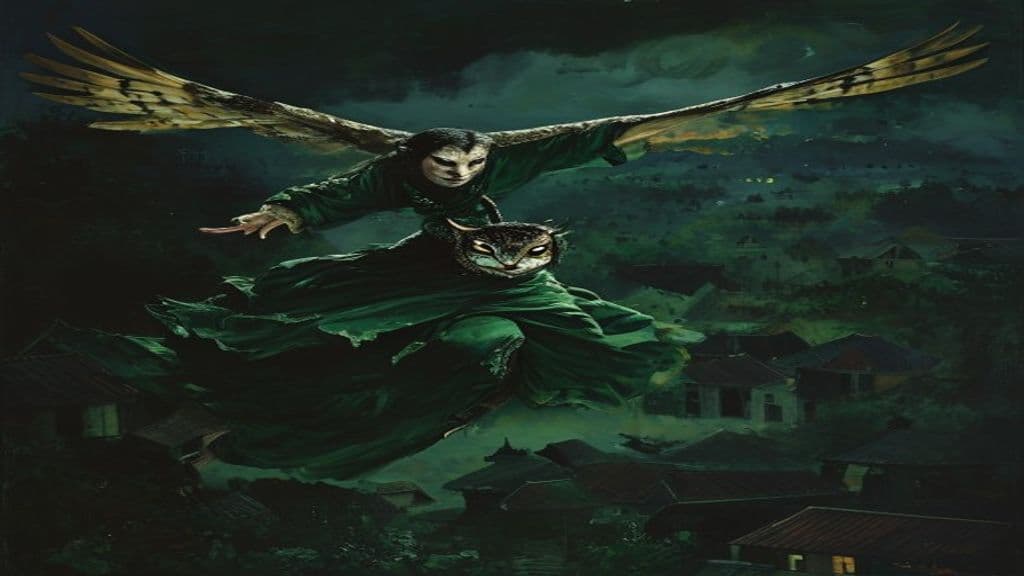
A Malay banshee-vampire — the spirit of a woman who died in childbirth, transforming into a beautiful owl-woman who sucks the blood of infants through a hole in the back of her neck.
Orang Bunian
The 'invisible people' of Malay tradition — a sophisticated parallel civilization of beings sharing the world with humans but normally unseen, who can abduct or adopt humans who stray into their realm.
Penanggalan
A Malay vampire consisting of a detached human head with dangling organs that flies at night to feed on the blood of infants and new mothers, then soaks its organs in vinegar to reattach.
Toyol
A malevolent fetal spirit used as a supernatural familiar in Malay and Javanese black magic — typically stolen or purchased from a dukun, fed blood, and set to steal from neighbors.
Pomba Gira
Pomba Gira is an Afro-Brazilian female spirit invoked in Umbanda and Quimbanda who personifies feminine sexuality, desire, and liminality; she functions as a consort to Exu, is petitioned for matters of the heart, and is treated with respect because of her reputed wrath and power in ritual possession.
Pombero (Pombéro)
The Pombero is a small-statured nocturnal humanoid figure from Guaraní-derived folk belief in Paraguay and neighboring regions. Portrayed as a forest-dwelling trickster and interlocutor with domestic animals and rural households, the Pombero is blamed for mischief (loosed cattle, stolen eggs) and, in some accounts, for unexpected pregnancies; he is commonly appeased with nightly offerings.
Pontus
Pontus is attested in the supplied sources primarily as a Greek theonym meaning "sea" (Πόντος, Póntos) and as a geographic/ethnic designation for the region on the southern coast of the Black Sea. The corpus does not provide evidence of Pontus functioning as a discrete, living folkloric spirit with attendant rituals or abilities.
Ponyo
Ponyo is a fictional goldfish-like child with a human face from the Studio Ghibli film Ponyo on the Cliff by the Sea. Born as Brunhilde to the underwater wizard Fujimoto and the powerful maternal figure Gran Mamare, she escapes to the human shore, bonds with a boy named Sōsuke, and uses potent magic whose release threatens the balance between sea and land.
Community Record
- [1]Kuntilanak (Wikipedia: Pontianak). Wikipedia entry 'Kuntilanak' (Pontianak), summary of Kuntilanak/Pontianak as a vengeful female spirit; notes on appearance, monstrous true form, and relation to Langsuir.wiki
- [2]Pontianak | USC Digital Folklore Archives. USC Folklore Archive entry describing Pontianak as a female monster appearing as a beautiful woman and contextual notes on origins and tree associations.folk
- [3]Pontianak | USC Digital Folklore Archives (Pontianak-2). USC Folklore Archive 'Pontianak-2' entry summarizing vampiric analogy, causes of becoming a pontianak (suicide on discovering infidelity, death during pregnancy), and living on banana trees.folk
- [4]Alluring Afterlives: Decrypting the Parallels Grooved into Yakshi and Pontianak. Comparative analysis linking Pontianak to South Asian yakshi motifs and framing the Pontianak as a tragically wronged woman turned vengeful revenant targeting men.academic
- [5]Mother/Monster - Splice (review/commentary). Discussion of Pontianak imagery in Singaporean folklore: 'a vengeful female vampire... erupts from banyan leaves to feed on male flesh' and the 'pristine, innocent shell' motif.other
- [6]Ghosts in Malay culture (Wikipedia). Overview situating Pontianak among Malay hantu traditions and noting syncretic influences (animist, Hindu‑Buddhist, Islamic) shaping ghost beliefs in the region.wiki
- [7]Cine‑Excess interview: 'Banana Trees And Bloodbaths: The Pontianak As A Disruptive Postcolonial Feminist Body' (Rosalind Galt). Interview and film criticism describing Pontianak's circulation in film and postcolonial/feminist readings of the figure.other
- [8]Strange Horizons: 'Tiger Style And Other (Post)colonial Metamorphoses' (Mikko Toivanen). Commentary on cross‑community circulation and postcolonial metamorphoses of regional folkloric figures including the Pontianak in modern contexts.other
- [9]Sumpah Pontianak (Malay language page referenced). Malay language page referenced in source notes that mentions learning phrases 'if attacked by a pontianak'; specific ritual text not reproduced in supplied excerpts.folk
- [10]Malay Magic. Skeat, Walter William. 1900. Malay Magic: An Introduction to the Folklore and Popular Religion of the Malay Peninsula. Macmillan.academic
- [11]Supernatural in Malay Tradition. Winstedt, Richard. 1925. Shaman, Saiva and Sufi. Constable.academic