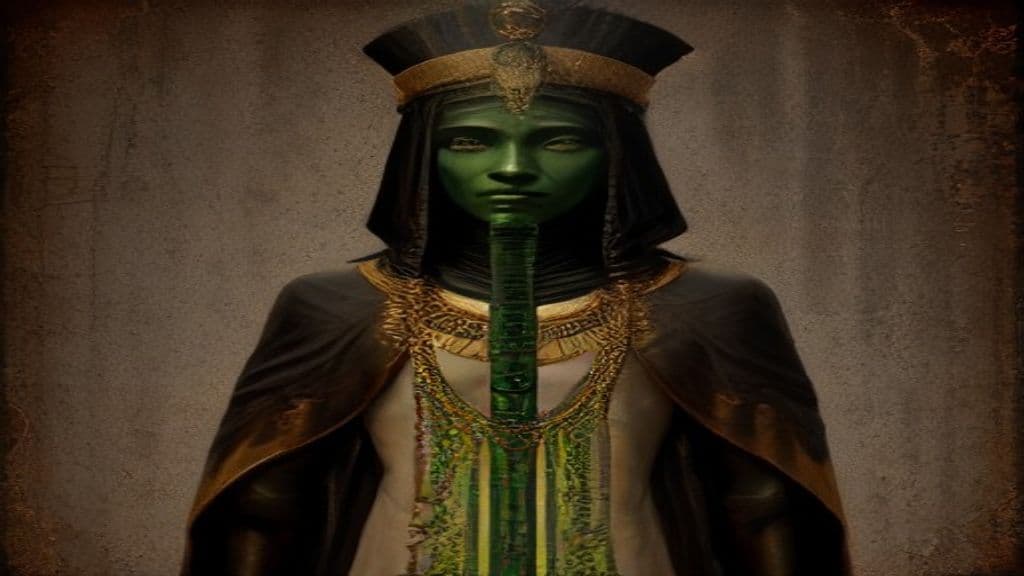
In the Memphite theological tradition Ptah is presented as the divine craftsman and origin-principle who conceives the world internally and brings it into being by the power of speech. Texts associated with the Memphite tradition (notably material preserved on the Shabaka Stone) describe Ptah as forming the design of the world 'in the heart' and giving life 'through this heart and this tongue', thus situating creation as an intellectual and uttered act within Memphis religious thought.
Ptah is typically depicted as a mummiform man with dark (green or black) skin, clothed in a close-fitting shroud and wearing the divine beard. He holds a composite sceptre combining the Was, Ankh, and Djed symbols. In syncretic hypostases he appears in funerary shroud form (Ptah‑Sokar‑Osiris) — human, half-human/half-hawk, or falcon variants — used in tomb statuary. In his Tatenen aspect he is shown as a youthful man wearing a crown of two tall plumes (sometimes associated with solar symbolism). In later periods representations include dwarf forms; Ptah’s imagery in the Late Period and popular contexts may be found alongside figures like Bes.
Ptah functions as a creator-deity whose creative mode is cognitive and verbal: the world is conceived in his heart and realized by his tongue/speech (as recorded in Memphite theological texts). He is the patron and divine exemplar of craftsmen and architects; historically, the high priests of Ptah served as master craftsmen and chief architects on royal funerary projects. Ptah acts as master of ceremonies in royal ritual (including roles in coronation contexts and the Heb Sed festival), an intercessory deity who 'listens to prayers' (cult architecture such as carved ears marks this receptive role), and in syncretic forms (with Sokar and Osiris) a necropolis patron whose statuettes accompany and protect the dead. In his Tatenen aspect he is associated with subterranean/volcanic fire, metalworking, and geophysical forces (earth tremors), reverenced by metalworkers and blacksmiths.
Weaknesses
- otherNo traditional vulnerabilities attested
Wards
- symbolPtah‑Sokar‑Osiris statuettes placed in tombs (funerary protective function)
- symbolCarved large ears on the sanctuary enclosure (cult signifying Ptah's listening/intercessory role)
Community Record
- [1]Ptah - Wikipedia. Wikipedia, 'Ptah' entry summarizing Ptah's roles, iconography, syncretism, and cult history.wiki
- [2]Ptah (Wikidata). Wikidata entity for Ptah (classification and identifiers).other
- [3]The Shabaka Stone (Ancient Egyptian Texts) at Attalus. Attalus compilation of ancient Egyptian texts including the Memphite theology on the Shabaka Stone (creation by heart and tongue).academic
- [4]Ptah - in ancient sources (Attalus names index). Attalus index and references for Ptah in ancient sources.academic