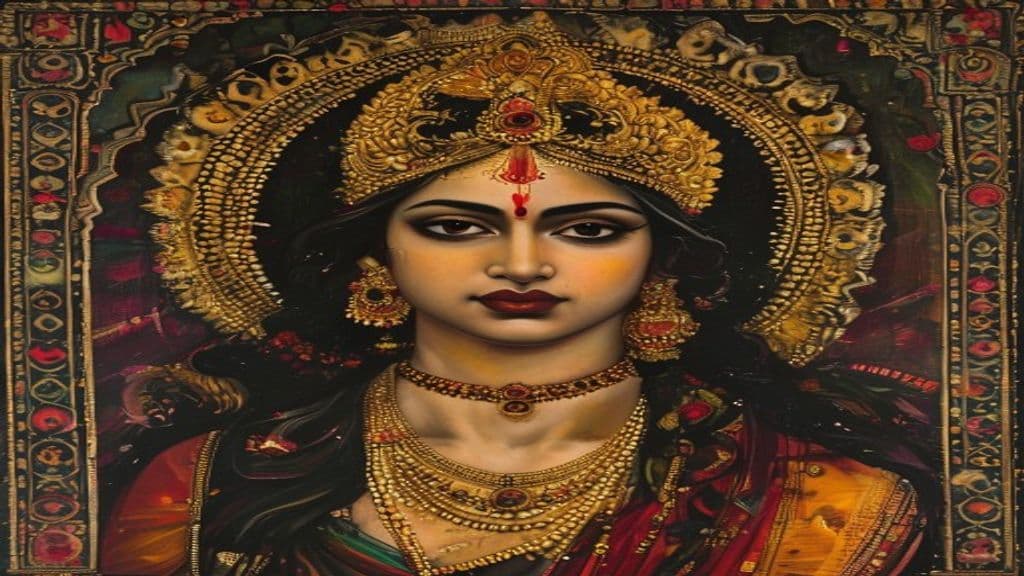
Radha's prominent literary role develops within medieval Indian devotional literature and Puranic accounts. Her first major canonical poetic prominence is conventionally dated to the 12th century Gita Govinda of Jayadeva, which foregrounds the Radha–Krishna romance; later Bhakti poets of the 15th–16th centuries (e.g., Vidyapati, Chandidas, Meera Bai, Surdas, Swami Haridas, Narsinh Mehta) further amplified her devotional stature. Puranic and tantric texts cited in the tradition (for example, passages discussed in secondary summaries of Devi-Bhagavata Purana, Brahma Vaivarta Purana, and the Rādhātantram) present her variously as an avatar or aspect of Lakshmi, as Mūlaprakriti or hlādini-śakti (the internal/pleasure potency of Krishna), and in some streams as an autonomous supreme goddess.
Source traditions provide epithets and iconographic roles rather than a single standardized physical description. Devotional literature commonly styles her with names such as Gaurangi (complexion bright as gold), Kishori (youthful maiden), and Vrindavaneshvari (queen of Vrindavan), and identifies her as chief among the Braj gopīs and as queen of Goloka/Braj. These titles function in poetry and worship to evoke her feminine beauty, youthful charm, and regal status within the pastoral-cosmic setting of Krishna's līlās, rather than to supply fixed sartorial or color specifications.
Across the cited sources Radha's primary 'powers' are theological and devotional: she embodies supreme love, tenderness, compassion, and devotion (the paradigmatic devotee/lover), and in many theological accounts she is identified as Krishna's internal potency (hlādini-śakti) responsible for divine attraction and pleasure. Certain texts attributed in summaries (notably the Rādhātantram) portray her as an independent and authoritative goddess—in that portrayal Krishna is depicted as her disciple, which indicates a role in which she functions as guru and spiritual sovereign. The sources do not catalogue folk-magical feats or malevolent acts; her agency is primarily relational, emotional, and metaphysical within Vaishnava theology and bhakti literature.
Weaknesses
- otherNo mythic weaknesses recorded in the cited sources
Wards
- otherNo warding or protective antidotes against Radha are described; traditions center on worship and devotion rather than protective ritual
- ritualDevotional liturgical practices (e.g., recitation of sahasranamas and hymns) as modes of propitiation
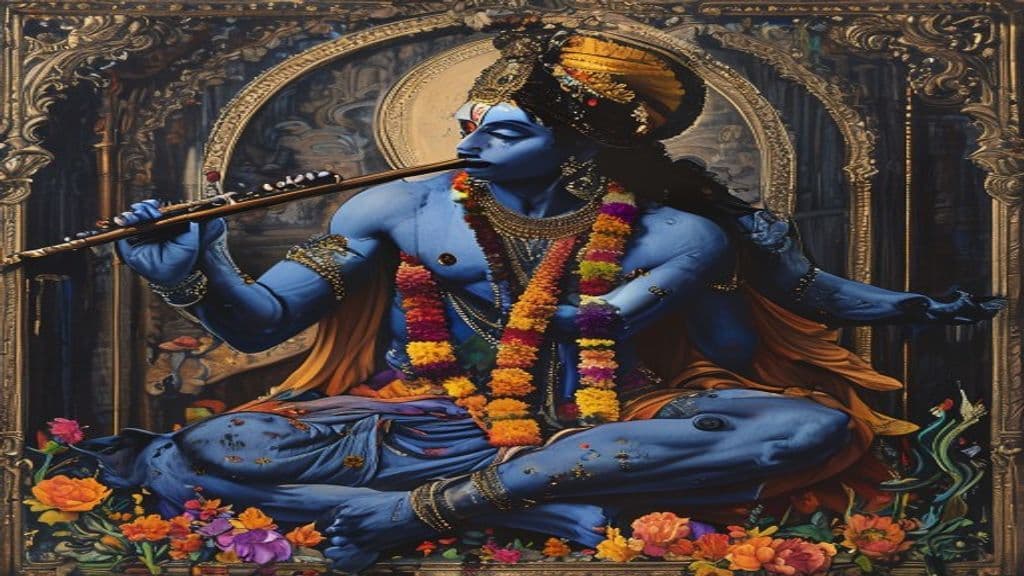
Krishna
Krishna (Sanskrit: Kṛṣṇa) is a major Hindu deity presented in the supplied sources both as the eighth avatāra of Vishnu and, in many traditions, as the Supreme Being (Svayam Bhagavān). He appears in a range of roles—child, cowherd, lover, charioteer, teacher and divine hero—and his life episodes (Krishna-līlā) are central to bhakti devotion, performance arts, and pilgrimage traditions.
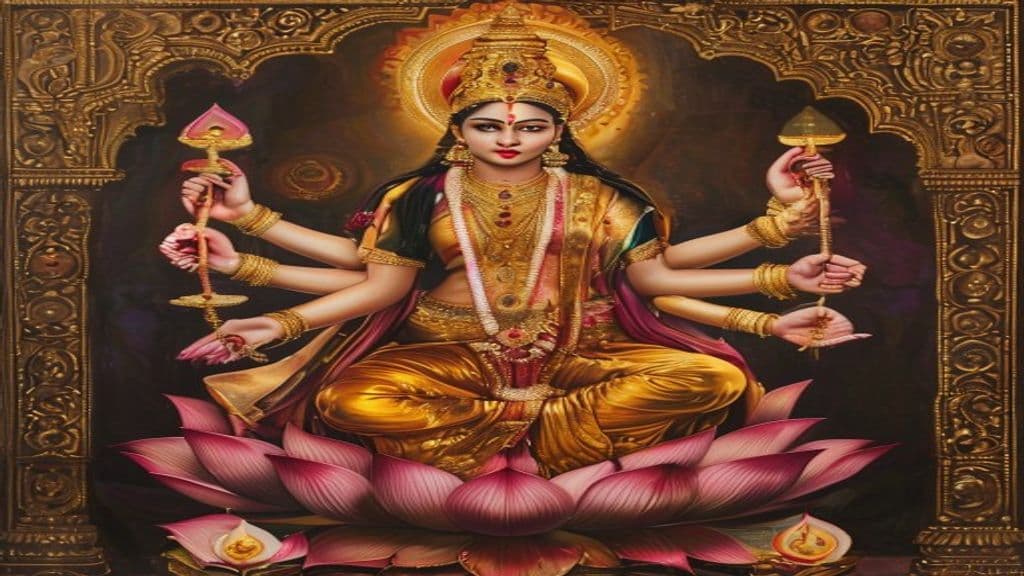
Lakshmi
Lakshmi is a principal Hindu goddess who personifies śrī (auspiciousness) and is revered as the giver of fortune, wealth, prosperity, beauty, fertility, sovereignty, and abundance. She is the consort and shakti of Vishnu in Vaishnavism, part of the Tridevi with Parvati and Sarasvati, and is the focus of popular devotional and festival practices such as Lakshmi Puja during Deepavali and Navaratri.
Achyuta
Achyuta (Sanskrit: अच्युत, acyuta) is primarily an epithet/theonym in Vaishnava Hindu tradition applied to Vishnu and Krishna, signifying the divine quality of being 'not fallen' — immutable, infallible, and imperishable. It functions as a devotional name in scripture, liturgy, and Pancharatra lists of divine emanations rather than as an autonomous folkloric spirit.
Aniruddha
Aniruddha is a mythological Vrishni prince and warrior in Hindu narrative (notably the Bhagavata Purāṇa), grandson of Kṛṣṇa and Rukmiṇī, son of Pradyumna and Rukmavatī. He is portrayed as a dynastic hero (a mahārathi), participant in the Uṣā–Bāṇāsura episode, father of Vajra, and—in certain Vaiṣṇava theological schemes—counted among the catur-vyūha and associated with the boar (Varāha) theriomorph.
Avatar (avatāra)
In classical Hindu theology, an avatāra is a divine 'descent' — the event or fact of a superhuman being or deity making a material appearance in the temporal world to accomplish a purpose (commonly to restore dharma). The term (Sanskrit अवतार, avatāra) emphasizes crossing down from the unconditioned into conditioned existence and is central to Vaishnava theology of Vishnu's incarnations while also appearing in other Indian religious contexts.
Dashavatara
Dashavatara (Sanskrit: daśāvatāra) names a canonical set of ten principal incarnations of the Hindu god Vishnu, each a full descent (avatara) taken to restore cosmic order (dharma) at moments of great disorder. The list and order of the ten vary by Purānic and sectarian traditions; the concept functions across mythology, temple cult, and devotional practice.
Devi
Devi (Sanskrit: Devī) is the general term for goddess in Indian religious thought, signifying the divine feminine or Shakti; in different texts and traditions she appears as individual goddesses (e.g., Parvati, Lakshmi, Saraswati) or as the supreme reality (notably in Shaktism and certain Upanishads). Sources treat Devi both as a class/category of female divinities and as a philosophical identification with ultimate reality.
Hindu deities
Hindu deities (Deva/Devi) are the diverse gods and goddesses recognized across Hindu traditions, ranging from Vedic forces of nature to later personalized major gods and goddesses. They function as patrons of rites, embodiments of moral and cosmic principles, and focal points for temple cults, festivals, and devotional traditions while often also being interpreted as aspects of a single Ultimate Reality (Brahman).
Krishna
Krishna (Sanskrit: Kṛṣṇa) is a major Hindu deity presented in the supplied sources both as the eighth avatāra of Vishnu and, in many traditions, as the Supreme Being (Svayam Bhagavān). He appears in a range of roles—child, cowherd, lover, charioteer, teacher and divine hero—and his life episodes (Krishna-līlā) are central to bhakti devotion, performance arts, and pilgrimage traditions.
Lakshmi
Lakshmi is a principal Hindu goddess who personifies śrī (auspiciousness) and is revered as the giver of fortune, wealth, prosperity, beauty, fertility, sovereignty, and abundance. She is the consort and shakti of Vishnu in Vaishnavism, part of the Tridevi with Parvati and Sarasvati, and is the focus of popular devotional and festival practices such as Lakshmi Puja during Deepavali and Navaratri.
Para Brahman
Para Brahman (Sanskrit: परब्रह्म, parabrahma) is a Hindu metaphysical designation for the Supreme Brahman — the highest, ultimate Reality described as beyond all descriptions and conceptualisations. Depending on school it denotes the attribute‑less absolute (nirguṇa) or the supreme personal God (saguṇa) identified with a sectarian deity.
Satyabhāmā
Satyabhāmā is a goddess in the Krishna-centered Vaishnava tradition, presented as one of Krishna's chief/third consorts and as an incarnation of Bhūmi (the Earth) and an aspect of Lakshmi; she appears in scriptural episodes (notably the pārijāta episode in Śrīmad-Bhāgavatam) and in living devotional and performative contexts (temples, classical dance).
Swaminarayan
Swaminarayan (born Ghanshyam Pande; 1781–1830) is a historical religious leader who founded the Swaminarayan Sampradaya. Within that tradition he is venerated as a manifestation of Krishna/Narayana/Purushottama, the teacher who established temples, scripture (notably the Shikshapatri), monastic orders, and diocesan organization via the 1826 Lekh.
Radagast (the Brown)
Radagast is a fictional Maiar in J. R. R. Tolkien's legendarium, one of the Istari sent to Middle-earth and chiefly associated with wild animals, plants, and the natural world. He appears only briefly in Tolkien's works and functions largely to aid other characters and to exemplify a nature-focused strand within the Istari.
Community Record
- [1]Radha — Wikipedia. Wikipedia contributors. "Radha." Wikipedia, The Free Encyclopedia. https://en.wikipedia.org/wiki/Radhawiki
- [2]Wikidata: Radha (Q15411472). Wikidata entry Q15411472 for 'Radha'. http://www.wikidata.org/entity/Q15411472other