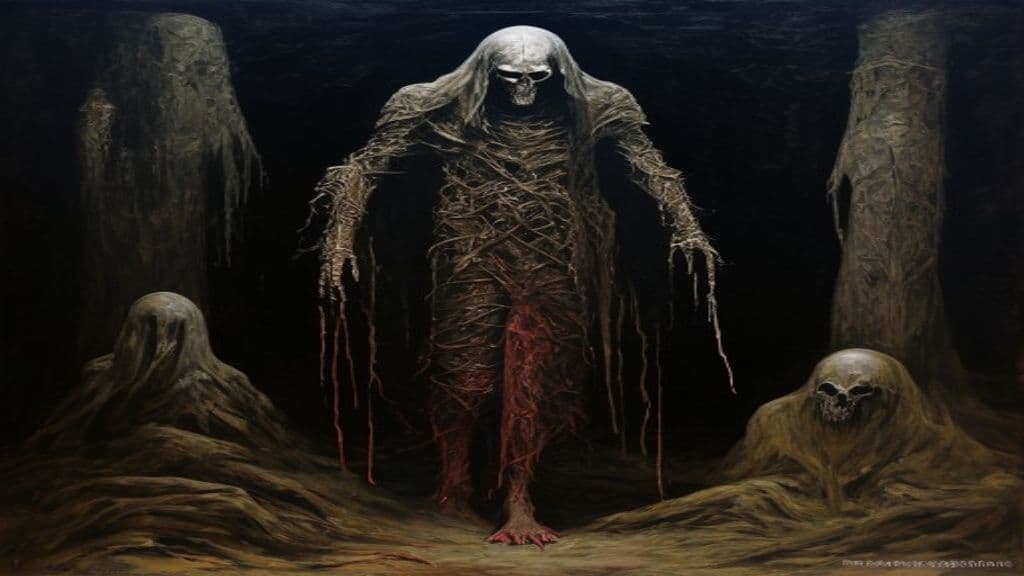
There is no single origin myth across sources; rather, the revenant functions as a cross-cultural folkloric category for dead persons who 'return' to the world of the living. In medieval chronicling (e.g., William of Newburgh) revenant episodes are narrated as extraordinary returns—sometimes framed as moral warnings—while archaeological and folkloric records show communities taking preventive measures in burial practice to stop the dead rising. Some traditions link revenant phenomena to disturbed burials or to human sorcery (as in comparative scholarship that echoes vampire-sorcery connections).
Appearance varies by tradition: from insubstantial ghostly manifestations to vividly corporeal, swollen or blood-suffused bodies recently issued from graves. Norse terms highlight differences of emphasis—aptrgangr ('again-walker') stresses walking dead; haugbui ('howe-dweller') indicates a corpse inhabiting a burial mound; draugr often denotes a corporeal, resisting presence. Medieval anecdote describes a swollen, blood-suffused wrapped corpse; other accounts describe decayed or animated corpses.
Revenants commonly haunt, wander among, and sometimes injure or kill the living. In medieval English accounts a revenant wandered courts and houses and caused fatalities; Norse narratives portray barrow-wights or draugar engaging in direct confrontation and sometimes resisting conventional weapons, requiring special destructive measures. Some comparative scholarship links certain revenant stories to blood-sucking or vampire-like activity, and Finnish 'dead-child' cases indicate restless spirits that can be laid by Christian rites—showing variation in causes and behaviors across traditions.
Weaknesses
- conditionincineration (burning the corpse)
- conditiondecapitation or removal of head
- otherphysical disabling (stones in jaw, legs bound, body parts removed) as preventive measures
- ritualChristian rites (baptism) for certain Finnish 'dead-child' beings
Wards
- otherstones placed over legs
- otherstones placed in the jaw to prevent speech
- otherbodies lodged with bricks or parts removed during burial
- rituallocking doors and remaining inside until sunrise
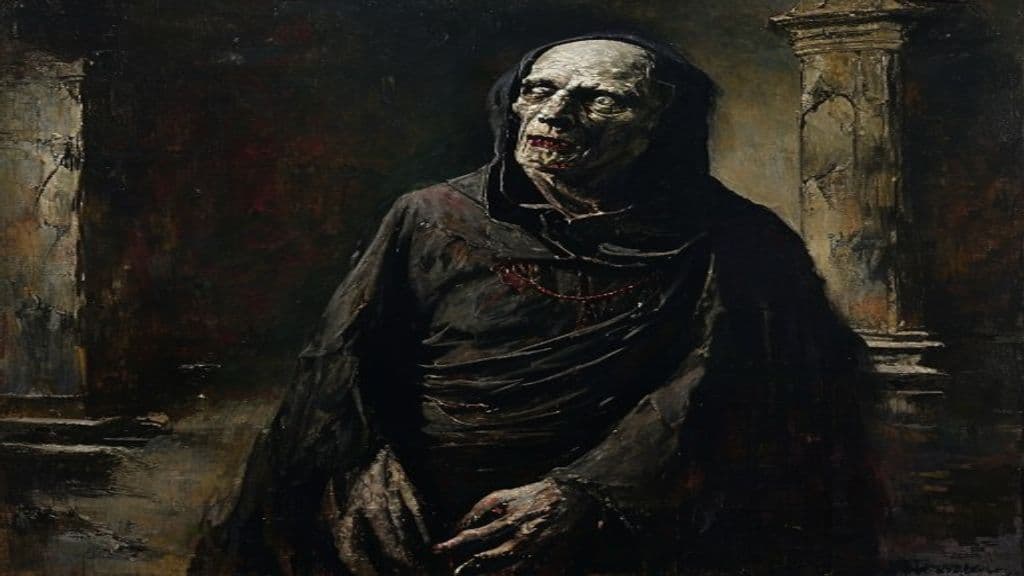
Vampire (tradition)
A class of revenant beings in southeastern and eastern European folk belief that subsist by feeding on the vital essence (generally blood) of the living. Recorded chiefly in early modern to modern oral traditions, these vampires are typically described as reanimated corpses whose presence explains unexplained illness, death, and post-mortem disturbances in their communities.
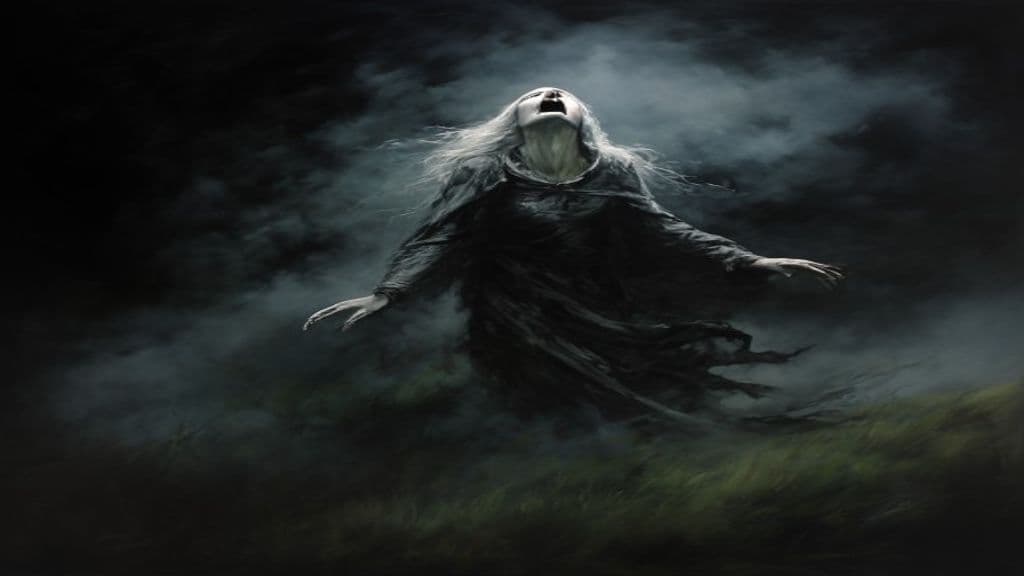
Banshee
A female spirit of Irish and Scottish folklore whose wail heralds an impending death in a family of Gaelic descent. Not a cause of death — a witness to it.

Draugr
In Nordic folklore the draugr (plural draugar; anglicized draug) is an archaic term for a malevolent revenant — a dead person who returns and remains active in the world of the living. Accounts emphasize variability: traits, behaviours, and descriptions change between stories and across regions, especially in early medieval Icelandic sagas and surviving Norwegian folklore.
Antero Vipunen
A giant in Finnish mythology with valuable spells and knowledge, possibly associated with underworldly powers. (Note: * Power tier should be Ancient (deity-level) due to possessing "very valuable spells and knowledge", which suggests immense magical power but not necessarily cosmic-level. * Appearance should clarify )
Baldr
Baldr (Old Norse Baldr; Old English Bældæġ; Old High German Balder/Palter) is a god in Germanic mythology. In the Norse branch he is named as a son of Odin and Frigg and as a member of the Aesir, attested alongside brothers such as Thor and Váli in the supplied sources.
Black Shuck
A spectral black dog of East Anglian legend, with glowing red or green eyes. Its appearance is an omen of death. Its howl has been heard on clifftops during storms for centuries.
Bäckahäst
A Scandinavian water-horse figure: a horse-shaped water spirit associated with streams, rivers, lochs and other watery edges. Presented in comparative folklore as a member of the wider water-spirit or ‘water-horse’ family that functions as a cautionary figure about the hazards of water and unknown horses at the water’s edge.
Deildegast
A Norwegian folkloric ghost bound to boundary stones as postmortem punishment for those who moved or tampered with property markers; compelled to attempt to restore displaced stones but never succeeding, it serves as a social deterrent against moving borders.
Deutsche Mythology
A collection of mythological narratives representing the collective myths, legends, and beliefs of ancient Germanic cultures. (Note: 1. Power tier: Primordial (Deutsche Mythology as a collective mythological narratives does not have supernatural abilities and behaviors attributed to it; rather, it contains those of individual Germa)
Domar (Dómarr)
Domar (Old Norse Dómarr, 'Judge') is a legendary Swedish king of the Yngling dynasty attested in medieval Scandinavian genealogical sources. He is presented as a mytho-historical ancestral ruler whose long and peaceful reign follows the sacrificial death of his father Domalde and whose own death was marked by cremation at Fyrisvellir and erection of a memorial stone at Uppsala.
Dragon (Long)
Long (龍, "dragon") is a pervasive cultural and artistic motif that appears in Taoist sacred-geographical contexts, Chinese literature, and modern exhibitions; the provided sources treat it as part of the broader mythic imagery present around Taoist sites and ritual scenes rather than as a single, consistently described doctrinal entity.
Draugr
In Nordic folklore the draugr (plural draugar; anglicized draug) is an archaic term for a malevolent revenant — a dead person who returns and remains active in the world of the living. Accounts emphasize variability: traits, behaviours, and descriptions change between stories and across regions, especially in early medieval Icelandic sagas and surviving Norwegian folklore.
Dís (dísir)
In Norse/North Germanic tradition, a dís (pl. dísir) is a collective term for female supernatural beings whose roles range from protective ancestral spirits and fertility figures to fate‑linked women comparable to valkyries or norns; they are invoked in both private and public cult (notably the dísablót) and can be benevolent or hostile toward humans.
Einherjar
Warriors who died in battle and were brought to Valhalla by valkyries, playing a crucial role in the events leading up to Ragnarök. (Note: - Power tier should be Primordial since they are associated with a cosmic event (Ragnarök) and are not described as deities or regional powers. - Abilities: The einherjar don't actually engage in dail)
Emuu
Emuu is attested in a brief modern catalogue entry as a "mythical creature from Finnish and Karelian folklores." Beyond this short label, the supplied sources contain no descriptive narratives, attributes, or rituals connected to Emuu.
Community Record
- [1]Revenant (Wikipedia). Wikipedia. 'Revenant'.wiki
- [2]Revenant (Wikidata). Wikidata. Q834114.other
- [3]William of Newburgh (medieval chronicle excerpt as cited). Excerpt summarized in the Wikipedia article citing William of Newburgh's account of a revenant in medieval England.literary
- [4]Archived audio/related references (contextual). Archive.org items referenced in source list (contextual material).other
- [5]Archived audio/related references (contextual). Archive.org items referenced in source list (contextual material).other
- [6]Archived audio/related references (contextual). Archive.org items referenced in source list (contextual material).other