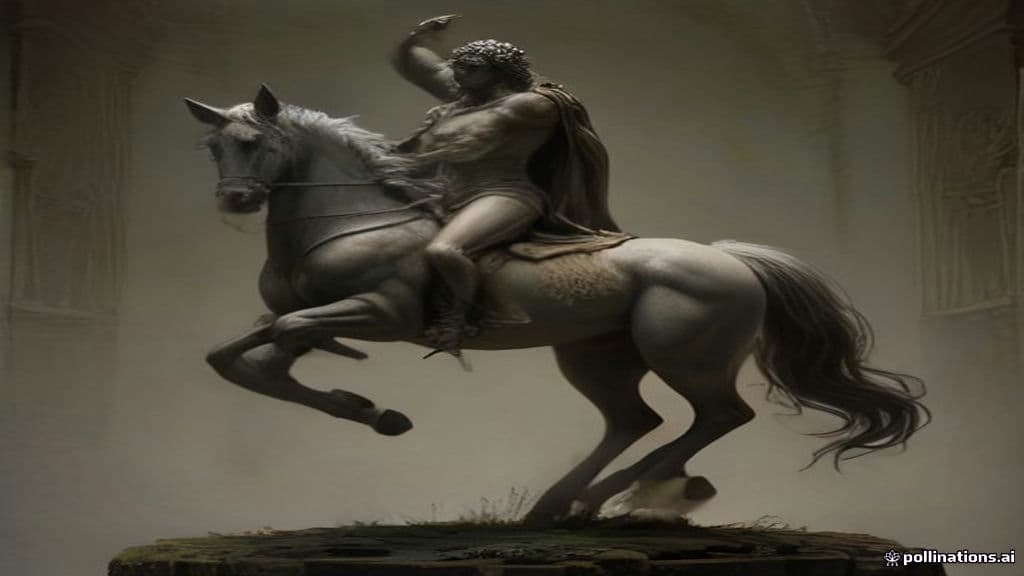
Rhipheus does not have an independently attested birth narrative or origin story in the supplied sources. He is recorded only as an individual name within catalogues of centaurs (Kentauroi) and is included among named centaurs cited in Ovid's Metamorphoses. The sources do not ascribe to him a distinct parentage, birthplace, or founding episode beyond his classification as a centaur.
As a member of the centaur class (Kentauroi) Rhipheus is implicitly portrayed as a half‑man, half‑horse being: the common composite form with human upper body and equine lower body found in classical depictions of centaurs. No detailed iconographic features (colouration, markings, costume) are attested for Rhipheus in the provided excerpts. The only specific descriptive fragment in Ovid is a hyperbolic line comparing him to great trees — “Rhipheus taller than the highest trees” — which functions as a poetic magnification of stature rather than a precise anatomical description.
The supplied sources do not record any unique powers or characteristic deeds for Rhipheus. Beyond the generic traits associated with centaurs in myth (physical strength, horsemanship, and frequent involvement in combative episodes), no catalogue of abilities, magical faculties, or habitual behaviors is preserved for this name. Ovid's brief comparison indicates exceptional height as a poetically noted trait but does not enumerate further capacities or supernatural functions.

Nedymnos
Nedymnos is a named member of the Kentauroi (centaurs) attested only in classical name-lists and modern catalogues; he appears as an individual centaur figure in compilatory sources rather than as a figure with independent narratives or cult. Attestations are limited to a Pauly-Wissowa catalogue entry (via Wikidata) and a modern compilation of Thessalian centaur names (Theoi).

Hippasus (Ἵππασος)
Hippasus is primarily attested as a historical/legendary Pythagorean figure (c. 530–c. 450 BC) associated in later tradition with revealing mathematical discoveries (irrational numbers or geometric constructions) and a cluster of legendary punishments; the same Greek name also appears for several otherwise ordinary mythic characters (centaur, Trojan prince, Thessalian warrior, son of Ceyx) in epic catalogues.
Community Record
- [1]OVID, METAMORPHOSES 12 - Theoi Classical Texts Library. Ovid, Metamorphoses, Book 12 (excerpt as presented on Theoi Classical Texts Library).literary
- [2]CENTAURS (Kentauroi) - Half-Horse Men of Greek Mythology. Theoi.com catalogue of centaur names and brief entries (listing Rhipheus/Ripheus among other centaurs).literary
- [3]Wikidata: Rhipheus (centaur). Wikidata item for Rhipheus (centaur) — limited onomastic entry.wiki