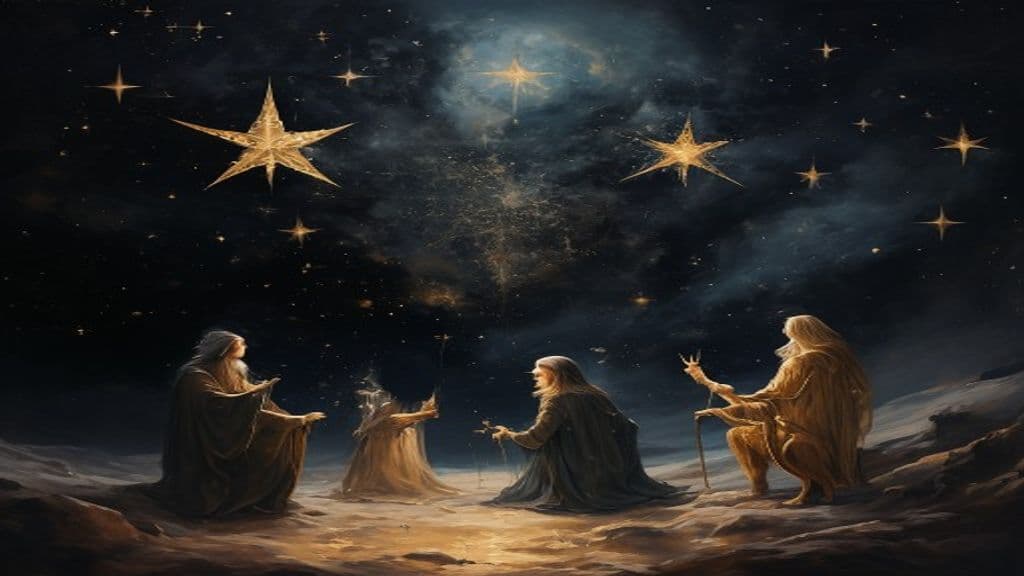
The Royal Stars were considered celestial guardians and markers of the cardinal directions in ancient Persia.
They appear as a group of four prominent stars in the night sky, but their individual appearances are not specified.
They served as celestial markers and indicators of astrological significance, playing a role in the cosmology of ancient Persia.
Rongomai-wāhine
Rongomai-wāhine is presented in the provided sources as a historical/matricentred tupuna (ancestress) and rangatira (chieftainess) from the Māhia Peninsula. Her personal name is the eponym for Ngāti Rongomaiwahine and is invoked in whakapapa that underpins tribal identity, land interests, and contemporary iwi authority rather than describing a supernatural being.
Rongorongo (Māori Ancestress)
An ancestral figure from Māori tradition, associated with the migration of her people to New Zealand. (Note: - Power tier should be Primordial or Ancient, given her association with Hawaiki (a mythological homeland) and ancestral reverence as a ward. - Appearance description needed; source material does not )
Ronove
Ronove is a named spirit from late Western grimoire and Goetic demonological material, listed in the Lesser Key of Solomon corpus as a titled infernal officer (Marquis / Great Earl) who commands legions and is attributed with teaching arts and languages and granting favor. Some modern summaries also describe him as a taker of old souls, but that detail is attested only in secondary summaries in the supplied materials.
Ros Beiaard
Ros Beiaard is a legendary horse figure central to the civic Ommegang festival of Dendermonde, Belgium. In that local tradition it is embodied as an enormous wooden horse effigy paraded through the town on a roughly decennial cycle and is locally understood as the Dutch/Flemish form of the wider Bayard (magical horse) legend.
Rostam's Steed, Rakhsh
Faithful and sagacious horse that accompanies Rostam in most of his Seven Labours. (Note: - Power tier: Primordial (given its association with a legendary hero like Rostam) - Appearance: Needs to be revised to reflect that there is no physical description of Rakhsh - Abilities: More specif)
Roua
Roua is a creator figure attested in a brief summary of Tahiti and Society Islands mythology, described as the creator god of the Tuamotus and the father, by Taonoui, of Fati (the moon god) and the stars.
Ruach
Ruach (רוּחַ) is a Hebrew term used in Jewish and related theological discourse to denote spirit, breath, or wind; it functions as the life‑giving principle that animates living beings and as a mode or influence of God's presence (e.g., Ruach Ha‑Kodesh, the Holy Spirit). The term is primarily conceptual and metaphorical rather than an individualized anthropomorphic spirit in the supplied sources.
Ruakaramea
A great ocean-going canoe in Māori tradition, used for voyaging and exploration in the early migrations that settled New Zealand. (Note: - Power tier: The article should be classified as a Primordial, given its significant role in the early migrations that settled New Zealand. - Weaknesses: There is no information provided about Ruakar)
Ruakerepeti
Ruakerepeti appears in Māori sources as a named tūpuna / individual remembered in oral narrative and material culture. He is recorded in a dispute with Tamatea over ownership of Rangaunu and is named among ancestors carved on a meeting-house koruru and tekoteko.
Ruapani
Ruapani was a historical rangatira (paramount chief) of the Tūranganui-a-Kiwa (Poverty Bay) region of the New Zealand East Coast in the 15th–16th centuries, said to have held paramountcy around 1525. He is an important ancestral figure whose genealogical convergence of high-status lines (including descent from Pawa and Kiwa of the Horouta waka) made his rule undisputed; his residence was Popoia pā and he was ultimately interred in the sacred cave Kohurau at Whare Kōrero. Several hapū and notable later figures claim descent from him, and his legacy anchors local whakapapa and territorial identity.
Ruawharo
Ruawharo is attested in Māori sources primarily as a personal/ancestral name and as a placename element. The name appears for an ancestor and craftsman involved in Tākitimu canoe-making, as an eponym for sites (Ōruawharo River, Ruawharo Marae), and in traditions crediting him with provisioning shellfish for descendants.
Rudaba
Mythological figure in Persian tradition, princess from Kabul and mother to Rostam. (Note: 1. Remove "Primordial" power tier as there is no information in the source material that would suggest Rudaba has cosmic-level abilities. 2. Add a note about her appearance, stating "no explicit descr)
Community Record
- [1]Royal starswiki