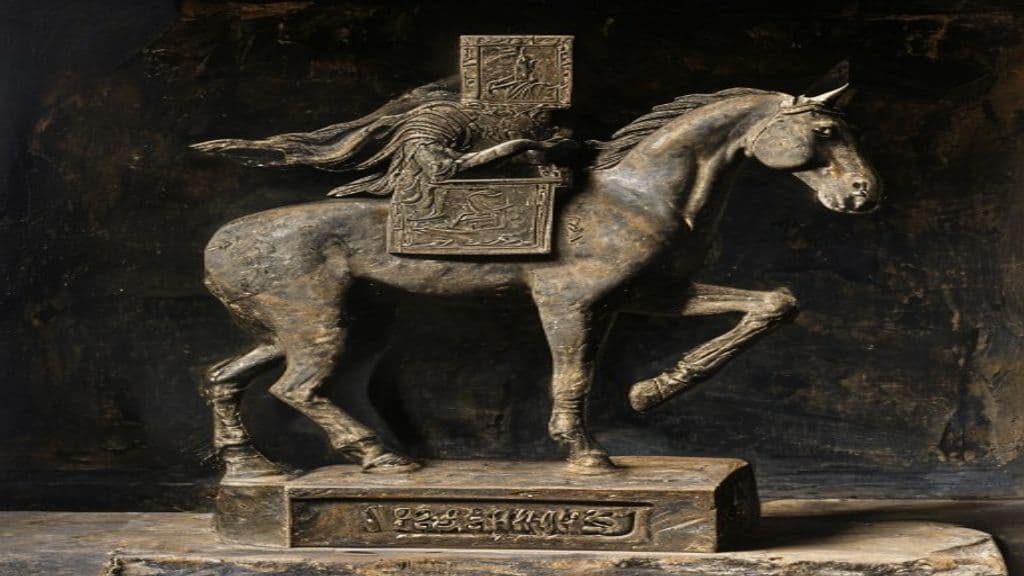
No mythological origin or narrative is preserved in the surviving material. The only attestation is a votive inscription on a bronze horse figurine; beyond this archaeological context no origin story or genealogy is recorded.
No anthropomorphic representation of Rudiobus is preserved. The name appears on a bronze figurine of a prancing horse about one metre high, part of a hoard found at Neuvy-En-Sullias and dated to the 1st century BC. The figurine's inscription describes the object as sacred to the god Rudiobus.
The sources provide no direct statements of abilities, powers, or behaviors. A scholarly suggestion—presented as a hypothesis—is that Rudiobus may be an aspect of the Gaulish version of Mars, which would imply martial or protective associations if accepted; this identification is not established by the primary evidence.
Ruach
Ruach (רוּחַ) is a Hebrew term used in Jewish and related theological discourse to denote spirit, breath, or wind; it functions as the life‑giving principle that animates living beings and as a mode or influence of God's presence (e.g., Ruach Ha‑Kodesh, the Holy Spirit). The term is primarily conceptual and metaphorical rather than an individualized anthropomorphic spirit in the supplied sources.
Ruakaramea
A great ocean-going canoe in Māori tradition, used for voyaging and exploration in the early migrations that settled New Zealand. (Note: - Power tier: The article should be classified as a Primordial, given its significant role in the early migrations that settled New Zealand. - Weaknesses: There is no information provided about Ruakar)
Ruakerepeti
Ruakerepeti appears in Māori sources as a named tūpuna / individual remembered in oral narrative and material culture. He is recorded in a dispute with Tamatea over ownership of Rangaunu and is named among ancestors carved on a meeting-house koruru and tekoteko.
Ruapani
Ruapani was a historical rangatira (paramount chief) of the Tūranganui-a-Kiwa (Poverty Bay) region of the New Zealand East Coast in the 15th–16th centuries, said to have held paramountcy around 1525. He is an important ancestral figure whose genealogical convergence of high-status lines (including descent from Pawa and Kiwa of the Horouta waka) made his rule undisputed; his residence was Popoia pā and he was ultimately interred in the sacred cave Kohurau at Whare Kōrero. Several hapū and notable later figures claim descent from him, and his legacy anchors local whakapapa and territorial identity.
Ruawharo
Ruawharo is attested in Māori sources primarily as a personal/ancestral name and as a placename element. The name appears for an ancestor and craftsman involved in Tākitimu canoe-making, as an eponym for sites (Ōruawharo River, Ruawharo Marae), and in traditions crediting him with provisioning shellfish for descendants.
Rudaba
Mythological figure in Persian tradition, princess from Kabul and mother to Rostam. (Note: 1. Remove "Primordial" power tier as there is no information in the source material that would suggest Rudaba has cosmic-level abilities. 2. Add a note about her appearance, stating "no explicit descr)
Rudras
A plural class of Vedic divine beings regarded as manifestations or attendants of the god Rudra (later identified with Śiva). They function as atmospheric/wind deities, vital forces within the human body, and ritually important gods occupying an intermediate place among the Vedic divinities.
Ruhurater
Ruhurater (also attested as Lahuratil) is an Elamite city-god of Huhnur attested from the Third Dynasty of Ur through Neo-Elamite and Mesopotamian scholarly texts. He functions primarily as a patron deity invoked as a divine witness in legal and administrative contexts and is described in Elamite sources as capable of bestowing kiten (divine protection).
Rukmavati
A minor mythological figure in Hindu tradition, connected to Krishna's lineage as the daughter and wife of Pradyumna. (Note: 1. Power tier: Given that Pradyumna's mother (Rukmini) is mentioned as Krishna's chief wife and an important figure in Hindu mythology, it suggests that Rukmavati may be a more significant character t)
Rukmini
Rukmini is a Hindu goddess and the chief/primary consort of Krishna, revered as an avatar of Lakshmi. She appears in Puranic and epic narratives as a princess of Vidarbha who arranges her marriage to Krishna, later becoming queen of Dvaraka and mother of Pradyumna; she is venerated across multiple Indian devotional traditions and regional cults.
Runic Song (Finnish Tradition)
Oral poetry and national epic representing the collective cultural heritage of Baltic Finnic peoples. (Note: - Power tier: Primordial (it's a national epic representing collective cultural heritage, implying a significant impact on the culture and identity of the Baltic Finnic peoples) - Appearance: missing )
Runtiya
Runtiya is a Luwian deity of the hunt and of deer, venerated in Anatolia from the Bronze Age into the Iron Age and later local contexts. He functions as a protective and hunting patron, depicted anthropomorphically in association with a stag or antlers and receiving offerings (notably gazelles) to secure success in the hunt.
Community Record
- [1]Rudiobus — Wikipedia. Wikipedia, entry 'Rudiobus'.wiki
- [2]Rudiobus — Wikidata. Wikidata item Q224361 (Rudiobus).wiki