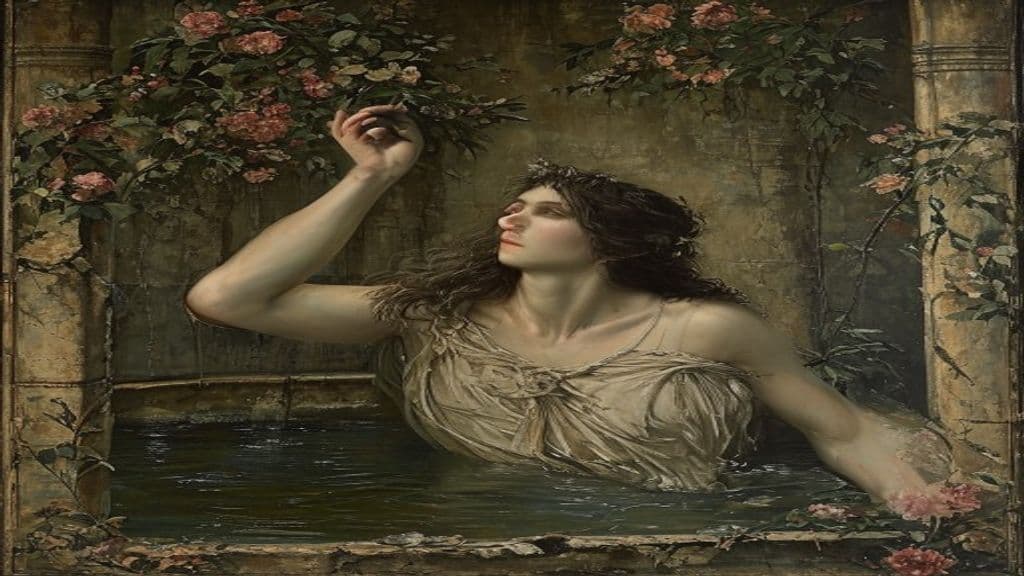
In classical accounts summarized principally from Ovid's Metamorphoses, Salmacis is the named naiad of a pool near Halicarnassus. In Ovid's version she becomes passionately attracted to the youth Hermaphroditus; after he resists and briefly leaves the pool, she throws herself upon him, clings to and kisses him, then prays to the gods that they be joined forever. The gods answer by fusing their bodies into a single being who possesses both male and female parts, and Hermaphroditus curses the fountain so that its waters will (reputedly) render men softer or effeminate. Alternative local traditions recorded by other sources include an Halicarnassian wall inscription naming Salmacis as the nymph who nursed and cared for an infant Hermaphroditus, and a Lucianic implication that Hermaphroditus may have been born hermaphroditic; these variants attribute different causal roles to Salmacis and show the myth's flexible local transmission.
Classical myth-texts do not supply a systematic, detailed physical description of Salmacis beyond depicting her as an active female nymph in and beside her pool. Later artistic representations (for example a fresco in the Casa della Venere in Conchiglia at Pompeii and multiple post‑classical paintings and sculptures) commonly show her as a nymph reclining or seated among reeds at a pond, often portrayed in the moment of encounter with Hermaphroditus and draped in classical garments. Such iconography establishes a conventional image of a pool-nymph but is not a primary textual description in the surviving mythic accounts.
Sources attribute to Salmacis passionate desire and decisive agency in the Ovidian narrative: her pursuit, physical embrace, and subsequent prayer are the proximate causes in the story for the divine fusion of her and Hermaphroditus' bodies (the metamorphosis is explicitly effected by the gods responding to her entreaty). The fountain she personifies acquires an etiological property in classical commentary: its water is reputed to make men 'effeminate and soft.' Variants of the tradition either reduce her role (e.g., as a nurse to the infant Hermaphroditus) or remove causal agency (accounts suggesting Hermaphroditus was born hermaphroditic), indicating that her attributed powers and behaviors vary by source.
Aegaeon
Aegaeon is a name used in ancient Greek myth for multiple figures, most notably a Hecatoncheir sometimes equated with Briareus and also borne by several localized personages (an Arcadian prince, a son of Lycaon, and occasional Giants). The name carries maritime and stormy connotations (etymologized as 'goatish', 'stormy', or 'Aegean') and in some traditions marks a primordial, multiform monstrous kin of the gods.
Aleuas
Aleuas (Greek: Ἀλεύας; Modern Greek: Alevas) is a figure in ancient Greek tradition presented as a mythical king and seer of Thessaly and the eponymous ancestor of the noble Aleuadae family of Larissa. The name also appears for distinct historical individuals and as a modern scientific/commercial homonym, but classical sources treat Aleuas as a legendary human ancestor rather than a recurring supernatural class.
Cyclops
In ancient Greek tradition the Cyclopes are one‑eyed giant beings appearing in multiple, sometimes contradictory strands: Hesiodic primordial artisan brothers who forge the gods' arms; Homeric solitary, cave‑dwelling shepherd‑monsters such as Polyphemus; and a legendary explanation for monumental ‘Cyclopean’ masonry.
Erechtheus
Erechtheus is a mythic-heroic foundational figure of ancient Athens whose identity blends an autochthonous, earth-born ancestor-king with a localized cultic name often syncretized with Poseidon; he functions as eponymous progenitor of the Erechtheidai and as the focus of ritual memory on the Acropolis (the Erechtheion).
Inachus
Inachus (Ἴναχος, Inachos) is a mythic ancestral figure of Argos who functions both as the region's eponymous first king/priest and as a river-divinity descended in some accounts from the Titans Oceanus and Tethys. He appears in etiological narratives that tie Argive territory, cult, and seasonal hydrology to a pre-Olympian generation of river-gods and founders.
Limnades
Limnades (Ancient Greek: Λιμνάδες) are classically attested nymphs associated with lakes in ancient Greek literature. They function as the lake-dwelling subgroup within the broader taxonomy of nymphs and are referenced as resident or offspring-attendants of named lake deities such as Bolbe.
Prometheus
Prometheus is a Titan of ancient Greek myth credited as a benefactor and culture-bringer to humanity, most famously for stealing fire from the Olympian gods and giving it to people. He is portrayed as intelligent and forward-looking (etymologically associated with 'forethought'), and as punished by Zeus for his transgression.
Saint Pimenius
Saint Pimenius (variants: Pigmenius, Pigmentius, Pigmène, Pimenio) is presented in the supplied materials as a Christian holy man and martyr venerated in the Catholic tradition. He is remembered as a tutor to the future Emperor Julian and as a martyr reportedly drowned in the Tiber in 362 AD, with later local cultic remembrance at a monastery in Aquis (Talavera de la Reina).
Salacia
Salacia is the Roman divine personification of saltwater and the calm, sunlit aspect of the sea, frequently portrayed as the consort of Neptune and a sea-nymph attendant within Neptune's court. She functions both as a named deity/nymph and as an invoked attribute of Neptune (e.g., "Salacia Neptuni").
Saleos
Saleos is a named spirit appearing in modern treatments of the goetic grimoire corpus. Contemporary occult commentators list Saleos as a ranked duke/earl-class spirit associated with fertility, sexual influence, and a set of astrological and ritual correspondences used by modern practitioners.
Samael
An angelic figure in Jewish textual traditions whose roles include accuser/adapter (Satanic function), tempter, destroyer/angel of death, and, in later mystical texts, leader of demonic or qlippothic forces. Samael is presented variously across Second Temple literature, midrashim, and Kabbalah; his destructive functions are often framed as serving divine purposes rather than as an independent absolute evil.
Samandar (Jewish tradition)
No documentation in the supplied sources identifies Samandar as a supernatural being in Jewish tradition. The term appears in the provided corpus primarily as a toponym — a medieval city (capital) of Khazaria — and in various modern secular or personal-name usages. Claims about a Jewish spirit named Samandar are unsupported by the given material.
Community Record
- [1]Salmacis (Wikipedia). Wikipedia entry 'Salmacis' summarizing classical sources (including Ovid) and artistic reception.wiki
- [2]Wikidata: Salmacis. Wikidata entry noting the mythic figure and modern name re‑uses.other
- [3]Archive: JSTOR Art Journal reference to Salmacis. Art historical reference to artworks and reception of the Salmacis theme.academic
- [4]Archive: Radio/playlist references to 'Fountain of Salmacis' reception. Broadcast/archive materials citing musical and modern receptions titled after the Fountain of Salmacis.other
- [5]Archive: Mythos, Heroes And Songs (PnR No. 476). Archive entry noting modern cultural receptions of the Salmacis motif.other