In Bengali custom, a woman who dies before her husband is considered auspicious — she dies 'in her sindoor', her marital status intact. But this very auspiciousness can become a trap. A Shakchunni is a married Brahmin woman who died young, before completing her domestic duties, who cannot accept that her life is over.
She haunts the home she was mistress of, or any home with a young married woman whose life resembles what she lost. She is distinguished from ordinary bhuts by the sound of her conch-shell bangles — the shankha that married Bengali women wear — which jangle audibly when she is near.
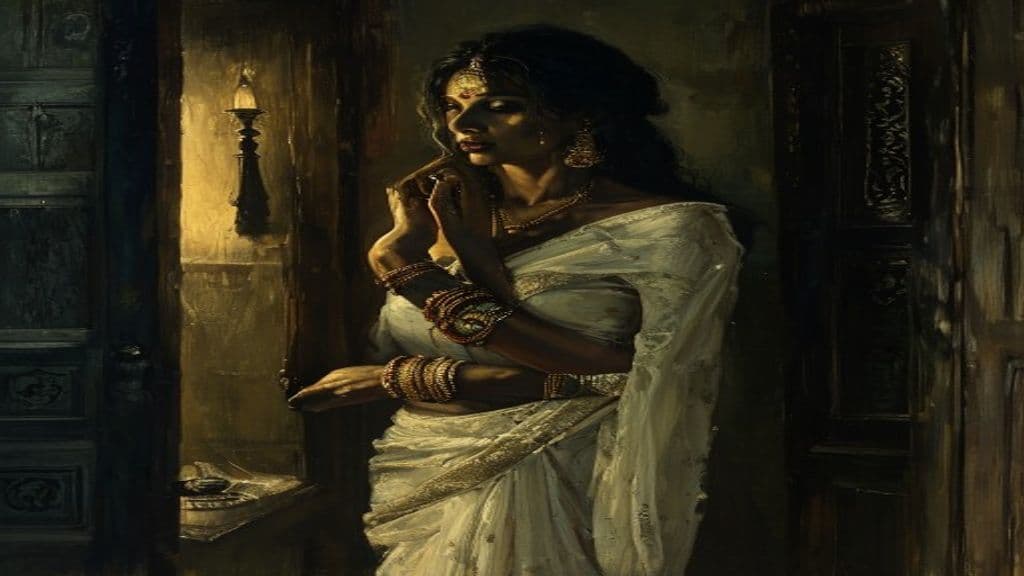
The Shakchunni wears a white sari (the garment of the widow, which she refuses to become) and the red-bordered sari beneath it — the contradiction visible in her dress. Her wrists carry the white conch-shell bangles of the married Bengali woman.
She is not frightening in appearance. She looks like any respectable housewife of the neighbourhood, and can pass unnoticed until the bangles catch attention.
Her primary power is possession of living married women, particularly those who are young, new to a household, or lonely. A possessed woman may take on the Shakchunni's mannerisms, speak of the ghost's living memories as her own, and refuse to leave the home.
She can also cause domestic disruption: fires in the kitchen, spoiled food, and the particular misfortune of things going wrong just as they should be celebrated.
Weaknesses
- ritualExorcism by a Tantrik with iron implements
- substanceIron nail driven into the threshold
Wards
- symbolIron horseshoe above the kitchen door
- mantraRecitation of the Shakti stotram
Petni is the Bengali ghost of an unmarried woman; Shakchunni is specifically the ghost of a married woman — she wears conch-shell bangles, returns to her marital home, and her hauntings center on domestic rituals she can no longer perform.
Community Record
- [1]Female Ghosts in Bengali Folk Tradition. Bandyopadhyay, P. (2001). Bhoot-pret: The undead in Bengal. Kolkata: Ananda Publishers.folk
- [2]Shakchunni — Wikipedia. Wikipedia contributors. Shakchunni. Wikipedia, 2024.wiki