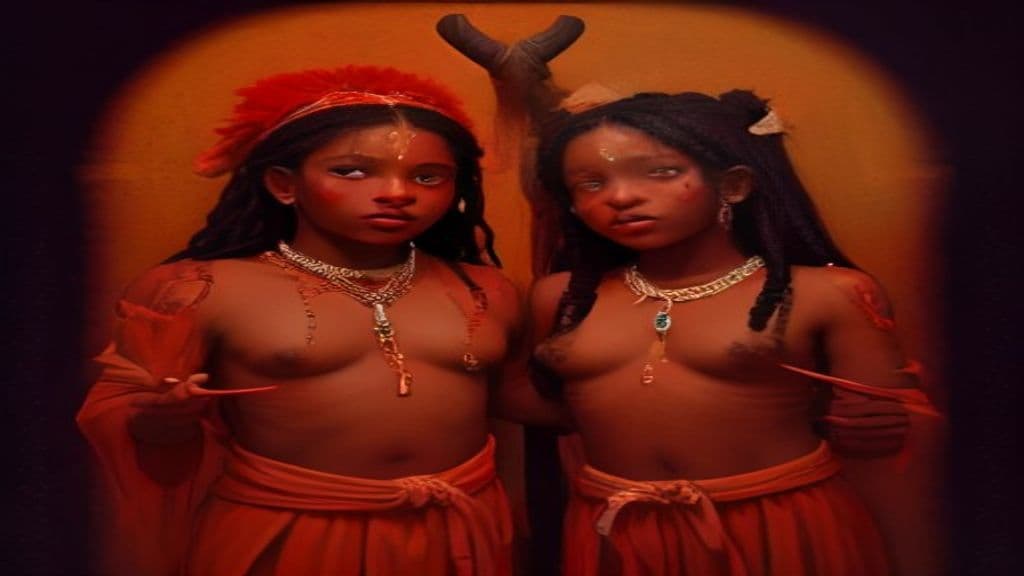
Sources present Ṣàngó as the posthumous deification of a historical ruler — the third Alaafin (king) of Oyo — who, in tradition, ruled for a relatively short period and became famed for warlike strength and royal authority. Over time he was venerated as an orisha associated with thunder and lightning; his cult commemorates both his royal ancestry and his control over atmospheric and judicial force. (Summarized from Wikipedia and traditional accounts cited in popular and diaspora sources.)
Iconography associated with Ṣàngó commonly includes a double-headed axe (oxê / Oṣé) as his primary emblem, red-and-white clothing and bead necklaces (elekes) often arranged in groupings of four or six, brass crowns and bangles, and the veneration of lightning-struck stones (thunderstones) at shrines. Candomblé portrayals emphasize a brass crown and a labrys-like oxê; elekes and red-and-white patterned cloth are recurrent markers of his devotees.
Ṣàngó is described as the orisha who commands thunder, lightning and fire and who enacts justice — narratives state he casts 'thunderstones' to earth, producing lightning against those who offend him. He embodies virility, martial authority and rulership; he is central to coronation invocations and is closely linked to bata drumming, sacred dances (e.g., alujá / roda de Xangô), and public ritual displays that recount his deeds. Traditions stress both his capacity to punish destructively and to uphold fairness and strength.
Weaknesses
- conditionritual neglect / taboo violations (traditional belief that improper observance may invite wrath)
Wards
- ritualwearing sacred elekes (red-and-white bead necklaces)
- ritualwearing sacred colors (red and white garments associated with Ṣàngó)
- ritualveneration and maintenance of thunderstones at sacred sites
- conditionobservance of food taboos (e.g., avoidance of cowpea by some worshippers)

Ọya
Ọya is a principal female orìṣà in the Yoruba pantheon associated with winds, lightning, and storms. She is also described in the supplied sources as the only orìṣà capable of controlling the Eégún, a power said to have been given to her by Babalú Ayé.

Oba
Oba is principally attested in the provided sources as a West African royal title (Yoruba and Bini) meaning 'ruler' and as a widespread modern proper name and toponym. The corpus contains no sustained folkloric account of an independent supernatural being called 'Oba'; references to ritual or religious function concern human office-holders rather than a nonhuman spirit.
Community Record
- [1]Shango - Wikipedia. Wikipedia, 'Shango' entrywiki
- [2]Shango (Wikidata). Wikidata entry for Shangoother
- [3]Shango (Marvunapp appendix). Marvunapp appendix on Shango (catalogue of names and relations)other
- [4]Shango (Wemba music page). Wemba-music.org overview of Shango and ritual invocation (e.g., 'Cabio sile Shango')folk
- [5]Shango (Hanksville storyteller page). Popular retelling and notes on Shangofolk