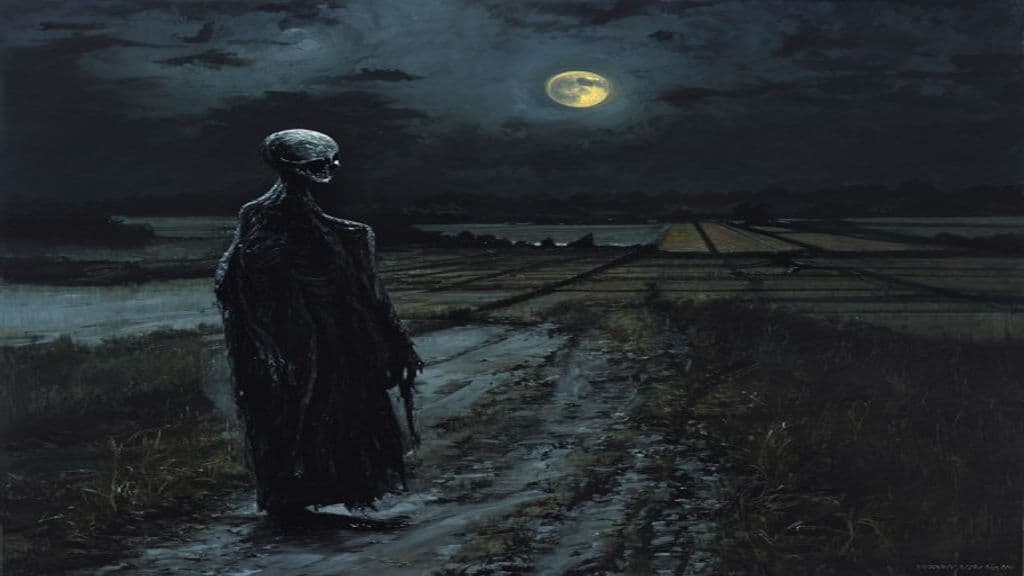
The Skondhokata belongs to the class of ghosts whose form reflects the manner of death. In Bengali folk belief, a death that left the body incomplete — decapitation in an accident or act of violence, drowning where the body was never recovered whole, or cremation where a body part was missing — creates a ghost that is physically incomplete in its ghostly form.
The incompleteness drives the ghost's behaviour: the Skondhokata searches for what is missing. This search is not coherent or purposeful — it is an instinct, like a body reaching for a severed limb — which is what makes the encounter so disturbing. The Skondhokata is not malicious, just incomplete.
The Skondhokata appears as a headless human figure walking — sometimes carrying a head under one arm, sometimes with the neck ending in a stump that emits a faint light.
It moves erratically, often stopping and turning as if looking around — despite the absence of eyes. The motion of a headless figure 'looking' for something is described by witnesses as among the most disturbing things they have seen.
The Skondhokata causes severe fright and fainting in those who encounter it directly. It is associated with neck and head ailments in those who are nearby when it passes — unexplained stiff neck, headaches of sudden and severe onset, and in dramatic accounts, temporary blindness.
It does not pursue its witnesses. The encounter is the entire event: the headless figure passes, the witness is terrified, and the Skondhokata continues its search.
Weaknesses
- ritualRecovering and cremating the missing body part ends the haunting
Wards
- conditionNot making eye contact with the head if it is being carried
- substanceMustard seeds thrown behind you when you feel you are being followed at night
Community Record
- [1]Bhoot-pret: The Undead in Bengal. Bandyopadhyay, P. (2001). Bhoot-pret: The Undead in Bengal. Kolkata: Ananda Publishers.folk