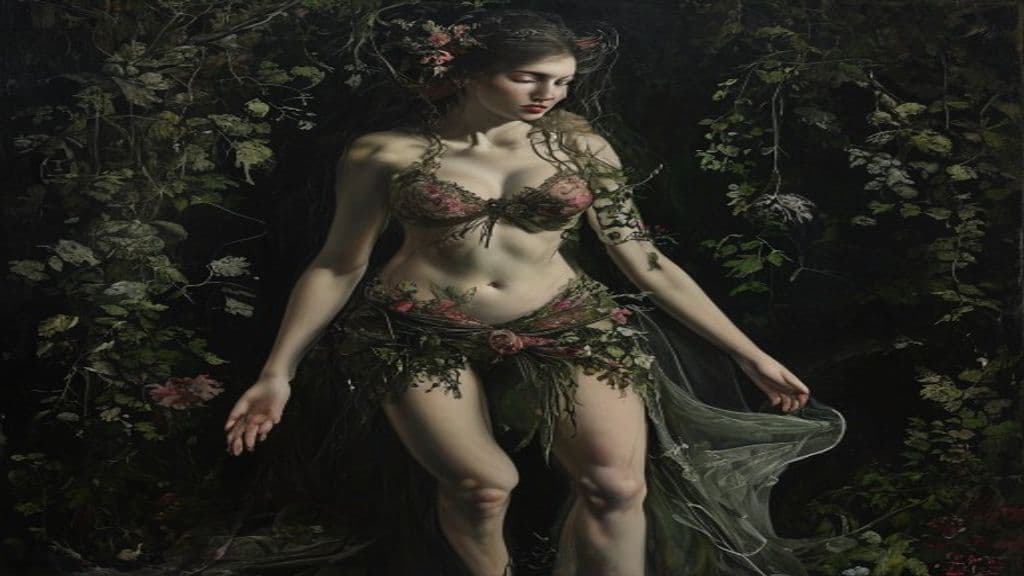
No birth myth or cosmogonic origin is recorded in the provided sources. Attestations treat Slattenpatte as a named figure in local legend and as a member of the broader class of elle-figures; certain archaeologists have interpreted material remains in parts of Zealand as connecting to water-goddess imagery and have read Slattenpatte into that interpretive context.
Slattenpatte is described primarily by her exaggerated maternal anatomy: breasts that "hang all the way to the knee area," so long she can "throw her breasts over the shoulder so a child can feed, even if it's carried on her back." She is presented as a female ellekone rather than the typically beautiful ellepige; sources emphasise her extreme breasts and a maternal form rather than conventional beauty.
Sources describe Slattenpatte as a "haunting woman" in local legend. A recurring narrative motif records that "Kong Volmer chased and shot her every night, only to see her return the next morning," presented as a feature of the tale rather than a specified metaphysical mechanism. Her long breasts enable nursing in unusual circumstances in the narratives (including feeding children carried on her back and, in one legend, feeding "fish-children under the water"). No explicit catalogue of magical powers, sorcery, healing, or immortality beyond these narrative motifs is supplied in the cited material.
Skogsrå
A female forest rå in Swedish folklore who rules the woods and its game; she appears as a beautiful woman from the front but reveals non-human features when seen from another angle. She interacts with hunters, woodcutters and charcoal-burners, offering favors (hunting luck, help with work, offspring) or ensnaring men who follow her into the forest.
Skondhokata
The headless ghost of Bengal — spirit of someone who died by decapitation or whose body was not found complete after death. Skondho (shoulder) + kata (cut): it carries its head under its arm, seeking the place where the head was lost and terrifying those who encounter it on rural roads at night.
Skuld (princess)
Skuld is the youngest of the three named Norns in Old Norse sources, a fate-being associated with obligation and what ought to occur; in Snorri's Prose Edda she is also listed among female figures who ride to battle in a valkyrie-like function, taking the slain and deciding fights.
Sky Father
A comparative-mythological archetype denoting a principal sky-being addressed as a paternal figure, often occupying the role of ancestral progenitor or former/senior ruler within a pantheon and frequently paired with an 'earth mother' as a complementary cosmic principle.
Sky Woman (Anpetu Wakpa)
Sky Woman is referenced in Dakota/Lakota cultural landscape material as a mythic/ancestral figure tied to place-identity and origin narratives. The available source links such figures to Dakota sites (for example the Cannonball–Missouri confluence) but provides no detailed mythology, appearance, or rituals for Sky Woman itself.
Sky deity
A class of deities associated with the sky, heavens, or celestial phenomena; commonly high‑ranking divine figures who occupy an 'upper world,' often serving as sovereigns, creators, or luminaries within diverse polytheistic cosmologies.
Slavic Water Spirits
Female tutelary beings associated with bodies of water in Slavic paganism, often dual-natured as benevolent or malevolent. (Note: - Power tier is unclear based on the source material; no indication that they are limited to a "Lesser" power tier. - Appearance is not described in the source material, so this section should be remo)
Slavic dragon
A class of serpent‑like supernatural beings in Slavic oral tradition and epic literature, often associated with snakes, water, weather, and liminal places. Regional vernaculars (e.g., Russian zmei, Polish smok/żmij, Romanian zmeu) describe variants that range from multi‑headed, regenerating monsters to humanoid or ambivalent figures who may help or court humans.
Sledovik
A sacred stone in Slavic and Finnic pagan practices, imbued with spiritual significance. (Note: - Power tier should be Primordial (due to their widespread presence and spiritual significance in Slavic and Finnic cultures). - Abilities description is incomplete and inaccurate (the text only menti)
Sleep Temple (Greek/Egyptian)
A mystical site in ancient Greek tradition associated with inducing sleep, influenced by Imhotep and Egyptian mysticism. (Note: 1. Power tier should be Lesser (local spirit) instead of Minor Spirit. 2. Add sensory cues and wards based on possible connection to hypnosis (e.g., drowsy atmosphere, trance-inducing melodies). 3. Cl)
Sleeping Beauty (folktale motif)
A widespread fairy-tale narrative figure (Aarne–Thompson Type 410): a royal young woman who falls into a prolonged enchanted sleep caused by a curse or a magical/physical agent and is later awakened by reversal of that causation. The story functions as a folkloric motif across Italian, French, and German literary traditions and many later adaptations.
Sleih beggey
An umbrella term in Manx tradition for the island's 'little people' or fair folk, covering a range of domestic and wild fairy types who interact with human communities — sometimes helpful or neutral, sometimes hostile, notably in accounts of hunting, music, hearth-occupation, and infant abduction.
Community Record
- [1]Slattenpatte — Wikipedia. Wikipedia, "Slattenpatte"wiki
- [2]Wikidata: Slattenpatte. Wikidata entry Q1805429, "Slattenpatte"other