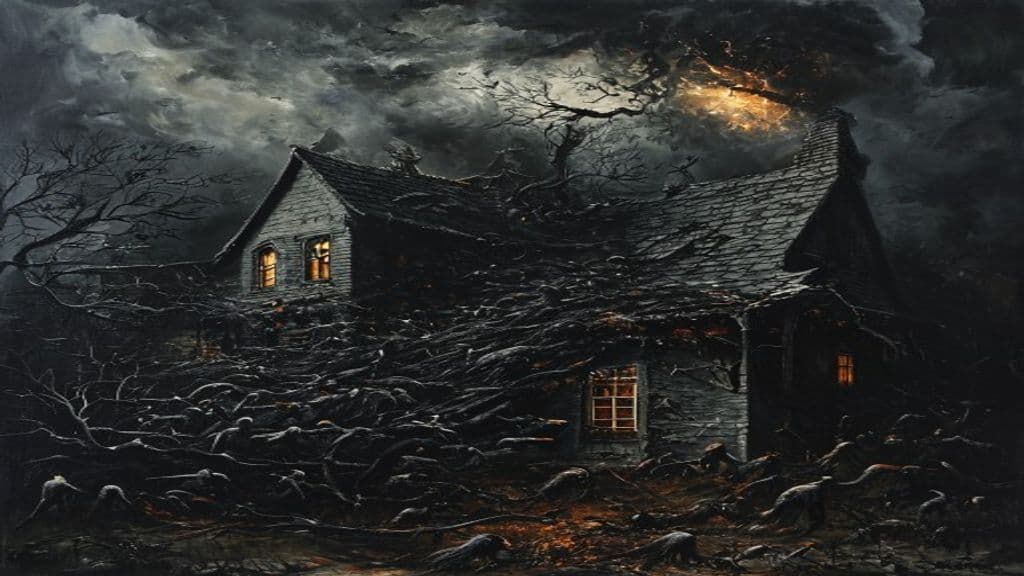
The Sluagh ('host' or 'crowd') were the spirits of dead sinners refused entry to heaven and refused entry to hell — the truly lost dead. They travel as a swarm, dark birds against the western sky, and are most dangerous at Samhain. They came in from the west because that was the direction of the dead. They tried to enter the homes of dying people to carry off the soul before it could be received elsewhere.
Seen as a flock of dark birds or shadowy figures moving against the sky from the west. Up close, they appear as human figures, pale and haggard, with hollow eyes. They moved in groups and their passage created cold winds.
Could carry off the souls of the dying if windows were left open. Could wound the living with fairy darts (flint arrowheads). Could force a living person to accompany them for a night, compelling them to attack other living people before returning them, exhausted and broken.
Weaknesses
- ritualClosing all west-facing windows when a person is dying
- symbolIron placed on windows
Wards
- ritualKeeping vigil over the dying so the Sluagh cannot approach
- substanceIron
Anu
Anu (also Ana, Anann, Anand) is a mother-figure in early Irish tradition associated with nourishment, territorial fertility and prosperity—especially in Munster—and is variably conflated with other maternal or war-related goddesses in later sources.
Baobhan Sith
A Scottish Highland vampire fairy — a beautiful woman in a green dress who appears to men alone in the wilderness and drains their blood, her deer hooves hidden beneath her skirts.
Caoineag
The 'Weeper' of Scottish Highland tradition — an invisible spirit heard wailing near waterfalls before a disaster befalls a clan, a Highland variant of the Irish Banshee.
Cat Sídhe
A large black fairy cat of Irish and Scottish tradition with a white spot on its chest, who could steal a corpse's soul before burial if allowed to leap over it.
Cú Chulainn
A legendary Irish warrior-hero and demigod of the Ulster Cycle, Cú Chulainn is the central martial protagonist of the Táin Bó Cúailnge and a culture-constituting figure whose stories were preserved in multiple medieval manuscripts and continue to appear in modern memorial and institutional contexts.
Cú Sídhe
The supernatural fairy hound of Celtic tradition — enormous, dark green or white, who hunts in eerie silence and whose triple bark is a death omen.
Dobhar-chú
The 'water hound' of Irish folklore — a ferocious hybrid creature, part otter and part dog, lurking in Irish lakes, known to have killed people and capable of pursuing its hunters at terrifying speed.
Dullahan
The headless horseman of Irish legend who carries his own rotting head under one arm, stops at the door of those about to die, and cannot be kept out by any lock.
Each-Uisge
The most dangerous water horse in Scottish Highland folklore — haunting sea-lochs and mountain lakes, more violent than the river kelpie, known for consuming its victims whole.
Ecne
Ecne is the personification of wisdom in Irish/Celtic mythic tradition, attested in modern summaries as a member of the Tuatha Dé Danann and glossed in Old Irish as 'wisdom' (ecna, ecne). Sources present Ecne genealogically as the offspring of three brothers and as connected to the goddess Anu/Ananna, with variant accounts assigning ambiguous gender and, in one later report, an association with poetry.
Fairy
A class of anthropomorphic supernatural beings found across multiple European folk traditions, fairies are magical, liminal entities variously described as spirits, an older race, or enchanted people; their depiction ranges from human-sized to diminutive and their attributes and moral alignment vary by region and period.
Kelpie
A Scottish shape-shifting water horse that appears as a beautiful tame horse near lochs and rivers, then drowns and devours any rider foolish enough to mount it.
Community Record
- [1]The Fairy Faith in Celtic Countries. Evans-Wentz, W.Y. 1911. The Fairy Faith in Celtic Countries. Oxford University Press.academic
- [2]Celtic Twilight. Yeats, W.B. 1893. The Celtic Twilight. Lawrence & Bullen.folk