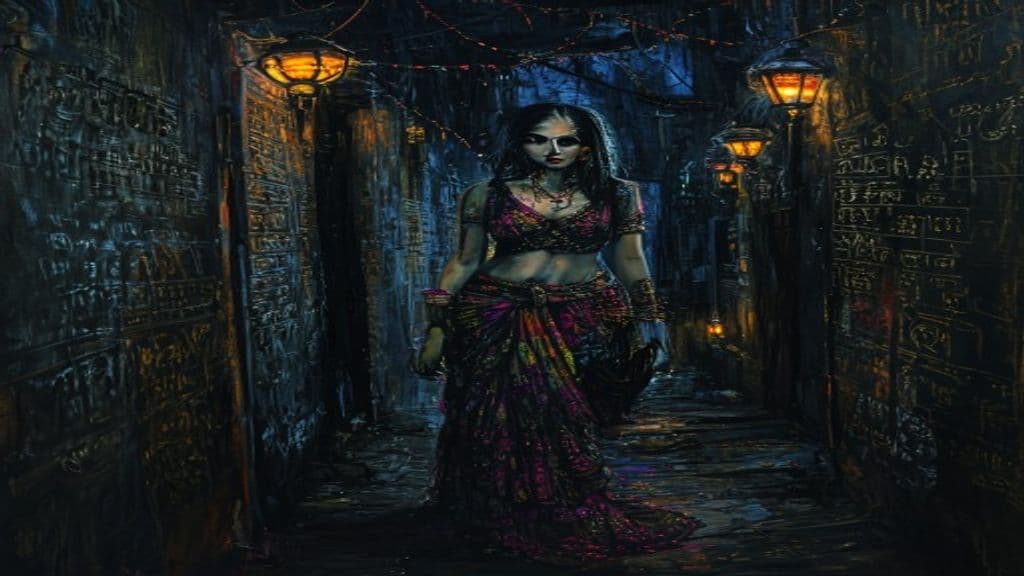
In the town of Chanderi and surrounding villages of Madhya Pradesh, a long-standing belief holds that a powerful female spirit targets men during the nights of major festivals — particularly the four nights of Navaratri. She appears as an extraordinarily beautiful woman who lures men away from crowds.
Those who follow her are never seen again, or are found wandering the outskirts of town days later with no memory of what happened. The origin stories vary: she is the spirit of a woman wronged by the town, a bride abandoned on her wedding night, or simply an ancient territorial presence.
The practical counter-measure — writing 'O Stree, kal aana' (O Woman, come tomorrow) on the outer walls of homes and shops — is so deeply embedded that the inscriptions can be seen on real buildings across the region to this day.
Stree appears only at night, always as a beautiful young woman in festival dress. She never shows her face directly — witnesses report seeing her only from behind or in peripheral vision before she turns.
She is said to emit a faint fragrance of flowers and burning ghee. Her feet, in some accounts, do not touch the ground.
Stree's primary power is selective invisibility and attraction. Men under her influence describe a compulsion they could not resist. She does not harm those who are accompanied by women, and is powerless against anyone who addresses her directly and confidently.
She is bound by the 'come tomorrow' inscription in the same contractual logic as Nale Ba — accepting the deferral means she cannot act tonight.
Weaknesses
- conditionPresence of women
- symbol'O Stree kal aana' written on walls and doorframes
Wards
- substanceSindoor (vermilion) at the threshold
- ritualWalking with female companions during festival nights
Bhunni
The female guardian-spirit of agricultural fields in Bihar and eastern UP — her presence ensures fertile soil and good harvest, but she is territorial and punishes those who plough without permission, steal crops, or use chemical methods that poison the soil she inhabits.
Dayan (Daayan, Ḍāin, Ḍāini)
A North and East Indian folkloric figure: a malevolent female revenant or vengeful spirit commonly associated with women who died in traumatic or unresolved circumstances. Dayans are described in popular sources as powerful life-draining entities with distinctive physical markers and as a label that also functions in social witch‑hunt practices.
Doyen
The Bengali witch — closely related to the North Indian Dayan but with Bengali-specific characteristics including the ability to steal livers, which the witch must periodically consume to maintain her powers. Doyen accusations continue to drive violence against women in rural Bengal and tribal districts of Jharkhand.
Jokhini
A female supernatural predator of Assamese folklore — the Jokhini appears as a beautiful woman to lure men, but also as a hideous crone to devour them. She is associated with the dense forests of the Brahmaputra valley and is one of the most feared night entities in Assamese village belief.
Mahapreta
The 'great ghost' — in Bihar and UP folk classification, a Mahapreta is a preta of exceptional power, born from a death involving multiple injustices simultaneously: wrongful killing, incomplete rites, and unresolved family debt combined. It commands lesser spirits and can cause harm across an entire lineage.
Mamdo Bhoot
The ghost of a Muslim person in Bengali Hindu folk belief — 'Mamdo' deriving from 'Mahmood.' The Mamdo Bhoot occupies a unique place in Bengal's supernatural taxonomy: a cross-religious ghost in a deeply syncretic tradition, with its own distinctive characteristics and ward practices that follow the ghost's religious tradition rather than the observer's.
Nathiya
Ghost of a young bride who died before her first Diwali as a wife — still wearing her wedding nose ring (nath), she haunts the marital home she never truly inhabited, causing illness in subsequent brides and making the household unwelcoming to new marriages.
Pichal Peri
Shared across North Indian and Pakistani folklore — a female spirit with reversed feet who lures lone travellers off roads at night. One of the most cross-cultural supernatural figures in the subcontinent, appearing in Hindu, Muslim, and Sikh communities alike.
Straw Millionaire
A supernatural entity representing moral lessons in frugality and cleverness, appearing in Japanese Buddhist folk tales to illustrate the power of resourcefulness and determination. (Note: - Power tier: Lower to Greater (The Straw Millionaire's abilities are more in line with a regional entity, given its focus on moral lessons and resourcefulness rather than cosmic power.) - Origin stor)
Stray Sod
A clump of enchanted grass attributed to faeries in Celtic tradition, causing disorientation and loss of direction. (Note: - Power tier: Primordial (not Lesser), as the effect described is far-reaching, causing disorientation even in familiar surroundings. - Abilities: Add that the effect can persist even after leaving th)
Strigoi
The vampire of Romanian folklore — either a living witch (strigoi viu) or an undead blood-drinker (strigoi mort). The source tradition from which the literary vampire emerged.
Strix
A nocturnal, ill-omened bird-monster of classical antiquity that also functions as a lexical label for harmful, often female, practitioners of witchcraft; implicated in infant predation, corpse-deforming acts, and magical practice.
Community Record
- [1]Folk Demonology of Central India. Sinha, A. (2003). Spirit beliefs and apotropaic practice in Malwa. Indore: Devi Ahilya University Press.academic
- [2]Stree (2018 film) cultural references. Wikipedia contributors. Stree. Wikipedia, 2024.wiki