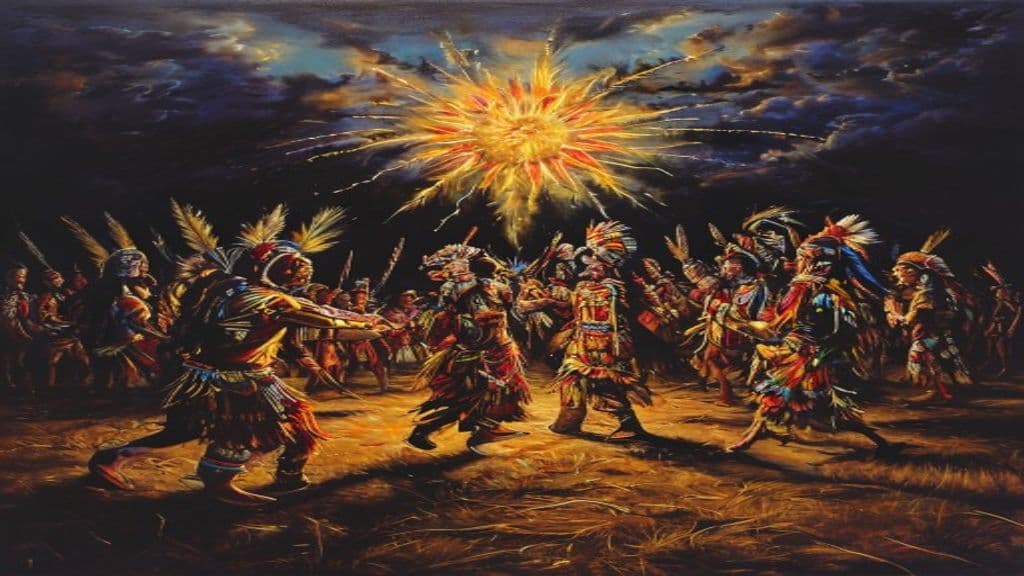
The Sun Dance appears as a vibrant and elaborate ritual, with participants often wearing traditional regalia, adornments, and performing intricate dances. The ceremony may involve sacred objects, songs, and rituals.
Through the participation of its dancers, the Sun Dance is believed to maintain balance between humans and nature, connecting individuals to the sun and reaffirming their place in the world. Participants engage in rituals of sacrifice, self-mortification, and dancing without food or water for extended periods.
Weaknesses
- ritualDisruption of traditional practices
Wards
- symbolSacred objects or songs used to protect the ceremony
Anog Ite
In Lakota mythology, Anog Ite is a complex entity associated with emotional pain and chaos. She is punished for attempting to disrupt balance. (Note: 1. Power tier should be revised based on the entity's abilities described in the source material (Primordial=cosmic, Ancient=deity-level, Greater=powerful regional, Lesser=local spirit, Minor Spirit=w)
Pahá Sápa (Black Hills)
Sacred site and geographical feature in the Lakota tradition, comprising an isolated mountain range in western South Dakota. (Note: 1. Power tier: change to Ancient (the entity's formation and spiritual significance in Lakota tradition do not align with Primordial). 2. Appearance: add that the name "Pahá Sápa" translates to "Black)
Untunktahe (Lakota Water Spirit)
In Lakota mythology, Untunktahe is a water spirit associated with bodies of water. (Note: 1. Power tier: Greater seems inconsistent with "associated with bodies of water", which could imply Lesser or Primordial. 2. Abilities: Not enough information to determine abilities; should be marked )
Škaŋ (Lakota Superior Spirit)
One of the four Superior Spirits created by Wakáŋ Tȟáŋka to comprise the universe, representing 'Motion' or 'Sky'. (Note: 1. Power tier: Primordial (as it is one of the four fundamental elements created by Wakáŋ Tȟáŋka) 2. Origin story: Corrected wording for Wakáŋ Tȟáŋka, referring to "The Great Spirit" in both cases 3. )
Sulevipoeg
Sulevipoeg is an Estonian runic‑song and literary character presented as a son within the mythic family of Kalev. Attested in runic songs (notably the song 'Suisa suud') and later literature, he appears as a mortal member of a kin-group tradition rather than an explicitly cosmological or supernatural being.
Sumatinātha
Sumatinātha is the fifth Tīrthaṅkara (ford-maker) of the current cosmic age in Jain tradition: a royal-born figure who renounced worldly life, attained omniscience (kevala jñāna), taught the dharma, and achieved liberation (mokṣa) on Mount Śikharjī. He is venerated in Jain temple and artistic contexts as one of the canonical Jinas.
Sumedha
Previous life of Gotama Buddha, demonstrating selflessness and spiritual dedication. (Note: - Power tier should be Ancient (deity-level), not Primordial (cosmic). Sumedha's abilities are remarkable but not cosmic in scope. - The article doesn't mention any sensory cues, wards, or weaknesses )
Summanus
Summanus is the ancient Roman divine figure associated with nocturnal thunder and lightning, functionally contrasted with Jupiter's daylight thunder. He is etymologically and ritually tied to the Manes (chthonic/ancestral spirits) and received public cult observances in Rome and at locales such as Mount Summano.
Sun Wukong
Sun Wukong (孫悟空, Sūn Wùkōng), popularly the "Monkey King," is a mythic non-human sapient figure from Chinese literary and religious tradition best known from the 16th‑century novel Journey to the West. Portrayed as an exceptional stone-born monkey who acquires supernatural powers through Taoist practice, he is alternately a rebellious trickster who challenges Heaven and, after punishment, a protector and disciple who accompanies the monk Tang Sanzang on a Buddhist pilgrimage.
Sun and Moon (Inuit myth)
An English-titled index entry for a traditional Inuit story concerning the Sun and Moon is listed on a Wikipedia disambiguation page. The supplied sources do not contain the narrative, characters, cosmology, or ritual details of this story; only the disambiguation listing itself is present in the provided material (Source 1).
Sunakake‑Baba
Sunakake‑Baba is a malicious yokai depicted as a little old woman who attacks travelers by throwing sand into their eyes; attestations in the supplied materials are sparse and situate her within the broader Japanese yōkai tradition and popular media retellings.
Sundel Bolong
A Javanese-rooted Indonesian folkloric apparition: the vengeful ghost of a woman who died in circumstances tied to sexual stigma (pregnancy out of wedlock or death in childbirth), depicted as a white‑gowned woman with long black hair and a large hole in her back. The figure functions in folklore and modern media as a punitive revenant addressing sexual violence, social shame, and the loss of motherhood.
Community Record
- [1]